Source reader · 201 supplied PDF pages
Enhancing Academic Advisement with Case-Based Reasoning
Tanat Tonguthaisri · RMIT University · August 2003
OCR transcription, not a proofread edition. The source contains recognition errors, especially in front matter, formulas and code. Inspect the original scan before quoting. Printed numbering jumps from 134 to 136; the cause is unresolved. Navigation uses the unambiguous PDF page number.
Open the proofread transcription with native tables and equations ↗
Source PDF · page 1 of 201Check original scan ↗
No readable text was extracted from this source page. Open the scan below.
View original scanned page

Source PDF · page 2 of 201Check original scan ↗
ROYAL MELBOURNE INSTITUTE OF TECHNOLOGY
USE OF THESIS
T his v c lu c e is the p rccec/ of =c'/si M eikcum e Irsztute cf , ech n cicgy, ku tthe righ,3 of the
author m ust be respected. If any p a ssa g e is mooted cr c icseiy pa. cohraseo ir. a paper cr^
written work precared bv the user, the source cf die p a ssa g e roust c e ack n cw !ecce- in ore
w c fk If & e user desired :c puciish a caper cr w hzen work containing p a ssa g es ccc,ed_cr
c=cs»'v parac'r.rased from this thesis, which p a ssa g e s w cu lc ir. ccns-.u^e ir.,,mi;!,.g
c o p y fc^th.e pum cse cf Pre Copyrignt Act. he cr sh e m ust obtain bhe w nzen permission cr
the author to do so.
:v has been
You are requires to fill cut the acknow ledgem ent ceicw Pta: a vciurr
su cclied to you on your unoertaking to observe tne scc v e ccnc;..cr.s
S I G N ,
NAME;;" cap s)
. 3
View original scanned page

Source PDF · page 3 of 201Check original scan ↗
Enhancing Academic Advisement
with Case-Based Reasoning
A thesis submitted in fulfilment o f the requirements for the degree o f
Master of Engineering
Ta n a t T o n g u t h a is r i
B.Eng., B.AppSci.
School of Electrical and Computer Engineering
Faculty of Engineering
RMIT University
August 2003
View original scanned page

Source PDF · page 4 of 201Check original scan ↗
STK THR 378.173446 T665
Enhancing academic advi
sement with case-based
reasoning
Swanston
LCN: 10897272
B/C: 31259007822161
View original scanned page

Source PDF · page 5 of 201Check original scan ↗
Declaration
I certify that except where due acknowledgement has been made, the work is that
of the author alone; the work has not been submitted previously, in whole or in
part, to qualify for any other academic award; the content of the thesis is the result
of work which has been carried out since the official commencement date of the
approved research program; and, any editorial work, paid or unpaid, carried out by
a third party is acknowledged.
Tanat Tonguthaisri
August 22nd, 2003
View original scanned page

Source PDF · page 6 of 201Check original scan ↗
Acknowledgements
I would like to take this opportunity to express my utmost gratitude towards my
senior supervisor, Roy Ferguson, for his insight, advice, guidance, support,
understanding and patience, which has been given to me in numerous occasions
during the course of this research. Without him, I would most probably be unable
to complete this study and this thesis.
I would also like to acknowledge the very timely, professional, and high quality
editorial work, provided by Chris Vedelago of WordsRU.
View original scanned page

Source PDF · page 7 of 201Check original scan ↗
Contents
ABSTRACT 1
CHAPTER 1 INTRODUCTION.............................................................................................................................................2
1.1 B ack g ro u n d............................................................................................................................................................................2
1.2 T hesis overall g o a l s......................................................................................................................................................... 6
1.3 O rganisation of th e T h e s is............................................................................................................................................7
CHAPTER 2 CBR BACKGROUND.....................................................................................................................................8
2.1 H istory o f A I.......................................................................................................................................................................... 8
2.2 RBR BACKGROUND................................................................................................................................................................10
2.2.1 Fuzzy Rules.................................................................................................................................................11
2.2.2 Disadvantages o f Rule-Based Systems......................................................................................................16
2.3 H istory o f C B R ................................................................................................................................................................... 17
2.4 C ase-Based R easoning A p p r o a c h e s....................................................................................................................... 22
2.4.1 Textual CBR Approach............................................................................................................................22
2.4.2 The Conversational CBR Approach.......................................................................................................... 23
2.4.3 The Structural CBR Approach.................................................................................................................. 24
2.5 C ase-Based A dvisory Sy ste m s..................................................................................................................................30
2.5.1 Ways in which case-based advisory systems support user reasoning and learning...............................31
2.6 Goa l-based Scen a rio’s (GBS) To p-dow n A pproach to De sig n..................................................................33
2.6.1 Analysis o f Case-Based Advisory Systems and Knowledge-Sharing Systems.......................................34
2.6.2 Present cases as well as overall knowledge representation..................................................................34
2.6.3 Make explicit important features, deep structure, and rules, models or strategies used.......................35
2.6.4 Explain cases with generalised domain knowledge.................................................................................35
2.6.5 A void reasoning bias by presenting exceptions......................................................................................36
2.7 Kno w ledge supporting the CBR p r o c e s s............................................................................................................36
2.8 T he ASK sy s t e m s..............................................................................................................................................................37
2.9 Case-Ba sed Kno w ledge S haring Sy s t e m s..........................................................................................................39
2.10 CBR Operation................................................................................................................................................................... 40
2.10.1 Case Structure...................................................................................................................................... 40
2.10.2 CBR components.................................................................................................................................. 40
2.10.3 CBR classification................................................................................................................................ 44
2.10.4 Case Similarity Functions....................................................................................................................44
2.10.5 Case Acquisition.................................................................................................................................. 50
2.10.6 Case Retrieval...................................................................................................................................... 51
CHAPTER 3 ACADEMIC ADVISEM ENT.................................................................................................................... 55
iv
View original scanned page
Source PDF · page 8 of 201Check original scan ↗
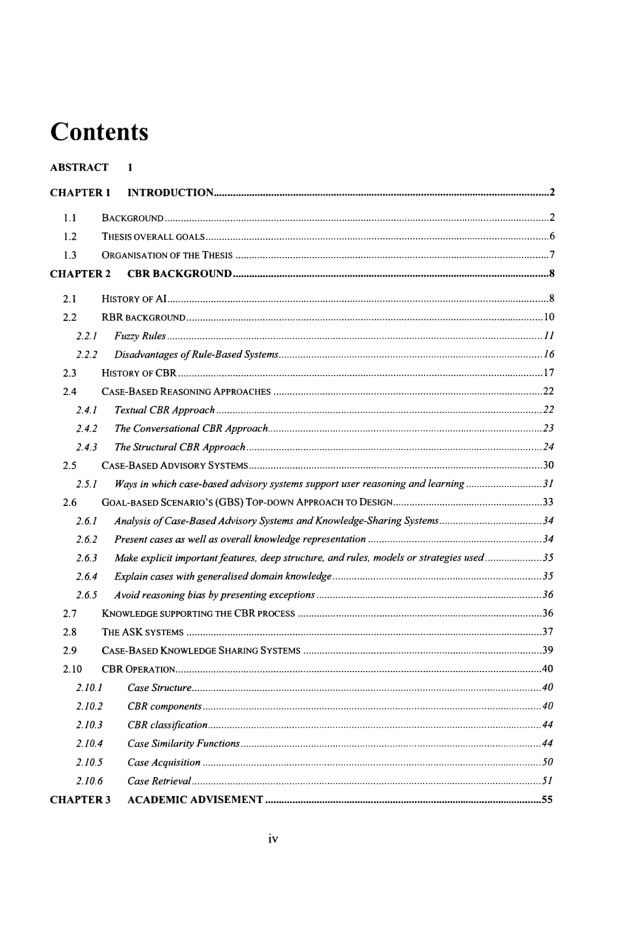
3.1 The P r o b l e m ..........................................................................................................................................................................56
3.2 Expert A d v iso r....................................................................................................................................................................56
3.3 Existing ad visin g pr a c t ic e........................................................................................................................................... 57
3.3.1 Current Web-based advising systems.......................................................................................................57
3.4 Expert System s an d A cadem ic A d v isem en t..........................................................................................................59
3.5 Degree A u d its......................................................................................................................................................................62
3.5.1 PeopleSoft Academic Advisement............................................................................................................66
3.6 Technology in the S elf-H elp A dvising A g e........................................................................................................66
3.6.1 World Wide Web........................................................................................................................................67
3.6.2 Advising over the Internet.........................................................................................................................69
3.7 Internet-based expert system for selecting an aca dem ic m a jo r............................................................ 69
C H A P T E R 4 A PP L Y IN G C B R T O A U T O M A TE A C A D E M IC A D V IS E M E N T ................................................ 70
4.1 N eeds for A utom ated A cadem ic A d v isin g........................................................................................................... 70
4.1.1 The Role o f Technology in Higher Education.......................................................................................... 70
4.1.2 Strategies for Addressing Resource Constraints......................................................................................71
4.1.3 Non-traditional Access to Advising Services...........................................................................................71
4.2 RMIT and D ifferent Perspectives A ppr o a c h.......................................................................................................74
4.2.1 A review o f program structure................................................................................................................. 74
4.2.2 Governing Rules (applicable to all courses)............................................................................................ 76
4.3 A iding in electives selec tio n......................................................................................................................................76
4.3.1 Why select electives?................................................................................................................................ 77
4.4 Indexing Ca s e s....................................................................................................................................................................79
4.4.1 Four qualities of good indexes................................................................................................................. 80
4.4.2 Matching Calculation...............................................................................................................................82
4.5 The “P rototype System” ............................................................................................................................................... 89
4.5.1 Decision Breakdown................................................................................................................................ 89
4.5.2 3-pass process of Stream Elective decision.............................................................................................90
4.5.3 Common Rules for Compulsory Elective decision..................................................................................92
4.5.4 External input for Compulsory Elective decision...................................................................................93
4.5.5 Substructure o f course..............................................................................................................................93
4.5.6 Description of the prototype Case-based Reasoning Academic Advisement system............................104
4.5.7 Initial Direction......................................................................................................................................105
4.5.8 Change in Direction................................................................................................................................106
4.5.9 System Modelling....................................................................................................................................108
4.5.10 Prototype Versions............................................................................................................................112
4.6 Case Refinin g (F iltering o f retrieved so lu tio ns) ......................................................................................... 116
4.6.1 Comparison-Based Recommendation....................................................................................................118
V
View original scanned page
Source PDF · page 9 of 201Check original scan ↗
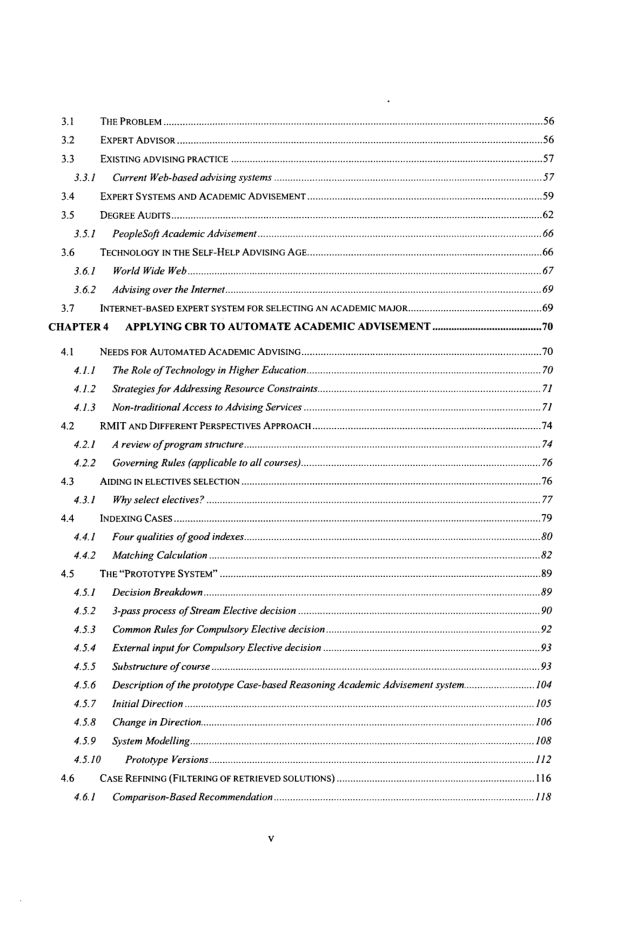
4.7 Valida tio n..........................................................................................................................................................................119
4.7.1 Stability under change.................................................................................................................................................119
4.7.2 Plausibility when the student's perceived performance is lower than the course's difficulty...............119
4.7.3 Plausibility when the prerequisites o f the recommended courses have not yet been fulfilled...............124
4.7.4 Plausibility when both the student's performance is lower than the course’s difficulty AND the
prerequisites o f the recommended courses have not been fulfdled................................................................................. 129
4.8 Fram ew ork........................................................................................................................................................................ 130
4.8.1 Characteristics o f Case-Based Academic Advisement Recommender Systems.........................................130
4.8.2 Development and Use o f Case-Based Academic Advisement Recommender Systems.............................132
4.8.3 Tweaking......................................................................................................................................................................... 136
4.8.4 Ratings-based.................................................................................................................................................................137
4.8.5 Preference-Based..........................................................................................................................................................138
CHAPTER 5 CONCLUSION AND FUTURE W O R K S.......................................................................................... 139
5.1 Co n clu sio n......................................................................................................................................................................... 139
5.2 Future W o r k......................................................................................................................................................................142
5.2.1 Case Representation.................................................................................................................................................... 142
5.2.2 Case Indexing................................................................................................................................................................ 143
5.2.3 Improving Case-Based Recommendation.............................................................................................................144
5.2.4 Case Adaptation and Learning.................................................................................................................................145
5.2.5 Emerging Hybrid Systems..........................................................................................................................................146
5.2.6 CBR and Rule-Based Reasoning (RBR).................................................................................................................146
5.2.7 Machine Induction........................................................................................................................................................148
5.3 Im plic a tio n s.......................................................................................................................................................................150
BIBLIOGRAPHY.......................................................................................................................................................................151
APPENDICES 157
A ppendix A: N on-tech nical F r a m ew o rk..............................................................................................................................157
A .l Organisational Processes during System Development............................................................................................157
A.2 Technical Processes during System Development...................................................................................................... 160
A ppendix B: K now ledge Base C o n t e n t s..............................................................................................................................164
A ppendix C: PHP sc r ipts............................................................................................................................................................... 166
Functions, inc.................................................................................................................................................................................. 166
Index.php........................................................................................................................................................................................ 173
Knowledge.php............................................................................................................................................................................. 176
Match.php.......................................................................................................................................................................................177
A ppendix D: A lgorithm Com parison an d V a lid a tio n...................................................................................................184
A ppendix E: E xample Screen O u t pu t.....................................................................................................................................185
VI
View original scanned page
Source PDF · page 10 of 201Check original scan ↗
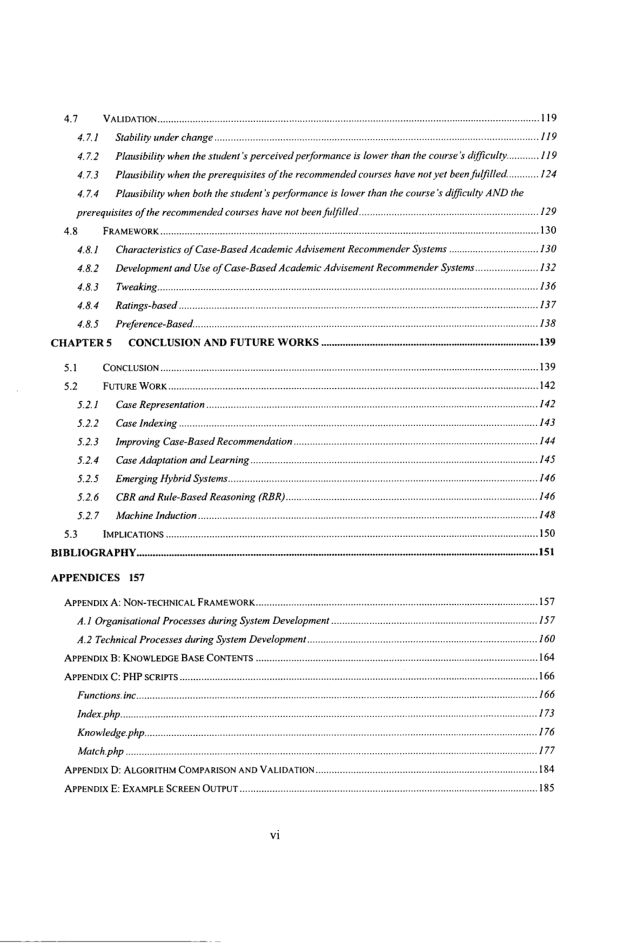
Table of Tables and Figures
Table 2-1: Comparison of the different CBR approaches................................................................. 27
Table 2-2: PROFILE Relation.............................................................................................................. 47
Table 2-3: a similarity matrix for expertise areas............................................................................... 48
Table 4-1: Process Types..................................................................................................................... 132
Figure 2-1: Aamodt & Plaza's CBR cycle [1] 41
Figure 4-1: System Architecture 108
Figure 4-2: Obj ect Model 109
Figure 4-3: ER diagram 110
Figure 4-4: Flow of Control 111
Figure 4-5: Correlation and Ranking table to show the efficiency of improvement algorithm over
earlier versions 128
View original scanned page
Source PDF · page 11 of 201Check original scan ↗
Abstract
This research involved the study of an application of Case-Based Reasoning (CBR) in the field
of academic advising. Academic advisement has been recognised as an important function of
higher education. However, there is a widespread desire to improve the advisement services
provided by many educational institutions (e.g., colleges and universities) around the world. In
the last ten years, CBR expert systems have made important contributions in many domains by
applying CBR methodology to a variety of areas of human problem solving. However, to date,
expert advisement systems have not been successfully applied to academic advisement, which
seems to be a very appropriate domain for this technology.
Academic advising is an important and time consuming task, and different tools and techniques
must be used to make it an effective and efficient process. This thesis describes the design,
development, and validation of a prototype case-based academic advisement recommender
system that supplements the conventional advising process, and could eventually evolve to
replace human academic advisors when its full potential is realised.
1
View original scanned page
Introduction
Source PDF · page 12 of 201Check original scan ↗
Chapter 1
Introduction
1.1 Background
In interacting with students, the academic advisor is on the “front line” of the university. It is a
critical position, and the success or failure of a student’s education and growth is greatly
influenced by the advising function.
The overall goal of academic advisement is to assist students in the development of meaningful
educational plans that are compatible with their life goals. In essence, academic advisement is a
fundamental part of higher education. The process helps students receive information, consider
options, and make choices. Academic advisement assists students in achieving their educational
potential by helping them understand themselves and learn to use the resources of the campus to
meet their individual needs and aspirations.
Academic advisement should be viewed as a continuous process of clarification and evaluation.
Academic advisement is a decision making process through which a student, aided by an advisor,
effectively and efficiently plan their curricula according to the student’s goals.
It is important to remember, however, that the ultimate responsibility for making informed
decisions about life goals and educational plans must reside with the student. The academic
advisor helps to identify options for the student, each with its benefits and consequences.
Therefore, advisors may also be called upon to help students discover what their goals are.
Ideally, the role of an Academic Advisor should be:
• To maintain up-to-date files containing the records of each student that is considered an
advisee
2
View original scanned page
Source PDF · page 13 of 201Check original scan ↗
• To provide students with correct academic information concerning the university and the
major school or department, noting their progress towards the fulfilment of general
education, minor, and major requirements.
• To help foster in each advisee the ability to make informed choices concerning
alternatives, limitations, and the consequences of academic decisions (selection of
courses, major declaration or change, dropping courses, etc.)
However, these circumstances have changed in the past few years in Australia. As ever before,
the ideal scenario remains an ideal; indeed, it is even becoming less achievable and less realistic.
This is because Australian non-private tertiary education providers have seen gradually bigger
cuts in higher education budgets.
The higher education system in Australia has been undergoing a significant change for the past
few years, and this trend will continue for years to come. Australian universities and colleges are
social institutions embedded in the general economy. Consequently, changes that are now
reshaping Australian businesses and organisations inevitably influence higher education as well.
Resource scarcity, increased competitiveness, downsizing and outsourcing, and a generally more
turbulent, less predictable environment are the characteristics of the post-industrial environment.
Modem technology has altered the expectations of consumers and the behaviour of service
providers. Businesses that successfully take advantage of technological innovations are able to
create efficiencies that allow them to recapture and sustain a high level of productivity and
competitiveness.
While a greater number of students have access to tertiary education through increased quotas
and full-fee places, staff-student ratios have decreased. In turn, this has adversely affected the
availability of staff to provide academic advice to students.
Just as the higher costs of technology and human resources have affected business organisations,
the steadily increasing cost of delivering higher education programs, coupled with enrolment
increases predicted for the next decade, will create serious challenges for public education
institutions. Many economists and higher education administrators believe that the economic
3
View original scanned page

Source PDF · page 14 of 201Check original scan ↗
and financial future of higher education is in jeopardy [6]. During the past two decades, per-
student expenditures have increased while government student support and legislative funding
for public higher education have declined. Tuition at public universities has soared to levels that
alarm the public, and likely cannot be continued. Without changes in the delivery of higher
education, aggregate budget shortfalls at Australian universities are expected to rise dramatically
as we move further into this century [17].
At institutions of higher education, undergraduate enrolment will likely rise by 12% between
1996 and 2008. The traditional university age population of eighteen- to twenty-four-year-olds
is projected to increase at a greater rate, by 18 percent, and is expected to comprise 60% of
enrolments by 2008. It is estimated that students twenty-five and older will account for 40% of
enrolments by that date [9], Enrolment growth is a cause for concern, rather than a solution to
educational finance problems, because tuition revenues cover only about one-third of the actual
cost of public higher education. Declining federal and state government support will not make
up the difference [27, 46]. Cost containment and finding new funding sources are clearly the
primary challenges for higher education administrators.
The need to expand capacity to accommodate an increasing influx of students, and enhance the
ability to provide sound and satisfying academic advice in an effective and efficient manner, is
greater than ever before. With greater acceptance of automation technologies by the public,
there is a better possibility of the successful provision of academic advice to remote students
(e.g., via the Web). To achieve this goal, we require a system that “automates” the provision of
academic advice as much as possible.
Web advising for students has recently been gaining in popularity at universities across the
globe. Although only a handful of universities use this kind of system at present, human
academic advisors are contemplating the various benefits associated with its introduction. The
aim of this thesis is to develop a basic framework for automated academic advisement, and then
to design a prototype system that integrates conventional academic advising and Web-based
advising to form a hybrid advising model that can be easily applied to the advising process.
Automated academic advisement reduces the workload of human academic advisors to some
4
View original scanned page
Source PDF · page 15 of 201Check original scan ↗
extent by giving information to students before approaching them. While the academic advisor
assists them in this process, the final responsibility rests on the shoulders of the student. This
means that students must actively become involved in their own education choices. At this
point, the primary focus of the prototype automated academic advisement system is to provide
educational planning and advising resources in support of students’ academic objectives.
The convergence in Artificial Intelligence (AI) and Cognitive Science gave birth to a new
technique in Expert Systems (ES), namely Case-Based Reasoning (CBR). In short, CBR has the
potential to capture the experience of academic advisors and use that experience as a guide to
provide sound academic advice to students.
In CBR, systems expertise is embodied in a library of past cases, rather than being encoded in
classical rules. Each case typically contains a description of the problem plus a solution and/or
the outcome. The knowledge and reasoning process used by an expert to solve the problem is
not recorded, but is implicit in the solution.
To solve a current problem, the problem is matched against the cases in the case base and similar
cases are retrieved. The retrieved cases are used to suggest a solution that is reused and tested
for success. If necessary, the solution is then revised. Finally, the current problem and the final
solution may be retained as part of a new case.
Many people favour case-based reasoning because they are more comfortable with examples
than with conclusions separated from their context. A case library can also be a powerful
corporate resource, allowing everyone in an organisation to tap into the case library when
handling a new problem.
Since the 1990s, CBR has experienced widespread academic and commercial interest. Mature
tools and application-focused conferences exist. Case-based reasoning is often used as a generic
term to describe techniques including, but not limited to, case-based reasoning as it is described
(e.g., analogical reasoning is often referred to as case-based reasoning).
5
View original scanned page
Source PDF · page 16 of 201Check original scan ↗
1.2 Thesis overall goals
This thesis proposes a basic framework and outlines a prototype implementation of a case-based
academic advisement recommender system with the following four overall goals:
1. To minimise repetitive tasks currently performed by academic advisors - The
prototype case-based academic advisement recommender system demonstrates that its
implementation can minimise the amount of time and energy spent by academic advisors
on repetitive tasks such as answering frequently asked questions in person, by phone, or
by email.
2. To extend the availability of official advising related information to distance online
students - One of the most immediate and visible benefits of the proper implementation
of the prototype case-based academic advisement recommender system is to make
official and relevant advising information available on the Web, which would enable
ubiquitous academic advising for distance online students.
3. To provide academic guidance in a consistent way - By having all of the advising
guidelines stored electronically in one place, and using the same case-based academic
advisement recommender system to advise students on which courses to take next,
inconsistencies that used to occur with personal advising can be minimised.
4. To develop a backend reasoner that helps students to get a list of courses to take
next - This is the “intelligent” portion of the system. Based on a student’s academic
profile (courses already taken), the academic year requirements, and the database of
existing and available courses and their prerequisites, the prototype case-based academic
advisement recommender system provides the student with customised advice on which
classes to register for the next semester(s).
6
View original scanned page
Source PDF · page 17 of 201Check original scan ↗
1.3 Organisation of the Thesis
The remainder of this thesis is organised as follows. Chapter 3 describes the history of expert
systems and case-based reasoning. Chapter 4 describes the history of academic advisement and
how information technology has been utilised to improve the efficiency of academic advisement
to date. Chapter 5 explains why case-based reasoning is suitable for these types of problems. It
also outlines the development of the prototype case-based academic advisement recommender
system since its inception, validating the prototype system by means of test cases. Finally,
Chapter 6 concludes the thesis with a summary of the general features of the prototype system
and discusses the possible future extension of this system.
7
View original scanned page
CBR background
Source PDF · page 18 of 201Check original scan ↗
Chapter 2
CBR background
2.1 History of Al
The potential for computers to achieve “intelligence” equivalent to that of human beings was
recognised by the pioneers of modem digital computing such as Alan Turing [42]. The goal of
artificial intelligence (AI) scientists is to develop computer programs that can think and solve
problems as intelligently as human experts. Expert systems are computer programs that use
domain specific knowledge to emulate the reasoning process of human experts. It was not until
the late 1970s that AI scientists realised that the problem solving power of a computer program
mainly derives from the knowledge it possesses, rather than the inference mechanism it employs.
Developments in the early stages of the field of expert systems were aided by two major lessons
learned from the work on AI and DENDRAL*. The first was the importance of encoding a rich
source of knowledge within the program. General purpose reasoning techniques were
recognised as too limited to solve real problems. The second lesson was related to the scope of
* From http://smi-web.stanford.edU/projects/history.html#DENDRAL
DENDRAL began as an effort to explore the mechanisation of scientific reasoning and the formalisation of
scientific knowledge by working within a specific domain of science, organic chemistry. Another concern was to
use AI methodology to better understand some fundamental questions in the philosophy of science, including the
process by which explanatory hypotheses are discovered or judged adequate. After more than a decade of
collaboration among chemists, geneticists, and computer scientists, DENDRAL had become not only a successful
demonstration of the power of rule-based expert systems, but also a significant tool for molecular structure analysis
in both academic and industrial research labs. Using a plan-generate-test search paradigm and data from mass
spectrometry and other sources, DENDRAL proposes plausible candidate structures for new or unknown chemical
compounds. Its performance rivals that of human experts for certain classes of organic compounds, resulting in a
number of published papers in the chemical literature. Although no longer a topic of academic research, the most
recent version of the interactive structure generator, GENOA, has been licensed by Stanford University for
commercial use.
View original scanned page
Source PDF · page 19 of 201Check original scan ↗
the system’s knowledge. Systems that were designed for well-focused issues performed far
better than those addressing broad problems.
MYCINf was one of the first expert systems developed, and it is a benchmark for today’s rule-
based expert systems, which utilize Rule-Based Reasoning (RBR). Many of the commonplace
features in today’s systems were first developed during the MYCIN project. MYCIN [35] was
developed at Stanford University to aid physicians in diagnosing and treating patients with
infectious blood diseases caused by bacteremia (bacteria in the blood) and meningitis (bacterial
disease that causes inflammation of the membrane surrounding the brain and spinal cord). These
diseases can be fatal if not recognised and treated quickly. The system was developed during the
mid 1970s, requiring approximately 20 person-years to complete. MYCIN is a rule-based expert
system that uses backward chaining and incorporates approximately 500 rules. The system was
written in INTERLISP, a dialect of the LISP programming language.
During the 1970s, the field of AI was moving toward knowledge-based systems - systems that
contained and emphasised expert knowledge. Since the aid of an expert on infectious blood
t From http://smi-web.stanford.edU/projects/history.html#MYCIN
MYCIN is an interactive program that diagnoses certain infectious diseases, prescribes antimicrobial therapy, and
can explain its reasoning in detail. In a controlled test, its performance equalled that of specialists. In addition, the
MYCIN program incorporated several important AI developments. MYCIN extended the notion that the knowledge
base should be separate from the inference engine, and its rule-based inference engine was built on a backward-
chaining, or goal-directed, control strategy. Since it was designed as a consultant for physicians, MYCIN was given
the ability to explain both its line of reasoning and its knowledge. Because of the rapid pace of developments in
medicine, the knowledge base was designed for easy augmentation. Furthermore, because medical diagnosis often
involves a degree of uncertainty, MYCIN's rules incorporated certainty factors to indicate the importance (i.e.,
likelihood and risk) of a conclusion. Although MYCIN was never used routinely by physicians, it has substantially
influenced other AI research. At the HPP, MYCIN led to work in TEIRESIAS, EMYCIN, PUFF, CENTAUR, VM,
GUIDON, and SACON (described below), and to ONCOCIN and ROGET. The book, Rule-Based Expert System:
The MYCIN Experiment at the Stanford Heuristic Programming Project, describes the decade of research on
MYCIN and its descendants.
9
View original scanned page
Source PDF · page 20 of 201Check original scan ↗
diseases was sought to help solve the problem, this problem was a prime candidate for a
knowledge-based approach.
In summary, some of the primary motivating factors for building MYCIN were:
• An expert was required to solve the problem
• Experts on the problem were scarce or unavailable because of time constraints
• Immediate expertise was needed in a possibly life threatening situation
• Time constraints required decisions to be made with limited or inexact information
• The computer solution needed to be accommodating to the user, who may have limited
experience with computers
• Remembering the appropriateness and possible contraindications of a large number of
drugs was a challenge for the physician
2.2 RBR background
The rule-based systems that are used today are a product of an evolutionary process that has
taken place over the past 30 years. Earlier studies broke ground for the technology and
pioneered techniques that evolved through trial-and-error into established methods for designing
effective systems.
The idea behind the production (situation-action rule) system is simple, but effective. It offers
the argument that humans solve problems by combining problem-specific information contained
in their short-term memory with a set of productions representing problem solving knowledge
contained in their long-term memory. The production system became the foundation of today’s
rule-based expert system.
A rule-based expert system models the production system using the following modules:
• Knowledge base - Models a human’s long-term memory as a set of rules
• Working memory - Models a human’s short-term memory and contains problem facts
both entered and inferred by the firing of the rules
10
View original scanned page
Source PDF · page 21 of 201Check original scan ↗
• Inference engine - Models human reasoning by combining problem facts contained in
the working memory with rules contained in the knowledge base to infer new information
In the rule-based system, the rules contained in the knowledge base represent the productions
contained in the long-term memory, and the facts contained in the working memory represent the
situations in the short-term memory. The inference engine acts as the reasoning module of the
production system model and compares the facts with the antecedents or premises of the rules to
see which ones can fire. Those rules that can fire have their conclusions added to the working
memory, and the process continues until no other rules have antecedents that match the facts
contained in the working memory. Rule-based expert systems are not an exact match for human
problem solving, but they provide a reasonable model for replicating this behaviour with a
computer.
Traditional rule-based expert systems use exact matching which may not be the best approach for
solving many real-world problems. An alternative approach is to use fuzzy rules.
2.2.1 Fuzzy Rules
There are two types of fuzzy rules: fuzzy mapping rules, and fuzzy implication rules. A fuzzy
mapping rule describes a functional mapping relationship between inputs and an output using
linguistic terms, while a fuzzy implication rule describes a generalized logic implication
relationship between two logic formulas involving linguistic variables and imprecise linguistic
terms. The foundation of a fuzzy mapping rule is a fuzzy graph, while the foundation of a fuzzy
implication rule is the narrow sense of fuzzy logic. The two types of fuzzy rules are also related
to different disciplines. Fuzzy mapping rules are related to other function approximation
techniques in system identification and artificial neural networks, whereas fuzzy implication
rules are related to classical two-valued logic and multivalued logic.
View original scanned page
Source PDF · page 22 of 201Check original scan ↗
2.2.1.1 Fuzzy Mapping Rules
In many real-world problems, we are interested in finding the functional relationship between a
set of observable parameters and one or multiple parameters whose values we do not know. For
example, a financial trading broker is interested in the relationship between the history of various
financial indices and future stock values. A control engineer is interested in finding an
appropriate control law, which can also be viewed as a functional relationship between
observable state variables and controllable parameters. Indeed, fuzzy logic controllers use rules
of this type to approximate a mapping (typically nonlinear) from the observed state to a desired
control action. In fact, most industrial applications of fuzzy logic use fuzzy mapping rules.
The needs to approximate a function of interest is often due to one or more of the following
reasons, First, the mathematical structure of the function is not precisely known. Were the
structure known, one could use various parameter identification techniques to find the
parameters. Second, the function is so complex that finding its precise mathematical form is
either impossible or practically unfeasible due to its high cost. Third, even if finding the function
is not impractical, implementing the function in its previse mathematical form in a product or
service may be too costly. This is particularly important for low-cost high volume products (e.g.,
automobiles, cameras, and other consumer products).
Even though human insights about the function can often be captured using fuzzy rules, the focus
of this type of fuzzy rule inference is on exploring the trade-off between accuracy and cost. This
actually echoes the motivation for developing fuzzy logic technology. Because each fuzzy rule
approximates a small segment of the function, the entire function is approximated by a set of
fuzzy mapping rules. Such a collection of fuzzy mapping rules will be referred to as fuzzy rule-
based models or simply fuzzy models. The inference (i.e., mapping) for this type of rule is
always in the forward direction. The main difference between fuzzy rules and non-fuzzy rules
for function approximation lies in their “interpolative reasoning” capability, which allows the
output of interpolative reasoning, can be viewed as a kind of partition-based modelling in system
identification.
12
View original scanned page
Source PDF · page 23 of 201Check original scan ↗
Function approximation techniques can be broadly classified in three categories: global
techniques, superimposition techniques, and partition-based techniques. The global techniques
approximate a function globally using one mathematical structure (e.g., linear, second-order
polynomial, etc.). A major issue of this technique lies in finding the suitable model structure for
a given problem. The superimposition techniques approximate a function by superimposing
functions of a given form (e.g., B-splines, Taylor expansions). The partition-based approximate
techniques approximate a function by partitioning the input space of the function and
approximate the function in each partitioned region separately (e.g., piecewise linear
approximation). The latter two are also referred to as local modelling techniques, while the first
is referred to as a global modelling technique.
Fuzzy rule-based function approximation is a partition-based technique. It generalizes classical
partition by allowing a subregion to partially overlap with neighbouring sub-regions. This will
be referred as a fuzzy partition. In the input space where subregions partially overlap with each
other, the function is approximated using a kind of interpolation technique.
2.2.1.2 Fuzzy Implication Rules
Fuzzy implication rules are a generalization of “implication” in two-valued logic. Their aim is
to mimic human reasoning in its ability to reason with ideas or statements that are imprecise by
nature. Even though it is obvious that human beings perform certain kinds of approximate
reasoning, it is unclear how one can characterize such a reasoning process due to our present
limited understanding of the human reasoning process to date. Consequently, there has not been
posited a unique set of desired properties for fuzzy implication rules. Rather, several sets of
desired properties have been developed. Even though the set of desired properties is not unique,
they are useful for comparing different reasoning schemes using fuzzy implication rules. This
“non-uniqueness” aspect of fuzzy implication should be pointed out, because it is in sharp
contrast with many other techniques in science and engineering that were built on a set of well-
defined axioms, properties, or principles.
13
View original scanned page
Source PDF · page 24 of 201Check original scan ↗
The inference of fuzzy implications generalizes two kinds of logic inference using the
implications in classical logic: modus ponens and modus tollens. The logic inferences can e
briefly illustrated here, using the following implication:
IF a person’s IQ is high THEN the person is smart.
Given the implication and the fact that “Jack’s IQ is high,” modus ponens enables us to infer that
“Jack is smart.” On the other hand, if we are given the implication and the fact that “Jack is not
smart,” modus tollens enables us to infer that “Jack’s IQ is not high.”
Even though classical logic can perform these two kinds of inferences, they are limited in two
ways. First, these inferences insist on perfect matching. If Jack’s IQ is more or less high, for
instance, no modus ponens inference can be made from the implication above because “more or
less smart” is not identical to “smart.” However, our “common-sense reasoning” usually
suggests that we can infer that “Jack is more or less smart.” Second, these inferences cannot
handle uncertainty. For instance, if Jack told us his IQ is high but cannot provide documents
supporting the claim, we may be somewhat uncertain about the claim. Under such a
circumstance, however, logic cannot reason about the uncertainty.
These limitations motivated L.A. Zadeh [48] to develop a reasoning scheme that generalizes
classical logic so that (1) it can conduct “common-sense” reasoning under partial matching, and
(2) it can reason about the certainty degree of a statement. In particular, logic implications are
generalized to allow partial matching. In the previous example, this means that we can infer
“Jack is somewhat smart” from “Jack’s IQ is somewhat high” and the frizzy implication “If
Jack’s IQ is High, then Jack is Smart.” As shown below.
Given: Jack’s IQ is High -> Jack is Smart.
Jack’s IQ is somewhat High.
Infer: Jack is somewhat Smart.
14
View original scanned page
Source PDF · page 25 of 201Check original scan ↗
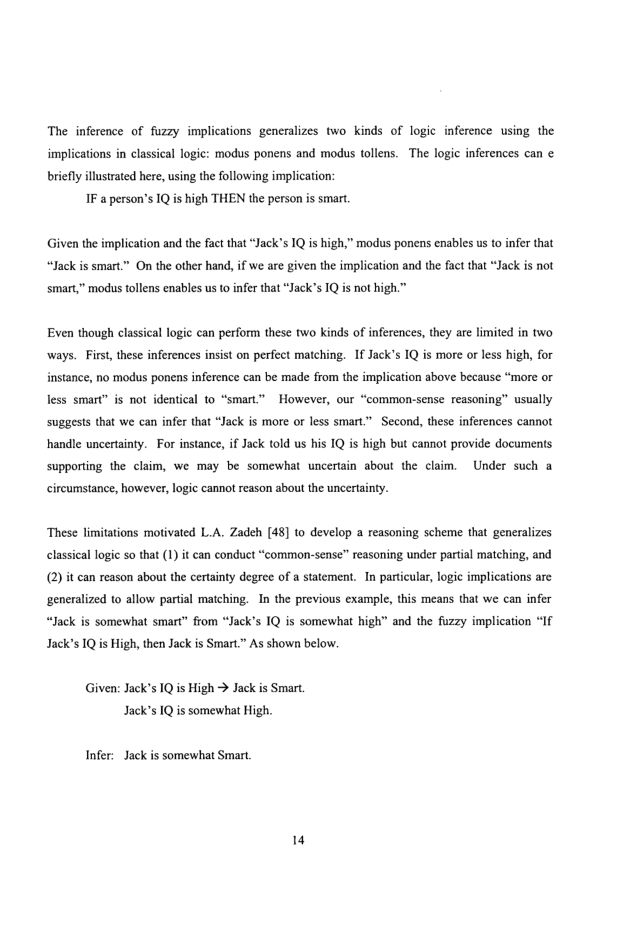
The second limitation of logic (i.e., inability to deal with uncertainty) has motivated another
extension to classical logic: multi-valued logic. Multi-valued logic extends the truth values in
logic from binary (i.e., true and false) to multiple (i.e., more than two) so that different degrees
of certainty are expressed by different truth values. Since fuzzy logic also generalizes the truth
values in classical logic beyond true and false, it is related to multi-valued logic. However,
fuzzy logic differs from multi-valued logic in that it also addresses the first limitation of logic
(i.e., restricted to a perfect match). The reason that a fuzzy implication can address the first
problem is that it uses linguistic variables in its antecedent (i.e., if parts). Consequently, the
statement in the antecedent describes an elastic condition that can be partially satisfied. In the
previous example, “A person’s IQ” is a linguistic variable in the antecedent, and “A person’s IQ
is high” describes an elastic condition about a person’s IQ. This enables a person with a
somewhat high IQ to partially match the condition. Obviously, the degree to which the condition
in a fuzzy implication is matched influences the inference that can be made from the fuzzy
implication.
Other approaches fro reasoning under uncertainty include Bayesian probabilistic inference, the
Dempster-Shafer theory, and non-monotonic logic. While these approaches have their merits for
reasoning under uncertainty, fuzzy logic is unique in that it addresses both the uncertainty
management problem and the partial matching issue.
The distinctions between fuzzy implication rules and fuzzy mapping rules are subtle, yet
important. Prof. Zadeh mentioned that fuzzy logic has four principle facets: (1) the logical facet,
(2) the set-theoretic facet, (3) the relational facet, and (4) the epistemic facet. Fuzzy implication
rules are primarily in the logic facet, whereas fuzzy mapping rules are in the relational facet
because functional mapping is a kind of relation.
15
View original scanned page
Source PDF · page 26 of 201Check original scan ↗
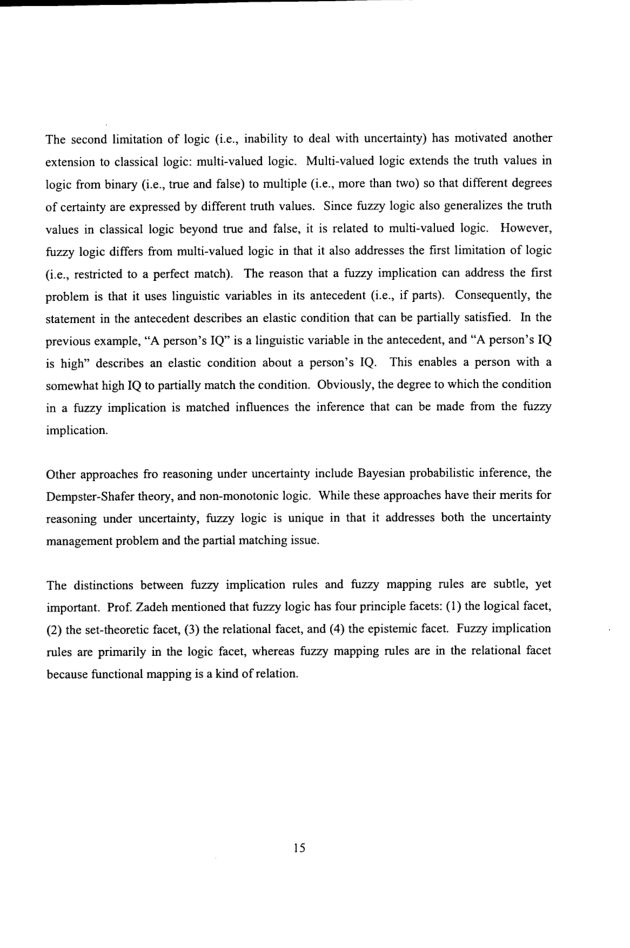
2.2.2 Disadvantages of Rule-Based Systems
2.2.2.1 RBR require exact matching
The rule-based system attempts to match the antecedents of the available rules with the facts in
the working memory. This is the primary characteristic of backward chaining expert systems.
The match must be exact for this process to be effective, which in turn requires a strict adherence
to consistent coding. For example, consider the following rule:
IF The motor is hot
THEN Shut the motor down
If we were to place in the short-term memory either of the following two statements:
• The motor is running hot
• The motor’s temperature is hot
We would not have an exact match and the rule would not fire. As humans, we can easily
interpret these two statements as meaning the same thing as the antecedent of the example, but
the computer is unforgiving of difference in the statement’s syntax.
2.2.2.2 RBR have opaque rule relationships
Although an individual rule may be easy to interpret, it is often difficult to determine how rules
are logically related through an inference chain. For example:
IF C THEN D, IF B THEN C, IF A THEN B
The first rule is dependent on the other two, and the second is dependent on the third rule.
During testing and debugging, it is important to be able to locate these related rules. Since the
rules can be placed anywhere in the knowledge base, and the number of rules can be large, it is
often difficult to locate and trace the related rules.
16
View original scanned page
Source PDF · page 27 of 201Check original scan ↗
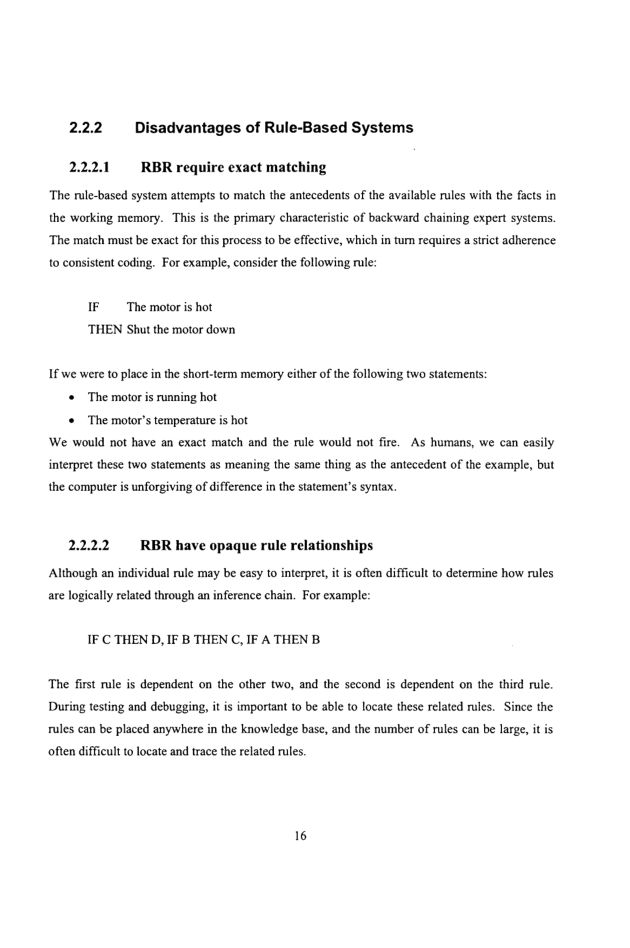
Z.2.2.3 RBR can be slow
Systems with a large set of rules can be slow. This difficulty occurs because the inference
engine must scan the entire set of rules when deciding which rules to apply. This can result in
slow processing times, which can be detrimental in real-time applications.
2.2.2.4 RBR are inappropriate for some problems
Another shortcoming of the rule-based system occurs when rules do not efficiently or naturally
capture the representation of the domain’s knowledge. Davis and King [8] comment on this
deficiency: “Program designers have found that production systems easily model problems in
some domains, but are awkward for others.” Rules provide only one choice for representing the
problem’s knowledge in the expert system. Other techniques include case-based reasoning,
frames, semantic networks, decision tables, etc.
Another difficulty is that the rules obtained from human experts are highly heuristic in nature.
These heuristic rules tend to be “brittle” and cannot handle missing information or unexpected
data values, although certainty factors may be introduced to handle missing data. Another aspect
of this brittleness is a tendency to degrade rapidly near the “edges” of the domain knowledge.
Unlike humans, RBR is usually unable to fall back on first principles when confronted with
novel problems.
2.3 History of CBR
Case-based reasoning (CBR) is an alternative to RBR that approaches problem solving in quite a
different manner. This technique uses an explicit database of problem descriptions and solutions
to address new problem solving situations.
The modem development of CBR derived from research into cognitive science. In hindsight, it
is also possible to find references of significance to CBR in Wittgenstein’s observation (1953
Philosophical Investigations UK: Blackwell) that natural concepts such as tables and chairs are
17
View original scanned page
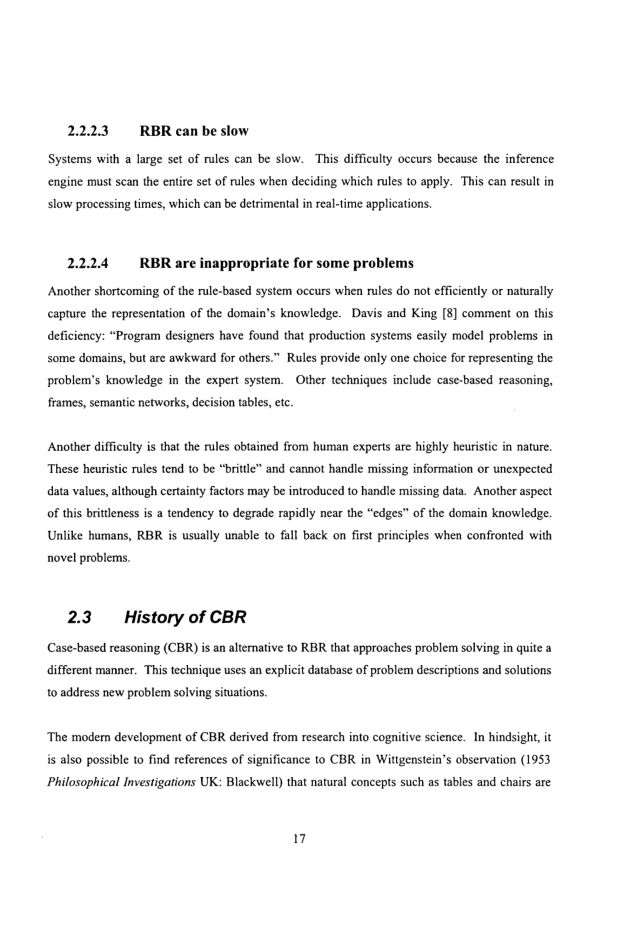
Source PDF · page 28 of 201Check original scan ↗
polymorphic and cannot be classified by a single set of necessary and sufficient features, but
instead can be defined by a set of instances (i.e., cases) that have family resemblances.
The work of Schank and Abelson [34] is widely held to be the origins of CBR. They proposed
that our general knowledge about situations is recorded in the brain as scripts, and these scripts
allow us to set up expectations about what we will hear about, which in turn allow us to perform
inferences (i.e., to infer the relationships between the things we hear). Case-based reasoning
could also be derived from a view of understanding as an explanation process [33]. As we read a
text or listen to a discussion, we use our knowledge about what is being written or talked about
to help us tie together the pieces. Our knowledge helps us predict what we will hear or read
next, establish a single semantic or grammatical interpretation for words, resolve pronouns, and
make connections between disparate elements. Making connections or explaining the
interactions of the individual elements we hear or read is particularly important in
comprehension.
While many may lay claim the philosophical roots of CBR, it was the pioneering work of Roger
Schank’s group at Yale University in the early 1980s that produced both a cognitive model for
CBR and the first CBR applications based on this model.
Scripts were proposed as a structure for conceptual memory, describing information about
stereotypical events such as going to a restaurant or visiting a doctor. However, experiments on
scripts demonstrated they were not a complete theory of memory representation - people often
confuse events that have similar scripts. For example, a person might mix up room scenes from
a visit to a doctor’s office with a visit to a dentist’s office.
In another word, scripts provide only one kind of knowledge; we also use knowledge about
goals, plans, interpersonal relationships, the roles people play, character traits, and so on in our
understanding. Understanding is seen as a knowledge application process in which the
explanations that tie together the individual things we encounter are formed. [23]
18
View original scanned page
Source PDF · page 29 of 201Check original scan ↗
Roger Schank also explored the role that memories of previous situations (i.e., cases) and
situation patterns, or memory organisation packets (MOPs), play in problem solving and
learning. The theory of Dynamic Memory [33], proposed by Schank and his students in the late
1970s [23], presented indexing as the key to using experience in understanding. The premise
was that remembering, understanding, experiencing, and learning cannot be separated. Our
memories, which are dynamic, change as a result of the new things we encounter, the questions
that arise in our minds because of these experiences, and the way we answer these questions.
We understand by trying to integrate new things we encounter with what we already know.
Thus, understanding causes us to encounter old experiences as we process new ones. Those
experiences provide expectations that allow the understanding process to be primarily simple and
top-down. Individual experiences and general descriptions of normative experiences are
encountered as we understand - both provide the same sorts of information to understanding
processes. The side effect of this process is that a dynamic memory never behaves exactly the
same way twice because it changes with every single experience. Thus, reasoning processes
never encounter exactly the same knowledge on two traversals through memory.
The means of selecting indexes and integrating general knowledge with experiences are
primarily important in this theory of dynamic memory. The theory proposed that memory is
organised by memory organisation packets (MOPs), which have two functions:
• They hold general knowledge
• They organise, in a complex hierarchy, specific experiences (cases) of that general
knowledge
Janet Kolodner developed the first CBR system, called CYRUS, in 1983. CYRUS contained
knowledge - as cases - of the travels and meetings of former U.S. Secretary of State Cyrus
Vance, and allowed users to ask questions about these events. CYRUS was an implementation
of Schank’s dynamic memory model. Its case-memory model later served as the basis for several
other influential CBR systems.
An early alternative approach came from Bruce Porter’s work into heuristic classification and
machine learning at the University of Texas in Austin, and resulted in the PROTOS system.
19
View original scanned page
Source PDF · page 30 of 201Check original scan ↗
PROTOS combined general domain knowledge and specific case knowledge into a single case-
memory model.
In the late 1980s, the U.S. DARPA program funded a series of workshops on CBR and the
development of a CBR tool. This tool became Cognitive Systems’ ReMind and marked the
transition of CBR from purely academic research in cognitive science and artificial intelligence
to the commercial arena. ReMind was joined in the marketplace almost immediately by several
other tools.
Bergmann [4] pioneered a system called “Induction and Reasoning from Cases’’ or INRECA.
The initial goal of this project was to develop innovative technologies that could help people
make smarter and faster business decisions using cases, and to integrate these technologies into a
single software platform that would allow the technology to be used more widely. In late 1995,
these goals were achieved and the methodology of INRECA was proven very effective among
CBR system designers and developers.
Goker and Roth-Berghofer [15] adapted this methodology to improve their old model for their
existing help desk support system HOMER, which was originally developed by Goker, Roth-
Berghofer, Bergmann, Pantleon, Traphoner, Wess, and Wilke [15]. The original CBR process
model involved four main tasks: retrieve, reuse, revise, and retain. The improved model was
broken down into two cycles, namely the application cycle and the maintenance cycle, with two
newly added tasks: recycle and refine. The two process cycles allow the two cycles to work
more autonomously and independently of each other. The flexibility for this help desk system to
be used in a dynamic, corporate environment by a large group of users was the outcome.
The success of this adaptation was included in INRECA-II and highlighted by Bergmann [4],
Other highlights included the integration of induction and CBR, the evaluation of CBR systems,
a methodology for developing CBR applications, and a reasonable number of INRECA
applications.
2 0
View original scanned page
Source PDF · page 31 of 201Check original scan ↗
Similar to information retrieval, CBR relies heavily on algorithms to retrieve cases efficiently. A
category of these algorithms is Nearest Neighbour, which is also well known and intensively
studied for the solution of classification and pattern recognition problems. Short and Fukunaga
[35] introduced the Value Difference Metric and the Euclidean-Hamming metrics, which were
accepted and used in the field of information theory until recently. Blanzieri and Ricci [5]
extended SF2 from the Short, and Fukunaga metric, with its definition to input spaces with
nominal features, and introduced a different estimate for the density probability used in this
metric. They also modified SF2 metric to be the Minimum Risk Metric (MRM) by optimising
the risk of misclassification instead. The MRM proved was less restrictive than SF2, and thus
seemed particularly suitable for CBR applications when a relevant classification of the cases is
available. Further work was required to address in depth the relation between MRM and the
base mathematical theory, as well as to explore the performances of the metrics in higher
dimensions and their sensitivity to noisy data.
Another approach was to adapt relational CBR. Armengol and Plaza [3] developed LAUD, a
distance measure that can be used to estimate similarity among relational cases. However, this
added the need to include feature terms into each case. LAUD was proposed to estimate the
similarity of relational cases as an aggregation of the similarities of the features that are common
to both cases. It was also shown that in their extension of similarity assessment to relational
cases, LAUD is not much more computationally intensive than a distance-based assessment for
propositional cases. This characteristic was deemed cost effective enough for most CBR
applications to switch to this new approach.
One variant of CBR that seems to be gaining popularity in the past few years is Conversational
CBR (CCBR). CCBR used a dialogue similar to a Questions & Answers style to derive the
user’s preference. Goker and Thompson [15] developed the Adaptive Place Advisor. While
most recommendation systems accepted keywords and produce a ranked list, the Advisor stood
out by conducting a conversation with users to progressively narrow their options.
Unfortunately, their current similarity calculation did not take into account the effects of a
combination preferences and diversification. They play an important role in the user’s approach
to selecting an item, and they should be incorporated into the Advisor in the future.
21
View original scanned page
Source PDF · page 32 of 201Check original scan ↗
The history of CBR is not as long as other decision-support technologies such as rule-based
system or neural networks. Ian Watson [43] believes that its rapid uptake is because of its
intuitive nature and relative simplicity of implementation.
2.4 Case-Based Reasoning Approaches
Case-Based Reasoning involves learning from previous experiences. Given that this is a very
general approach to human problem solving behaviour; it is natural that there are different
approaches for implementing this process in computer systems. In commercial CBR systems,
the three main approaches differ in the sources, materials, and knowledge they use.
2.4.1 Textual CBR Approach
The textual CBR approach eases case acquisition. It is very useful in domains where large
collections of expertise documents already exist and the intended user is able to immediately
make use of the knowledge contained in the respective documents. This approach is well suited
when there are not too many cases at a time (less than a couple of hundred) and each case has a
short description (three sentences at most). Otherwise, textual CBR retrieves a large number of
cases that are irrelevant. The cost for controlling the quality of textual CBR is high.
The developer of the case-based solution may decide to have cases recorded as free text. For
example, this could be course descriptions or academic reports. The CBR retrieval engine uses
various keyword-matching techniques to retrieve the cases. This can be based on string searches
or on N-grams. N-grams is a technique that separates words into lists of N characters. For
example, for tri-grams, the word “academic” is turned into the list of three characters “aca”,
“cad”, “ade”, “dem”, “emi”, and “mic”. Both the query and the case base are transformed, and
case matching is performed on these. This technique is robust even when there are spelling
mistakes. A word like “acdemic” would be recognised as similar to “academic”. The main
disadvantage of N-grams is that almost anything matches everything when there are large blocks
of texts with many words. The improvement of this is to use a proportional count, with many
22
View original scanned page
Source PDF · page 33 of 201Check original scan ↗
non-hits counting against case recall. That is if two cases had the same number of matches, the
case with the longer text would appear after the shorter one.
Two parameters are used to assess the quality of a textual CBR system: recall and precision.
Recall measures how many cases are retrieved from the set of existing relevant cases. Precision
measures how many of the retrieved cases are relevant. As the case base grows, there is often
high recall with low precision - the system retrieves many cases, but only a few of these cases
are relevant.
Example: Frequently Asked Questions. An academic advisor has a collection of documents
that represent the current set of frequently asked questions on his website. Each document
contains a single problem and its solution. Navigating and searching the list of documents is
difficult for students, as well as for a replacement advisor if the designated advisor is away. To
avoid this unfriendly search process, students tend to call the advisor instead of solving the well-
known problems on their own. As a result, consultation time is wasted on nonsense or trivial
queries rather than being spent on real issues from disadvantaged or troubled students. The goal
of CBR is to help students and advisors find solutions to problems that are already known and
documented.
2.4.2 The Conversational CBR Approach
The conversational CBR approach is very useful for domains where a high volume of simple
problems must be solved repeatedly. The system guides the agent and the customer with
predefined dialogs. However, the case author organises the case base manually, which is a
complex and costly activity when the cases are described by many attributes (questions). The
conversational approach is well suited for applications in which only a few questions are needed
for decision-making. Maintenance costs are high because the developer must manually position
each new case in a decision tree-like structure and update the ordering of the questions.
In the context of academic advising, the principle is to capture the knowledge contained in
student/advisor conversations. A case is represented through a list of questions that varies from
23
View original scanned page
Source PDF · page 34 of 201Check original scan ↗
one case to another. There is no domain model and no standardised structure for all of the cases.
This may produce unreliable behaviour in the resulting CBR system, which may ask questions
during the consultation that are irrelevant (e.g., questions about 4th year electives when the
student has just completed 2nd year and is entering the 3rd year of the program). To overcome
this problem, questions describing the cases are sometimes organised into tree-like structures.
The developer creates groups of questions that are used to describe a certain subset of the case
base. Each case is then positioned by hand in this structure, which must be maintained manually
by the developer. This task can be compared to developing an expert system that relies on
decision trees.
To index the cases, the case author must also define the order the user is asked to answer the
questions during the consultation. Thus, the work required to develop a conversational approach
CBR solution can be compared to building an expert system. The difference is that this “expert
system” displays cases to the user during the consultation.
2.4.3 The Structural CBR Approach
The structural CBR approach relies on cases that are described with attributes and values that
are predefined. The structural CBR approach is useful in domains where additional knowledge
beside cases must be used to produce good results. The domain model ensures that new cases
are high quality and the maintenance effort is low. This approach provides better results than the
two others, but it requires an initial investment to produce the domain model.
The idea underlying the structural CBR approach is to represent cases according to a common
structure called the domain model. The domain model specifies a set of attributes (also called
features) that are used to represent a case. The domain model structures this set of attributes. In
simple applications, the structure may be a flat table like those produced by a spreadsheet. In
complex domains, the case description cannot be a flat table.
A relational or object data model can be used in such applications. In a relational model, several
tables are indexed by a primary key. Each case has a unique key, and the case description is
24
View original scanned page
Source PDF · page 35 of 201Check original scan ↗
distributed in several tables. The relations of the database define the distribution. In an object-
oriented database, objects are decomposed into sub objects. For example, in an academic
advisement application, a course points to several sub objects, such as related fields of study and
perceived difficulty. Each object has its own set of attributes, such as the list of all fields of
study and the pass rate or high distinction rate.
Another important aspect of the structural CBR approach is that each attribute has a specific
type. The attribute can be a symbol that takes one or several predefined values in a list. For
example, the owning discipline of the course may be Software & Networks, Communications,
Electronics, Electrical, and so on. The data type can also be a number (integer or real) within a
certain range. For example, the pass rate of a course is a percentage between 55% and 65%.
Some CBR systems provide additional powerful attribute types. For example, the course
difficulty can be ordered as easy, moderate, or difficult. A taxonomy type can describe relations
of generality among attribute values. For example, for the attribute discipline, sub discipline
values; “Linux” and “Microprocessor” belongs to discipline software and networks;
“Microwave” and “Satellite” belong to communications, and so on. The ability to represent and
use this type of background knowledge can be used to discover additional similarities between
two cases. For example, if a student wants to enrol in a microprocessor course, a course about
micro assembler would be recommended over a course about C++.
To summarise, the domain model defines a standard way to represent all cases. Note that this is
different from the textual CBR approach, which may contain a structure using languages such as
Standard Generalized Mark-up Language (SGML*), but where the content associated to each
1 SGML is a standard for specifying a document mark-up language or tag set. Such a specification is a document
type definition (DTD). SGML is not a document language, but a description of how to specify one. It is metadata.
SGML is based on the idea that documents have structural and other semantic elements that can be described
without reference to how such elements should be displayed. The actual display of such a document may vary
depending on the output medium and style preferences. Some advantages of documents based on SGML are:
• They can be created by thinking in terms of document structure rather than appearance characteristics
(which may change over time).
25
View original scanned page
Source PDF · page 36 of 201Check original scan ↗
header is not standardised (it contains free text). Even if the content of these headers is stored in
a database (using what is called text blobs), this is not sufficient to qualify for the structural
approach. In the structural CBR approach, each attribute must be a field in the database and each
value must be standardised. Table 2-1 in the next page compares between different types of
CBR.
• They will be more portable because an SGML compiler can interpret any document by reference to its
document type definition (DTD).
• Documents originally intended for the print medium can easily be re-adapted for other media, such as the
computer display screen.
The language that this Web browser uses, Hypertext Mark-up Language (HTML), is an example of an SGML-based
language. There is a document type definition for HTML (and reading the HTML specification is effectively
reading an expanded version of the document type definition). SGML is based somewhat on earlier generalised
mark-up languages developed at IBM, including General Mark-up Language (GML) and ISIL.
2 6
View original scanned page

Source PDF · page 37 of 201Check original scan ↗
Table 2-1: Comparison of the different CBR approaches
Criteria Textual CBR Conversational CBR Structural CBR
Case Base A case is represented Cases are represented The case base is made
in free-text format. by a list of out of records in a
The cases may be question/answers. database. The records
structured according The list of questions contain field whose
to headers, but the and answers may values are standardised.
content of the headers vary from one case to Specific cases are
is in free-text form. another. There is no recorded by assigning
The case base is the common data values to the attributes
collection of free structure. The that have been defined.
texts that may be, for questions may be The initial case base
example, in stored in a database may easily be extracted
electronic documents but each question is from an existing
that are accessed on not a separate field of database.
the Internet. the database.
Query Case A query is A list of questions The query consists of a
represented by and answers set of attribute values.
question in free-text following a dialog These may be obtained
form whose content with the user. by asking questions. In
is similar to the an academic advisement
description part of the application, attributes
stored cases. are fields of interest and
academic history.
Results A list of documents A list of possible A list of database
that might be useful actions attached to records that describe
the cases that have cases
been retrieved
27
View original scanned page
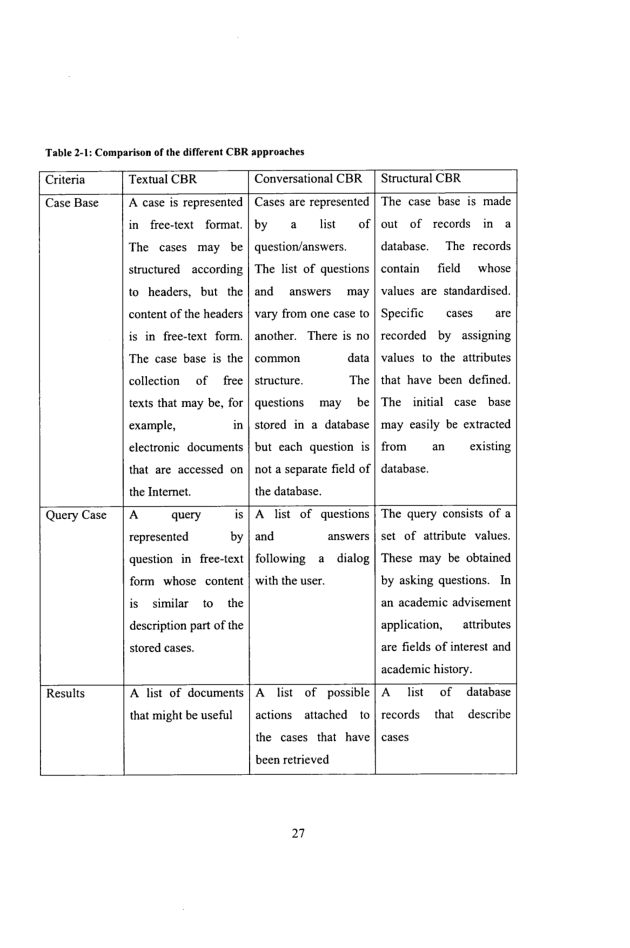
Source PDF · page 38 of 201Check original scan ↗
Criteria Textual CBR Conversational CBR Structural CBR
Background Dictionaries of Ordering of Domain model that
Knowledge similar terms like questions, hierarchy defines the case
“High Distinction: of questions in a tree structure. Rules to
competent” or like structure, deduce values.
“Microwave: possible answers for Information on how to
Wireless” and the questions that compute the similarity
information about the have been defined among attributes values
relationships between
different words
Initial Effort Defining terms, Storing dialogs Defining the domain
synonyms and stop- within a case base, model. Importing the
words. Analysing structuring the database or collecting
and setting up questions to organise cases according to the
relationships between the case base structure of the domain
different words manually, and model. This can be
ordering the done, for example, using
questions manually. an electronic
This can be done by questionnaire
entering existing
decision trees
Case Writing new Adding new dialogs. Adding a new record to
Creation documents Depending on the the database. A
structure of the questionnaire (forms)
dialog, new questions can be used in order to
must be entered. use the same
vocabulary.
28
View original scanned page
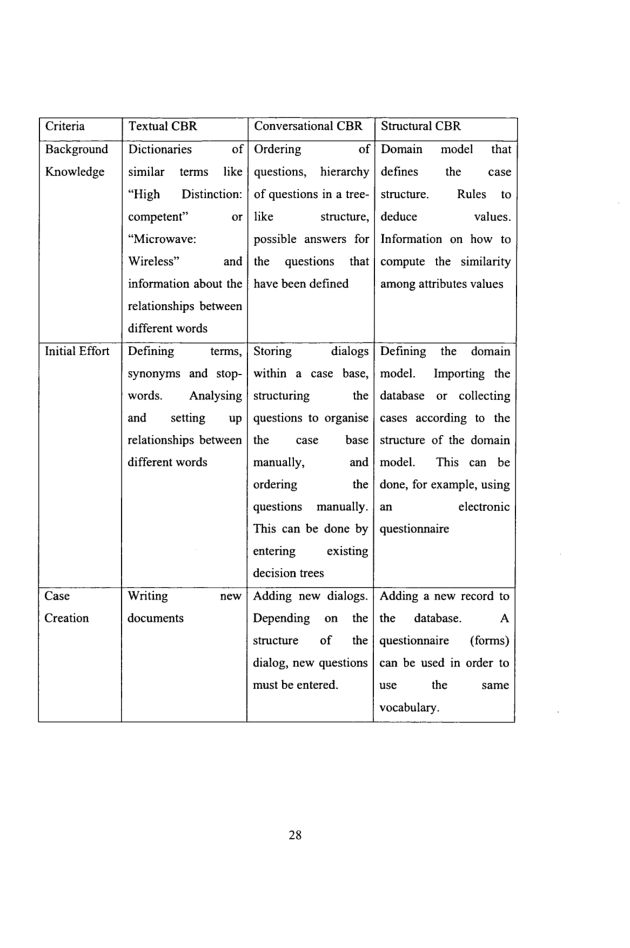
Source PDF · page 39 of 201Check original scan ↗
Criteria Textual CBR Conversational CBR Structural CBR
Maintenance Maintaining the Maintaining the list Maintaining the case
dictionary of of questions and base and the domain
controlled terms and answers. Eliminating model. The CBR
sentences. Analysing doubles, combining system must keep up
user queries and answers and with these
results. questions. modifications. It can
Reordering the automatically compute
questions by hand for the order of the
the consultation. questions during
consultation.
Multilingual Almost impossible. Difficult, no Easy to implement with
Case Bases Must have different standardised a single case base.
case bases. thesaurus of terms.
Advantages Existing documents The approach is An existing database can
can be used as cases. intuitive and easy to be used to produce the
No initial investment understand. The initial case base.
is required for system asks questions Creating additional
modelling the cases. which are answered cases can be done
by the user and this without any knowledge
dialog is stored in the about how the CBR
case base. system will use the cases
afterward.
29
View original scanned page
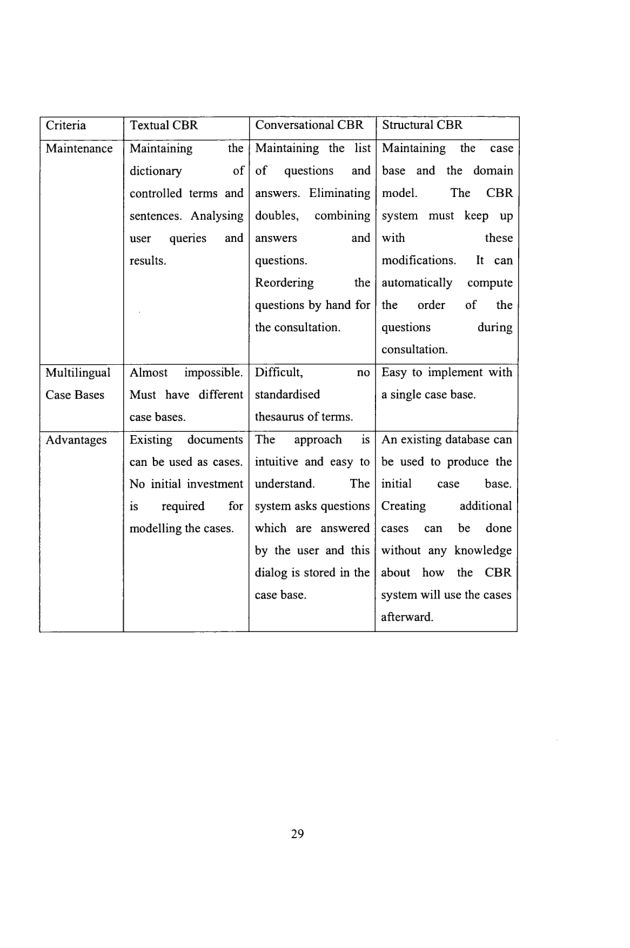
Source PDF · page 40 of 201Check original scan ↗
Criteria Textual CBR Conversational CBR Structural CBR
Drawbacks The user is not No explicit It may be difficult to
guided. The CBR knowledge create a predefined case
system must cope represented in the structure. This can
with spelling system for computing usually be achieved
mistakes. The quality similarity. The within most technical
of retrieval depends interdependencies domains, but it becomes
on the syntax and not among different harder in softer domains.
on the real content of dialogs cannot be High investment costs.
the cases. High costs predicted. High
for quality control of maintenance costs.
the CBR system.
2.5 Case-Based Advisory Systems
Case-based advisory systems are also often called case-based aiding systems. They use
interactive CBR engineering models to support human reasoning. Pragmatic CBR systems could
be divided into two categories: automated CBR systems and interactive CBR systems.
Automated CBR systems solve problems without human intervention. Most of the CBR systems
that implement CBR cognitive models are automated CBR systems. In contrast, interactive CBR
systems work with people to solve problems. Some interactive CBR systems require human
support for their reasoning tasks. For example, some CBR systems need people to help with
their adaptation, decision-making, or evaluation to successfully complete their tasks. Some
interactive CBR systems are designed to support human reasoning. For example, some such
systems act as case retrievers for a user who employs the cases to reason, while some provide
other forms of support, such as help with adaptation or evaluation. The degree of automation in
interactive CBR systems varies. However, no matter what degree of automation is used, those
interactive CBR systems designed to support human reasoning are usually case-based advisory
systems.
30
View original scanned page
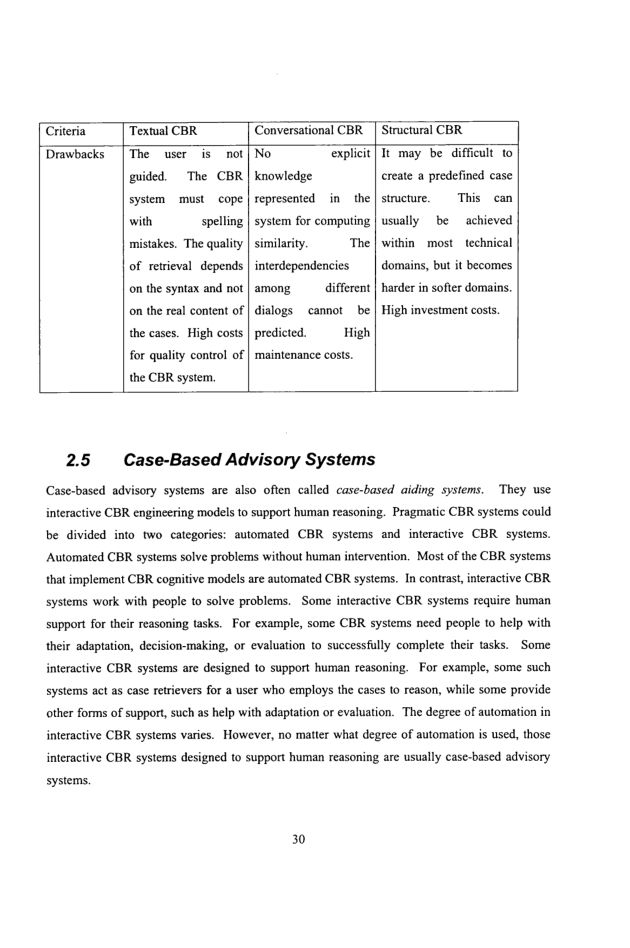
Source PDF · page 41 of 201Check original scan ↗
Case-based advisory systems provide users with the opportunity to learn on the job. The more
automated systems can act like an expert looking over the shoulder of the user, providing timely
support on an as-needed basis. The simpler systems use their case libraries to augment the
memory of a user solving a problem, and perhaps provide other forms of support as well. With
the support of case-based advisory systems, users can make decisions about which cases could
be used, which adaptations to apply, and which potential problems to address.
2.5.1 Ways in which case-based advisory systems support user
reasoning and learning
Case-based advisory systems typically support users in three ways: inform users of potentially
useful cases, provide adaptation support, and provide evaluation support. First, case-based
advisory systems can augment the user’s memory. The case library of a case-based advisory
system is usually built to cover the range of reasoning tasks the system will be responsible for
supporting, as well as cover the range of well known solutions and well known mistakes [23].
When users are trying to understand and assess situations, such representative sets of cases allow
them to interpret or understand a situation in the context of other similar situations. Those
similar situations can not only point out to users what to focus on and what outcomes might
arise, but it also allows them to argue and justify the pros and cons of interpreting a situation in a
certain way. It is especially helpful when users are interpreting open-ended and ill-defined
concepts. In the process of problem-solving, similar cases retrieved from the case library of the
case-based advisory systems allow users to:
• propose solutions to problems quickly, avoiding the time necessary to derive those
answers from scratch;
• propose solutions in domains that they do not completely understand;
• be aware of the potential for problems that have occurred in the past and take actions to
avoid repeating past mistakes
• focus their reasoning on the important parts of a problem; and
• propose solutions even when the logic behind the recommendations of the case are
weakly presented or absent.
31
View original scanned page
Source PDF · page 42 of 201Check original scan ↗
In addition, the variety of cases included in case-based advisory systems expose users to multiple
situations, multiple decisions, and multiple perspectives. This multiplicity helps to build
awareness of knowing what skills to apply and when to apply them. A beneficial side effect of
using the case-based advisory system to augment the user’s memory is that users could acquire a
representative set of cases for their own case libraries (memories) in the process of using the
systems to support their reasoning.
Second, case-based advisory systems can support the adaptation process of reasoners by
suggesting adaptation strategies, the applicable conditions of adaptation strategies, and past
adaptation processes that could be usefully recorded as part of the case in their case libraries.
Some case-based advisory systems, which integrate CBR method with semantic networks or
other reasoning methods such as rule-based reasoning or model-based reasoning, can also
provide users with relevant domain knowledge to support their adaptation. Adaptation support
from case-based advisory systems can help users identify what to change, find out the available
adaptation or repair strategies and their conditions, determine the appropriate strategies and, in
cases where several appropriate strategies suggest different adaptations, they can help users
choose among several appropriate strategies.
Third, case-based advisory systems can also help users with evaluation by showing them the
factors that should be considered during evaluation, as well as clustering cases to make
comparison easy. This could be done by:
• retrieving and presenting cases that have similar situations and similar solutions to those
being evaluated, and
• suggesting which factors the users should focus on when comparing and contrasting new
situations and their solutions to old ones in order to determine if an old outcome can
apply to a new situation.
The outcomes of the old situations can be projected on the new ones, allowing the outcome of
the new solutions to be predicted. When different old cases can be used to predict different
outcomes, the factors suggested by case-based advisory systems can also help the users to do
argumentation (i.e., to determine which of the old cases are similar enough to the new one for the
projection to make sense). This process has the potential to help the users in several ways. First,
32
View original scanned page
Source PDF · page 43 of 201Check original scan ↗
it can point out the potential problems with a proposed solution and point the way towards
repairing the solution. Second, it can point out what might be changed to make a good solution
better. Third, scenarios used during critiquing can serve as a justification for whatever solution
is selected. Fourth, it can help the users realise what is important to pay attention to in future
problem solving.
Because case-based advisory systems have the potential to support reasoning and learning in so
many ways, some case-based advisory systems have been built especially for instructional
purposes.
2.6 Goal-based Scenario’s (GBS) Top-down Approach
to Design
The moderated Dynamic Memory CBR model implies that a “learning” academic advisement
system should revolve around the target knowledge, skills, and experiences of the expert human
academic advisors that it aims to teach by helping the CBR system accumulate the kind of cases
that can lead to the acquisition of knowledge, generalisation of skills, and representation of past
experiences. In essence, the design of a learning system should take a top-down approach
starting with the higher level knowledge (skills and strategies of academic advisors), then going
down to the bottom level to choose specific cases that would facilitate the generalisation of the
higher level knowledge, and finally incorporating the conceptual knowledge to be taught into
those cases. The cases chosen should be ones that are directly linked to academic advising skills,
and the set of cases should be diverse in context and include both success and failure cases.
Correspondingly, in the design of GBS, the structure (mission structure) and content (scenario
operations, mission, mission focus, and cover story) of the learning environment is determined
by the target knowledge and skills. Advising experiences that do not directly contribute to the
generalisation of case attributes are minimised. Advising experiences that directly contribute to
the abstraction of case attributes are not only maximised, but they are also designed to be diverse
in context and include both experiences of success and failure. Strategies and conceptual
33
View original scanned page
Source PDF · page 44 of 201Check original scan ↗
knowledge are presented either as part of a scenario or as part of the expert academic advisors’
stories, which are presented to the CBR system when they experience expectation failures.
2.6.1 Analysis of Case-Based Advisory Systems and
Knowledge-Sharing Systems
Case-based advisory systems and knowledge sharing systems are different from Goal-Based
Scenario (GBS) and Learning by Design (LBD) not only because they are CBR systems, but also
because the majority of them are designed to be job aids rather than educational systems. Most
are built with engineering and economic concerns, and do not strictly follow any CBR cognitive
model. Factors such as the nature of the subject matter, the target audience, and the resources
available often determine what the framework of a specific case-based advisory system or case-
based knowledge sharing system would be. This characteristic presents a great potential in the
academic advisement application, with factors such as students’ fields of interest, academic
performance, and preferences towards technical field specialisation.
2.6.2 Present cases as well as overall knowledge
representation
Kolodner’s Category and Exemplar model, and some integrated CBR models, suggest there are
semantic networks of general domain knowledge in people’s memory. These CBR models
acknowledge that overall knowledge representation of an expert academic advisor’s semantic
networks could affect his/her reasoning capacity. Therefore, these CBR models might suggest
that case-based advisory systems and knowledge sharing systems should make the overall
knowledge representation of the academic advisement domain available to students, who are
essentially users. For example, if the CBR systems are structured according to the structure of
the academic advisement domain, it might be beneficial to make the structure of the CBR system
and indices of cases available to students.
34
View original scanned page
Source PDF · page 45 of 201Check original scan ↗
2.6.3 Make explicit important features, deep structure, and
rules, models or strategies used
Kolodner’s CBR cognitive model suggests that making important features, deep structure, and
rules, models, and strategies explicit to users helps them focus on the important factors and make
more thoughtful decisions. Her model implies that case-based advisory systems should present
cases to users in such a manner and, in the case of case-based knowledge-sharing systems, those
systems should also have features to help users input their experiences into the system in a
similar structured manner.
Schank’s moderated Dynamic Memory CBR model also implies that presenting cases in such a
structured way would facilitate reasoning because it helps users to create a more effective
indexing scheme. In addition, the Dynamic Memory CBR model suggests that it is desirable to
present strategies in the context of cases, because:
• Strategies could only be acquired from cases
• After the users acquire strategies from those cases, their overall reasoning capability will
be enhanced and they would be better prepared to reason effectively and efficiently.
2.6.4 Explain cases with generalised domain knowledge
The Category and Exemplar model, and several integrated CBR models, emphasise rich
explanatory links between case knowledge and generalised domain knowledge. It proposes that
when explained with generalised domain knowledge, cases are easier to retrieve, easier to adapt,
more predictive, and more memorable. Therefore, it suggests that case-based advisory systems
and knowledge sharing systems should include explanations that refer to generalised domain
knowledge in their cases, and case-based knowledge sharing systems, in particular, should
include features or guidelines to encourage users to explain their experiences with generalised
domain knowledge whenever possible.
35
View original scanned page
Source PDF · page 46 of 201Check original scan ↗
2.6.5 Avoid reasoning bias by presenting exceptions
If the case-based advisory systems and knowledge sharing systems use the approach of explained
cases with generalised domain knowledge, the Dynamic Memory cognitive model would suggest
that exceptions to the generalised knowledge should also be made available to users. The
Category and Exemplar model also suggests that information should be provided to users to help
them become aware of similar situations in which the generalised domain knowledge would
apply.
2.7 Knowledge supporting the CBR process
Learning by acquiring new cases is an integral part of the CBR process: each problem-solving
episode provides a new case to save for future reuse. However, these cases form only one pool
of knowledge that supports learning in this framework. CBR systems rely on at least four types
of knowledge:
• The case base: the stored solutions known to the system
• The indexing scheme: the features used to retrieve cases from the case base. These
features are often predefined and fixed within the system
• Similarity criteria: the method used for the selection of candidates retrieved during the
retrieval process. Like indexes, the criteria used have traditionally been predefined by
the user
• Case adaptation knowledge: the stored problem-solving episodes provide a rich source of
knowledge that enables many types of learning
These four types of knowledge exist in support of various aspects of the CBR process. For
example, the indexing scheme supports the retrieval of relevant cases from the case base. While
the case base changes as new solutions are accepted by the system, the other three knowledge
sources are generally unchanging and defined from the outset of processing in the system. With
the acquired knowledge, there is a potential to affect the other knowledge sources already in the
system. Kinley [23] claimed that the stored plan cases could be reapplied more effectively if
better case adaptation knowledge is available.
36
View original scanned page
Source PDF · page 47 of 201Check original scan ↗
Case-based reasoning can be further improved by augmenting the retrieval similarity criteria
with the stored case adaptation knowledge. Stored cases can be selected for reuse based on how
easily the system can subsequently adapt them. The interaction of different knowledge sources
to augment and overcome the deficiencies of one another has previously been established and
documented (Richter, 1995). However, the types of knowledge interactions available with the
addition of learned case adaptation knowledge have not been examined.
2.8 The ASK systems
The ASK systems [12] are hypermedia case-based advisory systems designed to simulate a
conversation between a novice (the user) and an expert (the system). This series of systems (e.g.,
ASK-Tom, ASK-Michael, Advise the president, Trans-ASK, Engines of Education) are
essentially CBR systems that consistently predict what a user might be interested in and retrieve
cases for her/him to review.
A user starts using an ASK system by first “zooming” from the top-level structure of a domain to
a specific case. This is done by identifying an area of interest, then choosing a theme from that
area of interest, and subsequently choosing a case of interest from that theme. Afterwards, the
user starts the “browsing” process in which they go from case to case in a manner similar to
conversing with an expert. A user starts browsing with the first case he/she chooses at the end of
the zooming process. The case summary and follow-up questions related to that case are
presented in a case screen, and the user can either:
• Choose to view the full case
• Choose to follow up a question to go to another case screen
If he/she chooses to view the full case, a story in the form of a short video is presented. When
the user finishes viewing or reading the first case, they are brought back to the case screen.
He/she could then follow the links to another case screen and repeat the cycle.
For example, ASK-Tom [12] teaches novice bank consultants at Anderson Consulting about trust
bank consulting. When ASK-Tom is started, it displays a big picture diagram of trust bank
37
View original scanned page
Source PDF · page 48 of 201Check original scan ↗
consulting with several topic areas. Clicking on the nodes or links in this diagram causes the
screen to display either a more specific big picture diagram describing, for example, the temporal
layout of a typical consulting engagement at a trust bank, or a screen showing a set of themes
and stories that they organise. Big picture diagram screens ultimately lead to a theme screen.
When the users reach the theme screen, they find several listings representing individual stories
that correspond to various aspects of the theme. Once a choice is made, the system presents the
story screen of the story chosen. The clip named in the centre of the screen is a link to the video
clip of the main story. The questions linked to the main story are questions that the users might
ask in a conversation with the expert following their previous conversation. These questions are
predicted by the CBR system using a conversation model. Choosing one question linked to the
current story brings the user to another story screen, and the cycle repeats.
The tree of all big picture models in the system form a conceptual map of the domain organised
around its most important agents, relationships, and processes. These big picture models not
only mediate the users’ choices of areas of interest, but also help the learners understand the
structure of the domain and prompt them to see individual cases as illustrations of general
principles. By using case-based reasoning algorithms, these case-based advisory systems are
able to provide users with a coherent model of the subject matter. This coherent model, in turn,
enables the users to assimilate the answers to their questions in a way that they can then use
those answers to solve problems.
ASK systems use a story telling approach to instruction implied by the Dynamic Memory
cognitive model. The ASK systems are designed with the assumption that expertise can be
represented as a large, diverse bank of cases organised by a knowledge structure similar to the
structure of the subject domain, and that novices could leam to become experts in a certain
domain by becoming familiar with the experts’ case library. The ASK system is an example of a
case-based advisory system.
38
View original scanned page
Source PDF · page 49 of 201Check original scan ↗
2.9 Case-Based Knowledge Sharing Systems
Case-based knowledge sharing systems are case-based advisory systems extended to augment
users’ memory and to be augmented by users’ memory. Users’ experiences of reasoning with
the support of case-based knowledge sharing systems are selectively collected and recorded as
new cases for the systems’ case libraries. Such CBR systems are usually used as corporate
memory. A case-based knowledge sharing system starts with a representative case library, and is
constantly augmented by new cases to update and perfect its library. The idea is to gradually
build a system that could act as a large-scale case-based reasoner that consists of the case-based
knowledge sharing system and all of the users of the system. This large-scale case-based
reasoner would solve problems by:
• Assessing the problem situation on the users’ side using the case library of the system
• Retrieving similar cases from the case library either automatically or through special
requests from users
• Interpreting the current case using past experiences and adapting available cases to solve
new problems, usually done by the users with the support of the system
• Evaluating the solution and recording useful lessons as new cases, which is done by the
users but recorded in the system
The valuable experiences of all reasoners who use the system would be incorporated into the
large case-based reasoner’s memory. In turn, this “memory of the community” would use the
collective experiences and expertise of the system and the entire user community to support the
reasoning of each reasoner.
In addition to all the benefits offered by case-based advisory systems, a case-based knowledge
sharing system also offers a forum for building and sharing wisdom and insights derived from
diverse sources. They encourage users to contribute their expertise through cases to a
community of users within an organisation, thereby enabling the best practices of the community
to be disseminated quickly. Since contributions from all users will not only serve as a source of
information, but also serve as a source of inspiration and criticism, the collective experiences of
members in the community can generate ideas that no individual would have developed alone,
39
View original scanned page
Source PDF · page 50 of 201Check original scan ↗
which leads to higher quality reasoning and more learning gains. In time, this will also result in
a higher quality case library in the case-based knowledge sharing system.
Another feature that is often included in case-based knowledge sharing systems, but not case-
based advisory systems, is the collaboration tools. The collaboration tools allow users to discuss
certain cases or reasoning tasks, to annotate cases in the system, and to provide other forms of
support to one another that compliment the kind of support the system provides. The
communications, which carry these “other forms of support”, are sometimes also recorded in the
knowledge sharing system for later reference.
2.10 CBR Operation
2.10.1 Case Structure
The case structure for a given application is defined by the “advice” specifications used by the
expert human advisors. For academic advising, the case structure is well known in advance
since it relies on an existing set of student cases whose characteristics are known (This is
contrary to a diagnosis application where one must make an intensive effort to “discover” the
domain model, as in Hamilton & Gomes, National Semiconductor, in Watson 2003)
2.10.2 CBR components
The four components - retrieve, reuse, revise, and retain - are described in detail below. Each
component is listed alongside the key issues involved in its implementation, as well as the unique
knowledge necessary for that component’s successful use.
The conventional set of CBR principles are more fully defined as a cycle comprising four
activities, as shown in Figure 2-1:
• Retrieve similar cases to the problem description
• Reuse a solution suggested by a similar case
• Revise or adapt that solution to better fit the new problem if necessary
40
View original scanned page
Source PDF · page 51 of 201Check original scan ↗
• Retain the new solution
[Copyright Material Omitted]
Figure 2-1: Aamodt & Plaza's CBR cycle [1]
Ian Watson proposed an improved version that contains an additional two activities:
• Review the new problem-solution pair to see if they are worth retaining as a new case
• Refine the case base index and feature weights as necessary
The case is retained in a case-base, but it typically undergoes some pre-processing and filtering
(i.e., indexing and feature weighting). The reasoner retrieves the case to solve some problem
and attempts to reuse it. This may result in some revision or adaptation of the case’s solution,
resulting in new episodic data and the creation of a new case. The new case is reviewed (this
41
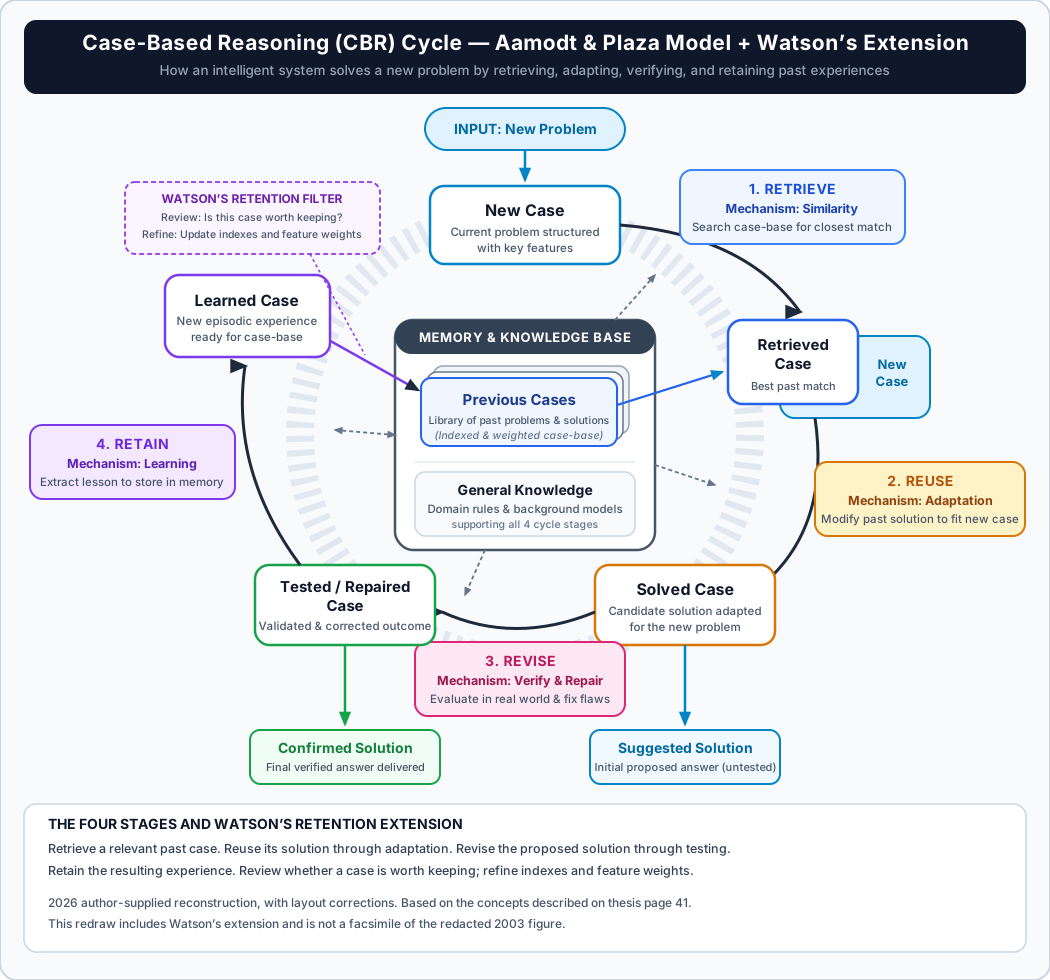
View original scanned page

Source PDF · page 52 of 201Check original scan ↗
involves comparing to cases already in the case-base) and, if it is judged useful, it is retained. In
addition, the use of the case (successfully or otherwise) may result in the case-base’s indexing
scheme or the feature weights being refined [44].
2.10.2.1 Retrieval
The retrieval process receives a description of the current problem as input. When first
encountering a new problem, a “ballpark” solution needs to be located in the memory of past
cases. This process assumes two factors: first, that a usable case exists somewhere in memory,
and second, that once located, cases can be evaluated based on their similarity to the current
problem. Once a case has been successfully retrieved, the next step is to apply the matching case
to the new situation. This is the task of the reuse phase of case-based reasoning.
2.10.2.2 Reuse
With the retrieved case, the system attempts to reuse the case in the current context. This
requires it to identify any potential problems with the reuse of the plan. An evaluation sub
component attempts to identify these potential problems so they may be repaired later. Several
different approaches to evaluation have been used by CBR systems. These methods include:
testing the proposed solution in the real world or a simulated world [17], asking a user for
feedback [33], examining the outcomes of previous cases [23], or accessing a rule base that
provides information about well known problems. If the evaluation identifies no relevant
problems, the solution can be used and the new case is retrained. Otherwise, the solution is sent
with a list of identified problems for revision. In practice, the boundaries between the reuse and
revise phases are blurred until an acceptable solution is built.
2.10.2.3 Revise
The revision component performs case adaptation as necessary to repair the problems identified
during the reuse evaluation. However, case adaptation can be difficult. To repair a problem, the
42
View original scanned page
Source PDF · page 53 of 201Check original scan ↗
problem must first be understood. For example, a student failing an exam could have many
potential causes: the student may not have studied, the exam was surprisingly difficult, or the
teacher graded the student unfairly. In order to minimise the chance of the student failing in the
future, it is necessary to assess blame [23] to a cause so that an appropriate solution can be
generated.
However, it is non-trivial to assign blame for the problems identified by the evaluator. One
solution could cause a host of other problems, some far more difficult to solve than the initial
problem. In fact, some problems may require knowledge that is outside the scope of the original
problem domain. These types of problems often require that a separate knowledge base be
created exclusively for the use of the case adaptation module.
Due to these difficulties, case adaptation is often performed using static adaptation rules or by
user intervention. Automated case adaptation has been considered by many to be an intractable
problem. The problem is so acute that experts in both CBR research [23] and applications [4]
agree that it is not currently practical to deploy CBR applications with automatic case adaptation.
As repairs are made, the case adaptation component passes the repaired solution back to the
reuse phase to ensure that other negative side effects do not occur. If other problems are found,
control is returned for additional revisions. This sub process continues until no additional
problems are found. The final solution now can be used, and it is passed to the retain phase.
2.10.2.4 Retain
The original four REs model did not provide a phase where an evaluation of the usefulness of the
new solution was performed. Thus, we assume that all solutions reaching this retain phase are
worth keeping. When the final solution is sent to be retained, it is ready to be placed in the case
base. A key issue for retention is where to store the final solution in the case base. A well-
organised case base can reduce the retrieval time and thus decrease the total overhead of the
CBR process. The retention process provides the mechanism for the system to learn from the
43
View original scanned page
Source PDF · page 54 of 201Check original scan ↗
problems that have been solved from scratch, and provides the opportunity to reuse the solutions
in future similar problem episodes.
2.10.3 CBR classification
A case consists of available information about a module, including its class and all
measurements. The case library that represents the experiences of the development organisation
is known as the fit data set. Each case in this library has known attributes and class membership.
The new cases whose class membership is to be predicted are known as the target or test data set.
Given a case with an unknown class, its class is predicted to be the same as the class of the most
similar case in the library, where similarity is defined in terms of case attributes.
Let the case library or fit data set to be used be selected by the user.
The case library consists of the fit data set, having n modules. Let Cj be the vector of
independent variable values for case j, and let Cjk be the value of the k'h independent variable of
case j. Similarly, a test data set is also selected by the user. Let Xj be the vector of attributes of
the i'h unclassified module, and x,* be the k'h attribute of that target module i.
The aim of academic advising CBR is to predict the dependent variable with minimal error.
Since test data is strictly quantitative, similarity is thought of as the distance between cases.
Consider each attribute to be a dimension of a multi-dimensional space. Each case is represented
by a point in this space, and the unclassified module by another point. Similarity is thought of as
the inverse of the distance between modules. Several similarity functions are provided to
calculate a distance, dy, between the target module, x, and every case, cj, in the case library.
2.10.4 Case Similarity Functions
For the purpose of explanation and similarity assessment, it is important for an “interpretive
CBR” program to know not only that a similarity or difference is significant, but also why it is
significant in terms of abstract knowledge.
44
View original scanned page
Source PDF · page 55 of 201Check original scan ↗
Although knowledge that a similarity or difference is significant can be represented by numerical
weighting schemes, knowledge of why it is significant must be represented symbolically in terms
of abstract knowledge. The symbolic representation should capture the general purposes and
strategies for drawing analogies and distinctions among cases as a guide to decision making. A
reasoner may, for instance, analogise a problem to positive case examples and contrast it with
negative examples as a way of arguing that a problem is governed by a general principle, policy,
or normative concern. Without this kind of abstract knowledge, a program cannot explain why a
similarity or difference matters, and thus cannot adequately justify or explain its conclusions [2],
Several measures of similarity functions are described in the literature according to the problem
domain, the availability of attribute data, and whether the data types are categorical, discrete,
real, etc. [23] The Euclidean distance and City-Block distance [22] are commonly used for
quantitative attributes. The Mahalanobis distance [10] has the advantage of explicitly accounting
for correlations among attributes. The raw metrics (i.e., the independent variables) usually have
vastly differing measurement units and highly varied ranges. Standardisation is a technique that
converts all of the metrics to a uniform system of coordinates so they will all have the same unit
of measure.
For each metric, Xj, the standardised metric, Z, is given by
s i
Where xi is the mean, and s, is the standard deviation of the ith metric, x,.
All independent variables in the data set are standardised to a mean of zero and a variance of
one. However, standardisation is not required when the Mahalanobis distance measure is used.
45
View original scanned page
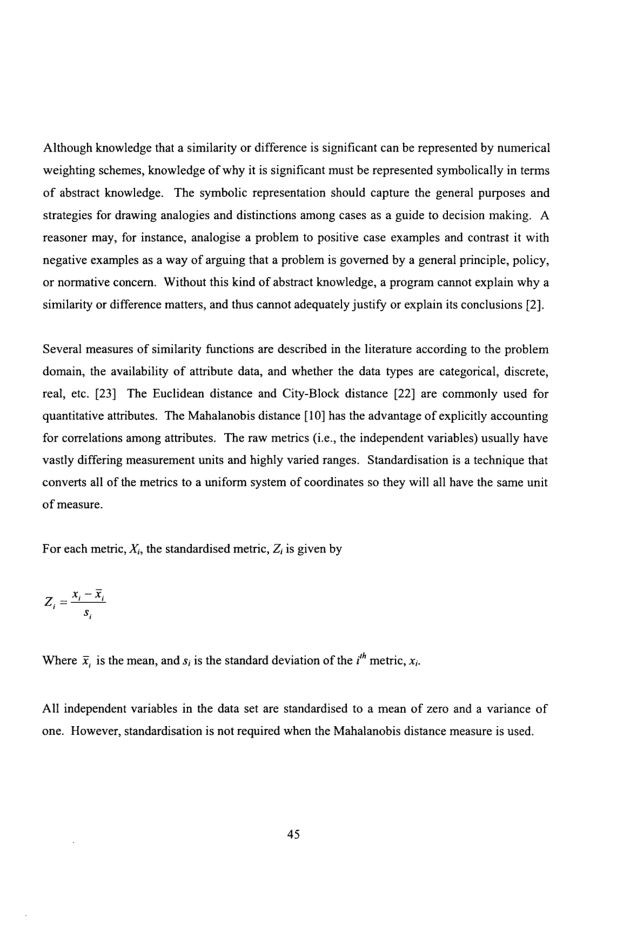
Source PDF · page 56 of 201Check original scan ↗
2.10.4.1 Absolute Difference
Absolute Difference is also known as “City block distance” or “Manhattan distance”. The
distance is the weighted sum of the absolute value of the difference in the corresponding
independent variables between a target module and a case in the library. The weights are
provided by the user. Since the direction is not taken into consideration, the absolute value is
used. The distance is given by the following equation:
Where m is the number of independent variables and w* is the weight of the klh independent
variable.
2.10.4.2 Euclidean Distance
Euclidean distance considers each independent variable as a dimension of an m-dimensional
space. A module is represented by a point in that space. The Euclidean distance between a fit
module from the case library and a target module is their weighted distance in this space. The
weights are those provided by the user. The distance is given by the following equation:
2.10.4.3 Mahalanobis Distance
Mahalanobis distance is an alternative to Euclidean distance. Mahalanobis distance is a very
good alternative to other distance measures when the independent variables are highly correlated
and/or vary on vastly differing scales. The distance is given by the following equation:
46
View original scanned page
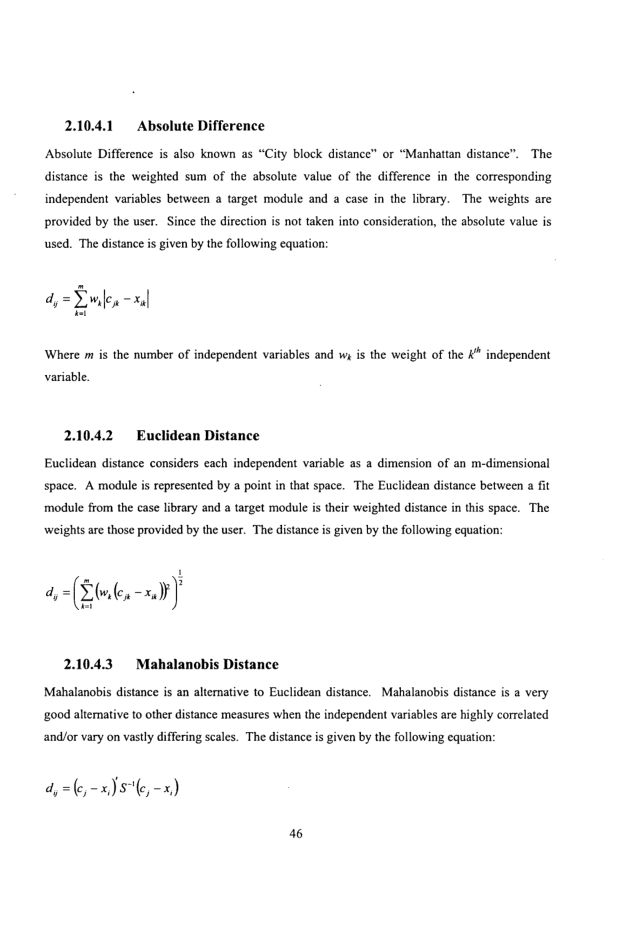
Source PDF · page 57 of 201Check original scan ↗
S is the covariance matrix of the independent variables over the entire case library, and S"1 is its
inverse. S becomes the identity matrix and Mahalanobis becomes the Euclidean distance
squared when the independent variables are uncorrelated and have a one unit variance. The
independent variables do not need to be standardised or normalised when the Mahalanobis
measure is used.
2.10.4.4 Fuzzy Relations
Fname Lname JobType Expertise
Bob McLedon Academic AI
Rob Mucker Industry Expert System
Nancy McCay Government Statistics
John Hunt Government Robotics
Table 2-2: PROFILE Relation
2.10.4.4.1 Relational Data Models
A relational model organizes data into relations, which can be viewed as tables with meaningful
names. The columns of this table are called attributes of the relation, while the rows are called
tuples. For example, table 2-2 shows a relation whose attributes are Fname (First Name), Lname
(Last Name), JobType, and Expertise. Conceptually, the relation describes the preferred careers
and the expertise of job candidates in a job search agency’s database. The relation is named
PROFILE.
To formally define a relation, we need to first introduce the notion of domains. A domain is a set
of values. A domain can be discrete (e.g., the set {Academic, Industry, Government}) or
continuous (e.g., the real numbers between 0 and 100). Each attribute in a relation has a domain,
which specifies all possible values for the attribute. Let Di, Dj, ..., D* be the domains of k
attributes in a relation R. The Cartesian product of these domains D u Dy, .... D* forms all
47
View original scanned page
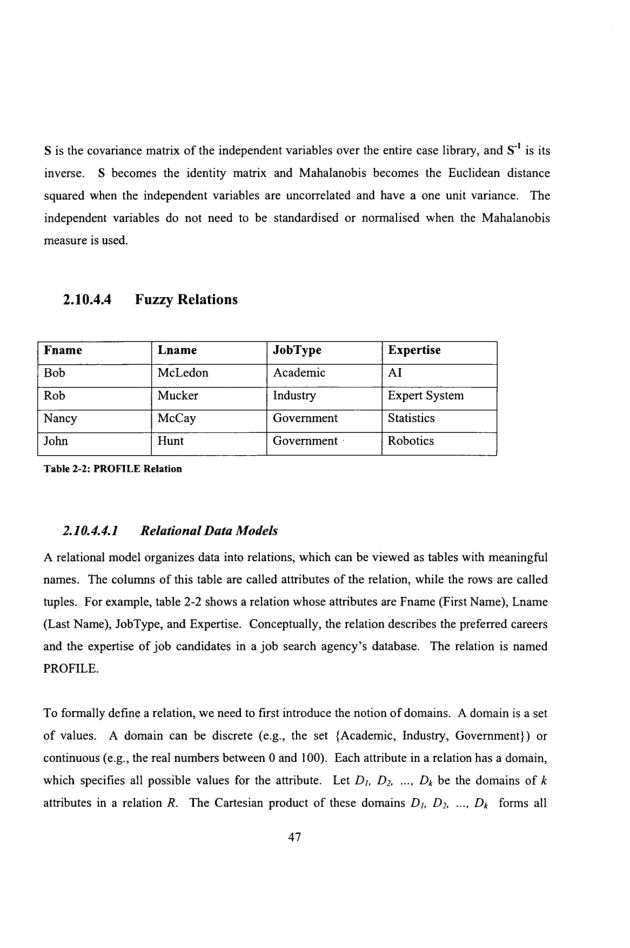
Source PDF · page 58 of 201Check original scan ↗
possible combinations of values of the k attributes. The relation R, hence, is a subset of the
Cartesian product D t, Dj, Dk . A tuple is a member in a relation.
Alternatively, a relation can be viewed as a set of mappings, each of which maps each domain to
a value. The main advantage of this formalism is that changing the order of a relation’s
attributes does not change the relation. In other words, a relation is defined solely by the content
of its table, independent of the order of its columns.
In the original relational model, the domains for each attribute have a set of predefined values.
Using the similarity matrix approach, the imprecision is implicit in the similarity matrix and so
the representation is still the same. Thus, this approach is very close to the conventional
relational model. The possibility approach requires changing the data representation to a
representation of fuzzy attribute values. For example, if we have an age attribute in a given
database, then originally this attribute will have numeric values. Using possibility distributions,
we will introduce terms like Young, Old, Middle-aged that are characterized by corresponding
possibility distributions. (This could be applied to student’s academic performance in Academic
Advisement system, e.g., Excellent, Good, Fair, Poor.) In the next two subsections, a more
detailed description of the two approaches will be presented. The table 2-3 below can be applied
to the Specialization Characteristics, i.e., High specialization, Some specialization, Minimal
specialization.
Robotics Expert Systems AI Statistics
Robotics 1.0 0.6 0.6 0.2
Expert Systems 0.6 1.0 0.9 0.2
AI 0.6 0.9 1.0 0.2
Statistics 0.2 0.2 0.2 1.0
Table 2-3: a similarity matrix for expertise areas
2.10.4.4.2 Similarity-based Fuzzy Relations
48
View original scanned page
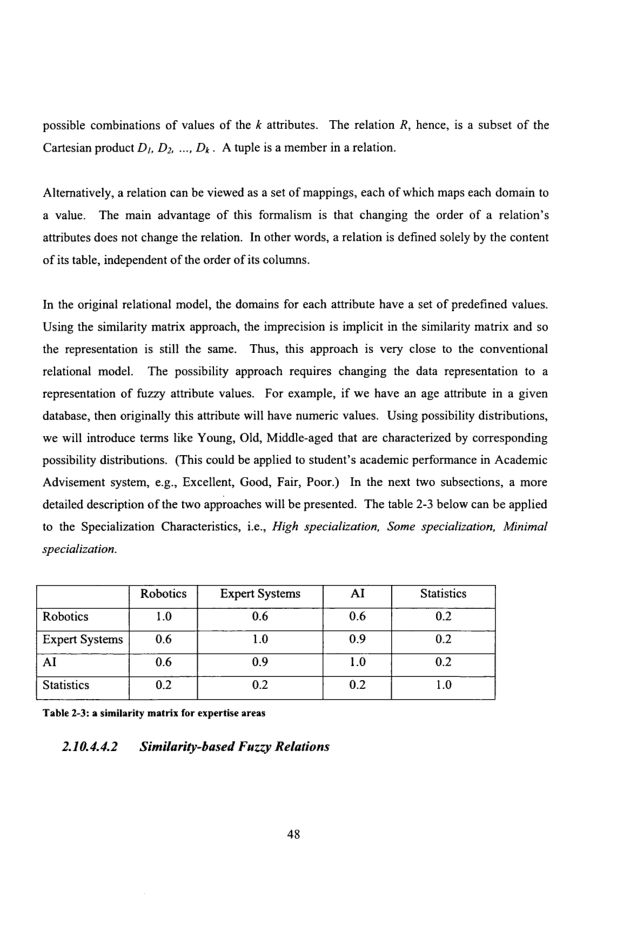
Source PDF · page 59 of 201Check original scan ↗
In a similarity-based fuzzy relation, the impreciseness of attribute values is primarily in their
meaning. For example, the values of the attribute EXPERTISE in the relation shown in
PROFILE Relation often partially overlap. The overlapping degree of these areas of expertise is
specified by a similarity matrix such as the one shown in table 2-3. In addition to imprecision
due to semantics, a similarity-based fuzzy relation could also describe imprecision due to
incomplete information. For example, we may wish to describe that the age of a suspect is 19 or
20. To do this, an attribute in a tuple is allowed to have a set of values, which describe all
possible values for the attribute in the tuple. A similarity-based fuzzy relation involving domains
Du D2, .... Dk is thus a subset of the Cartesian product 2°t x 2°2 x ... x 2°k . Furthermore, as we
discussed earlier, the values in domains Du D2, .... Dk are related by a similarity relations Su
S2, ..., Sk that map each pair of values in a domain to the interval [0,1]. A similarity measure of 1
means that the pair is identical, whereas a similarity measure of 0means the pair is entirely
different.
A similarity relation S for a domain D is a fuzzy relation that maps pairs of domain values in D
to the unit interval, i.e., S: D x D -> [0, 1] , with the following three properties for all x, y, z in D:
1. Reflexive: S d ( x , x ) = 1
2. Symmetric: SD(x, y) = SD(y, x)
3. Transitive: SD{x,z) > max(min(5D(x,y),5'£,(y,z)))
The first two properties are intuitive. The usefulness of the third property will become clear in
the context of redundancy issue in a fuzzy database.
An example of the similarity relation is given in table 2-3 in a matrix form. The matrix describes
the similarity within domain values of a given attribute. In the example, for the attribute
Expertise, the domain values are {Robotics, Expert Systems, AI, Statistics}. For each pair of
expertise areas, the similarity matrix describes one degree to which each expertise area is similar
to the others.
49
View original scanned page
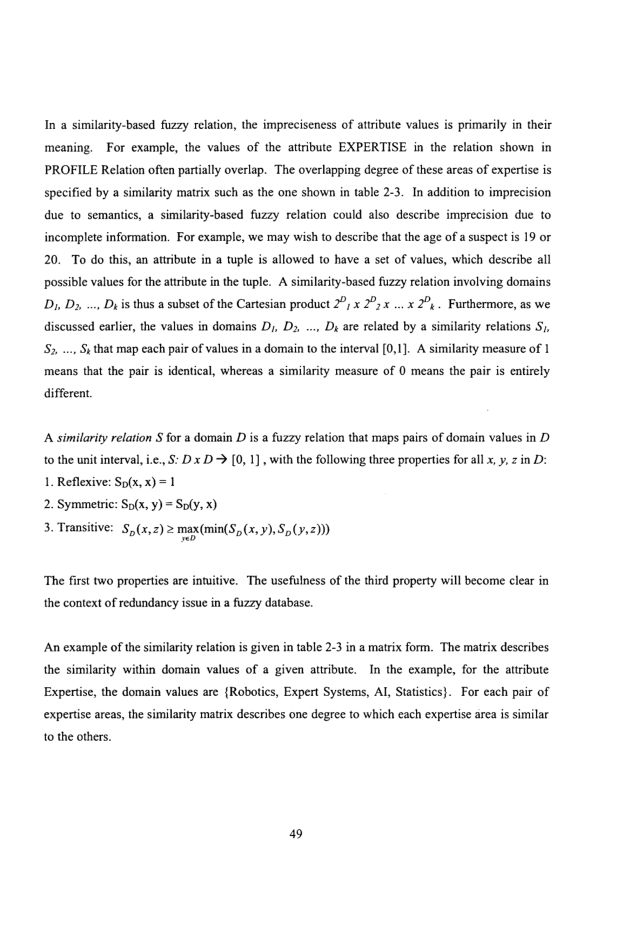
Source PDF · page 60 of 201Check original scan ↗
A similarity relation cannot be freely constructed. It has to satisfy the three properties listed
above. In fact, whenever we specify two different similarity measures s(x,y) and S(y,z) , the
similarity measure between x and z must be the smaller of S(x,y) and S(y,z).
2.10.4.4.3 Possibility-based Fuzzy Relations
The possibility-based approach is, as the name implies, based on the possibility distribution
theory. The possibility/necessity approach is more general than the similarity approach in the
sense that it handles all types of information. The similarity based approach uses domains with
discrete values. Even though an extension was added to it to handle the fuzzy number, the
similarity approach still heavily depends on discrete values.
A possibility-based fuzzy relation generalizes a relation by allowing the values of an attribute A
to be a possibility distribution Haw of the attribute's domain. Let Du D2, .... Dk be the attributes
of a fuzzy relation R. A tuple in a possibility-based fuzzy relation is denoted (v/, v2, .... v*)
where v/, v?, ..., vk are fuzzy subsets of D,, D2, .... Dk . The interest of such an approach is its
ability to represent, in a unified manner, precise values (singletons), NULL values, as well as
fuzzy values.
It should be noted that since the data are imprecise, then the result of the query will also be
imprecise. In theory, both possibility measures and necessity measures can be used for
processing queries in fuzzy databases. In practice, however, the necessity measures are rarely
used.
2.10.5 Case Acquisition
The cases for this thesis can be obtained from the existing student information database. As part
of creating the case base, it needs to be checked for accuracy and coverage. Some of the data
from the database may not be correct, so any “bad” cases that were created from incorrect data
50
View original scanned page
Source PDF · page 61 of 201Check original scan ↗
should be removed. It is recommended that the previous matches for all of the profiles that we
would want to match in the future are migrated. At this stage, we may have to manually check
for the accuracy by requesting help from expert advisors or devise an aid from rule-based
reasoning. In academic advisement, it is impossible to define a set of rules that is very accurate
in predicting the advice, but these rules can still point out the obviously correct cases. A set of
test rules can be used to point out cases where the advice does not match the student profile
within a set threshold, and then evaluate all of the cases with a large error by hand (or by expert
advisors).
2.10.6 Case Retrieval
This section describes a method to evaluate the quality of a specific matching algorithm. A
selection process that uses this method to evaluate an algorithm can be used to find the algorithm
that will reproduce sound advice and meet all of the desired attributes for the application of the
specified advice. Nearest neighbour retrieval is used. However, the nearest neighbour must be
determined by evaluating the degree of match in all of the attributes. This evaluation needs to
provide a consistent meaning of an attribute’s similarity throughout all attributes. Apart from the
preference in fields of interest, the consistency is achieved using fuzzy linguistic terms such as
Absolute, Partial, and Minimal (in Specialisation preference), and Difficult, Moderate, and Easy
(in Course’s Perceived Difficulty), which are associated with measured differences in an
attribute. Any number of linguistic terms can be used. A fuzzy preference function is used to
calculate the similarity of a single attribute of a case with the corresponding attribute of the
subject.
The fuzzy preference function may be further improved by using the difference in the values of
that attribute for the subject and comparable. For example, a difference of 1 unit would be
considered excellent, 2 would be good, 3 would be fair, and 4 would be poor. This rating is then
transformed into the fuzzy preference function.
The result of using fuzzy preference functions is a vector, called the fuzzy preference vector.
The vector contains a fuzzy preference value for each attribute. The values in this vector can be
51
View original scanned page
Source PDF · page 62 of 201Check original scan ↗
combined, through weighted aggregation, to produce a robust similarity value. The use of fuzzy
preference functions allows for smooth changes in the result when an attribute is changed, unlike
the large changes that are possible when step functions are used.
A fuzzy preference function is used to transform a quantifiable value for each attribute into a
qualitative description of the attribute that can be compared with the qualitative description of
other attributes. A fuzzy preference function allows a comparison of properties that are based on
entirely different scales, such as student’s GPA and the rate of success in a course. Based on
discussions with experts and work to classify previous matches into various sets of linguistic
terms, it was found that there was enough precision in the evaluation of the similarity of the
attributes to have four linguistic terms [44].
To assess the similarity of a problem case and a knowledge case, the similarities of all
corresponding parameter values are calculated by applying local similarity functions to each pair
of corresponding parameters. These local parameter similarities are then used to calculate an
overall similarity value for the two cases. From three aggregated attributes (derived from seven
raw measures) describing the cases, the preference in the fields of interest have complex
similarity measures that represent a part of customisation to support a student’s individuality.
The overall similarity is computed as the weighted average of the individual similarities. For our
initial testing purpose, the weight factor in the aggregated preference in the fields of interest is a
half, whereas the other attributes have a weight of a quarter each. The future improvement may
allow students to adjust them according to their priorities. The local similarities for discrete and
vector values are calculated in different ways. Discrete similarity measures can be defined
according to the fuzzy linguistic terms above.
2.10.6.1 Case Retrieval: Catalogue Search
Intelligent Catalogue Search can be incorporated into CBR in the Case Retrieval phase (or
similarity matching).
52
View original scanned page
Source PDF · page 63 of 201Check original scan ↗
Two techniques that may be applicable:
1. Parametric Search is common and often combined with keyword or stepwise
(hierarchical) searches to improve functionality. In this approach, the user enters one or
more values for attributes of the product. The attributes of the parameters can generally
be numeric or symbolic. A parametric search acts like a filter and is, in effect, the same
as a database query - it meets all of the search criteria exactly or it fails. Some parametric
search systems provide ranges and sets of values to overcome the limitations of the
database approach, but “No match found!” is still a common occurrence. Some
implementations of this approach use the product code and manufacturer’s code as the
parameters, meaning that the user must know the product he/she wants before starting the
search.
2. Another approach is the Nearest Neighbour method of searching, also called an
Intelligent Parametric Search. This approach is a key output from CBR research and is
the basis for the INRECA Catalogue Search applications (INRECA, 99). The
characteristics of the problem domain that make “nearest neighbour” so effective are as
follows:
o Student needs to search the knowledge base (a.k.a. product space) in its entirety
o Cases in the knowledge base will be similar in terms of their characteristics and
their structure
o Student generally does not need an exact match as each student’s profile is quite
individually unique - the optimum match will suffice
o Student needs the ability to negotiate with the search system
o No match found is an unacceptable outcome from a search
Human assessment of similarity or closeness is a normal thinking function and, in many cases,
an automatic one. Given that other constraints such as academic performance and program
structure do not hinder the request, an academic advisor interacting with a student in a real
scenario will not take the student’s requirements as absolute unless specifically requested to do.
The advisor will treat these requirements as a goal or ambition for the student, and will try to
establish the student’s priorities before making a recommendation. This allows the student to
53
View original scanned page
Source PDF · page 64 of 201Check original scan ↗
give a precise statement of requirements, but not have it interpreted as such. The intelligent
parametric search does exactly this, and uses weights to represent user priorities.
Retrieval is the essence of the CBR paradigm. Case retrieval consists of Identify Features,
Initial Match, Search, and Select (Weber-Lee et al., 1996). All of these subtasks are equally
important in order to perform an efficient case retrieval. The subtask Select chooses the solution
for the input case. The Select step may combine the cases returned by Initial Match and produce
the solution or simply choose the best match. Besides, when case retrieval is oriented by scores,
one needs to set a threshold to limit the amount of cases to be returned. This threshold
determines the domain of the Select subtask.
The selection of the best match may happen during the Initial Match step, but usually the Initial
Match returns a set of cases. However, there are other types of retrieval that search for matching
indexes, and the outcome of this retrieval can be of any size. The retrieval may yield either a
score meaning the degree of match or assign a yes or no to determine whether the case matches
sufficiently or not.
54
View original scanned page
Academic advisement
Source PDF · page 65 of 201Check original scan ↗
Chapter 3
Academic Advisement
In any academic program, one important staff role is to provide academic guidance to help
students progress in their academic careers with a minimum of difficulty. Staff who assume this
role are known as academic advisors, and usually have an in-depth knowledge of program
structures, as well as access to individual student academic records. Based on this information,
advisors can then provide useful academic advice to aid in a student’s academic pathway
selection or their future professional careers.
In the current information technology (IT) generation, many operations and processes have been
automated by computers. Academic advisement has the potential to migrate to this kind of
automation as well. In the author’s opinion, a future where students can obtain highly intelligent
academic advice over the Internet from comprehensive computer systems - without any human
intervention - is not farfetched.
To reach this goal, we have to concentrate on how to build intelligence and smartness into
computer systems. Human experts are able to perform at a high level because they know a great
deal about their areas of expertise. This simple, seemingly obvious observation is the underlying
rationale for the design of knowledge-based problem solvers. An expert system, as these
programs are often called, uses domain specific knowledge to provide “expert quality”
performance in a problem domain. Generally, expert system designers acquire this knowledge
with the help of human domain experts, and the system emulates their methodology and
performance. As with skilled humans, expert systems tend to be specialists, focusing on a
narrow set of problems. Like humans, their knowledge is also both theoretical and practical: the
human experts that provide the system’s knowledge have generally augmented their own
theoretical understanding of the problem domain with tricks, shortcuts, and heuristics for using
the knowledge they have gained through problem-solving experience. Unlike a human,
however, current programs cannot learn from their own experience: knowledge must be
55
View original scanned page
Source PDF · page 66 of 201Check original scan ↗
extracted from humans and encoded in a formal language. This is the major task facing
designers of knowledge intensive problem solvers.
3.1 The Problem
One educational application that seems highly amenable to the use of an expert system is
academic advisement. However, based upon a review of the literature published to date
(February 2003), it appears that few expert academic advisement systems exist. Yet, this
application is well within the scope of problems that expert systems are well suited to solve. No
detailed published account of an expert advisement system, which had been submitted for a
formal assessment of the quality of its output, was found.
3.2 Expert Advisor
An expert can be defined as an individual who is widely recognised as being able to solve a
particular type of problem that most other people cannot solve as efficiently or effectively [18].
Academic advisors have been perceived to possess differing degrees of effectiveness [19, 24,
40]. Experienced faculty and staff with prior experience in advising have been regarded as better
suited for this role than novices [28, 36]. Because different levels of competence exist within
this domain, it seems plausible that the most competent of the advisors could be considered
experts.
In contrast to some other domains, many aspects of expertise in academic advisement are related
to a thorough knowledge of a specific institution. Although global advisement principles and
practices exist [39], an academic advisor’s expertise is somewhat limited to a local institution. A
highly capable advisor in one setting could be incompetent in a different, autonomous institution
due to unfamiliarity with the school mission, curriculum requirements, articulation agreements,
institutional policies, and other related factors. Accordingly, the operational definition of an
expert academic advisor in this study was a faculty or staff member who was recognised by local
peers as being extraordinarily skilled in providing academic advisement to students.
56
View original scanned page
Source PDF · page 67 of 201Check original scan ↗
3.3 Existing advising practice
Many universities, especially in the United States, offer students one-to-one access to advisors;
in Australia, this is usually not the case. Different approaches have been developed to open up
different communication channels between advisors and students. Some provide advising via
email and assign each student to a specific advisor. Others develop an advising pool with one or
more advisors “on call” at any time to respond to students’ email questions. In some places,
advisors have established online chat rooms to provide opportunities for live or asynchronous
discussions of students’ questions.
3.3.1 Current Web-based advising systems
Universities have recently started to use the Web to help in advising. Although some only use
the Web to link to helpful sites or post the contact information of the advisors, an important trend
for using the Web in academic advising does exist. This section shows the advising tasks some
universities fulfil on the Web, and while they still have some limitations, these examples
demonstrate that Web-based advising is very popular these days. Some examples to be reviewed
are shown below.
North Dakota State University
('http://www.ndsu.nodak.edu/instruct/mcclean/ag www/advise.htm#usefuO
This is typical of the most common approach. North Dakota simply posts all requirements and
relevant information on the Web. Students still have to make their own decision on what courses
to take each semester. All general education and major requirements are defined clearly and
concisely on the Web.
INSITE (Indiana Student Information Transaction Environment), Indiana University
http://insite.indiana.edu/
INSITE is a Web-based service for Indiana University students, faculty, and staff. It provides
secure access to student information. For students, access to information is protected by a
Student ID number (SIDN) and PIN. The following information is available through INSITE:
57
View original scanned page
Source PDF · page 68 of 201Check original scan ↗
• Produce an advising report for a student’s current major
• Produce an advising report for a different major
• Produce an advising report for a special purpose program
• Produce an advising report for a program under development
• Produce an advising report for a special purpose program under development
• Generate a student transcript (course history)
• See how in-progress courses apply to a student’s advising report
Student Planning System - Brigham Young University
http://ar.bvu.edu/dept academ advise/sect3.htm
Academic Advisement at BYU combines the benefits of College Advisement Centres and other
academic services including the use of the AIM system, Advisement by Computer (ABC) report,
and faculty advising to provide direction and support to each student’s academic progress. These
resources are specifically geared towards addressing specific academic needs, and contribute to
the quality of each student’s overall university experience. Route Y is the BYU’s campus
intranet. It is designed to be a secure and personalised information source for current BYU
patrons. Patrons include current BYU students, faculty, and staff. To help monitor students’
general education and major progress, BYU has created the Advisement by Computer (ABC)
report. Students can view and print their ABC report by using the Route Y AIM system.
“PLANNER WEB”, California State University, Monterey Bay
http://csumb.edu/student/services/registration/
Planner Web for student advising is the first step in the Advising and Registration process for
continuing and newly admitted CSUMB students. All undergraduates and second BA/BS
candidates must submit their proposed schedule in order to register.
“Pre-major academic advising”, Duke University
http://pmac.aas.duke.edu/
The website doubles as a question site and an appointment site. Students can access advising
FAQs, and they can make appointments with their advisors.
58
View original scanned page

Source PDF · page 69 of 201Check original scan ↗
“Academic Advising Centre”, Western Washington University
http://www.acadweb.wwu.edu/advising/gur humanities.html
At West Washington University, academic advising is one of the most important services that
students receive. The process of academic advising is a shared responsibility where a student
works with faculty and staff academic advisers. Freshmen are assigned a faculty advisor at
orientation who serves until a major is declared.
“Advising Central”, North Carolina State University
http://www.ncsu.edu/advising central/advisers/preprof.html
Advising Central at NC State is designed to provide Web and Internet-based advising to NC
State undergraduate students. The goals of Advising Central are to:
• Make academic policies clear and meaningful for the students
• Help students navigate through NC State’s human resources to locate and secure advice
from the most knowledgeable person in a particular field or college, and help students
identify sources that will aid them in clarifying their academic direction and
strengthening their academic skills.
The above survey concluded that there are currently many universities with Web-based advising
systems at work. Most of the pages entitled, Web-based advising, are typically a bulletin board
with advising-related announcements, a repository of official documents in PDF or HTML
format, a collection of useful links that help students get official advising related information off
the Web, or a combination of these. They do not include any server-side scripts to process
specific student information or produce customised advice. Indiana University is an exception,
but the Web system is only for advisors to get their advisee’s information - it is not designed for
students.
3.4 Expert Systems and Academic Advisement
Educators have been comparatively slow in applying expert system technology to instructional
and management problems in schools [20]. Nevertheless, excitement about these systems has
59
View original scanned page
Source PDF · page 70 of 201Check original scan ↗
flourished in recent years, as it has in business and industry. The first reference to expert
systems in the Current Index to Journals in Education as a separate category appeared in 1983.
Other areas have been cited that are closely related to academic advisement, and have been
demonstrated to be suitable domains for expert systems. For example, at least three expert
systems have been developed for college admissions advisement [11, 13, 14]. The results from
their experience indicated that transcript evaluation and admissions counselling were appropriate
problem areas for expert systems. Edwards and Bader [11] concluded, “Expert systems have
been shown to be of value in the university undergraduate-admissions process, by improving the
consistency of decisions and reducing the workload of both the admissions tutor and the
admissions assistant.”
Another area closely related to academic advisement is the identification of “high-risk students”
[41]. The Dallas Community College District developed an expert system in the student support
area called the Computer Analysis System for Educational Success (CASES). The CASES
system provided an important ancillary function for the academic advisor. CASES had the
ability to analyse the records of all students and, based on a set of indicators, identify students
who could benefit from a variety of student support services. Data was input from a scan-form
and, in seconds, CASES printed a specific report on each student. Advisors were then able to
utilise the research and recommendations provided by CASES to offer more intelligent guidance
for the student. The developers indicated that they planned to incorporate articulation
information and degree planning into CASES later.
Although this has shown that computers have been used to assist advisement for nearly 30 years,
the use of expert systems in this specific domain is a unique and recent phenomenon. At the
beginning of the last decade, there were only a few examples of the direct application of expert
systems to academic advisement.
The earliest examples of expert academic advisement systems were published in 1984. The
Graduate Course Adviser (GCA) was an expert system that simulated “a faculty adviser in
suggesting the schedule of courses offered by the Department of Computer Science at Duke
University” [43]. The GCA system apparently “knew” about computer science courses, degree
60
View original scanned page
Source PDF · page 71 of 201Check original scan ↗
requirements, and departmental regulations at Duke. At the time of publication in 1984, the
GCA had advised students on an experimental basis for two semesters. Technically, GCA was
based upon MYCIN, written in the Prolog programming language, comprised 400 production
rules, and was implemented in four modules. It is significant that the GCA researchers
recognised that advisement was a complex task that involved both diagnostic and planning skills.
A monolithic structure was inadequate to solve such a problem. Two of the GCA modules were
required to determine the needs of the student, while the other two modules planned the student’s
schedule.
Another advisement tool was developed at Simon Fraser University in 1984 [8]. The Automated
Academic Advisor (AAA) was described as “a large practical artificial intelligence system”.
AAA was designed to offer faculty, students, and academic advisors accurate information on
degree requirements and course offerings. AAA was unique in that the performance of this
system was to be evaluated by an automatic and interactive subsystem that would gather users’
evaluation data as the application was running. The emphasis of the evaluation was placed on
the system’s general acceptability, rather than on a more traditional performance measurement
criterion. The researchers concluded, “Much work remains to be done before a robust prototype
can be tested by students, faculty, and academic advisors.” This system appeared to be very
promising, but no further reference to AAA can be found.
A later instance of an expert system used for academic advisement was described by Chan and
Cochran [9]. They described a program called the Graduate Student Advisor (GSA) at Arizona
State University. The GSA was used to help industrial engineering students get answers to
routine questions about academic matters. The program was a rule-based system implemented in
Personal Consultant, a pre-programmed expert system shell for personal computers. More than
100 rules were contained in the GSA. It was divided into four modules:
• Requirements for an M.S. or Ph.D. program
• Options for major fields of study and associated course and research structures
• Information on available courses
• Information on the faculty
61
View original scanned page
Source PDF · page 72 of 201Check original scan ↗
In their article, Chan and Cochran argued for using expert system shells to implement such
programs rather than using expert system languages like LISP or Prolog. They claimed the GSA
not only helped graduate students, but also used the advisors’ time more efficiently. “The
system has proved successful in a university administration environment, and may benefit other
organizations since the method is not necessarily limited to advising graduate students” [9],
Another example of an expert advisement system was created at the University of Arkansas to
advise computer science majors [15]. This system, called Mentor-I, was an experimental
prototype that contained expert knowledge embodied in rules. The rules were used to suggest
the number of hours and courses to take to satisfy college degree requirements. Additional
expertise was contained in Mentor-I in the form of suggestions for elective courses based on
student interests and career goals. Like the earlier GCA system, Mentor-I was both a diagnostic
and planning system and it was implemented in four modular components. Two diagnostic
components were implemented in the Personal Consultant expert system shell. C-Prolog was
used to create the other two planning modules. Although very few details were provided in the
report by Frank, Duffield, and Swearingen [15], an evaluation of Mentor-I had yielded positive
results. In two informal evaluations, Mentor-Ts output was comparable to human advisors’
advice in over 65% of the cases. At the time of their report in 1988, the authors had begun
implementing a second system (Mentor-II), which would be generalised for the entire college.
Several expert systems were applied to tasks closely related to academic advisement, including
the selection of college admission candidates, transcript evaluation, and the identification of
high-risk students.
3.5 Degree Audits
Simply stated, an automated degree audit matches completed coursework with sets of degree-
program requirements, tracking student academic progress from the declaration of a major to the
completion of a degree. In addition to assessing the progress of completed coursework, the
system applies various university policies and regulations - such as those related to residency,
course repetition, and pass-fail - in an automated fashion, negating the need for advisors to
62
View original scanned page
Source PDF · page 73 of 201Check original scan ↗
intervene manually. Furthermore, some degree-audit systems equate transfer credit to local
institution courses and provide for exception record data (course substitutions, waivers, and
individualised requirements).
Automated degree audits have become prevalent in colleges and universities in the past decade,
but they had their beginning in the early 1960s with the “Bingo Sheet” created at Purdue
University. In 1968, Georgia State University introduced its Programmed Academic Curriculum
Evaluation (PACE) degree audit, followed by North Carolina State’s table-driven system in the
early 1970s. Brigham Young University released its Advising by Computer reporting system in
1978, and Miami University (Ohio) implemented its Degree Audit Reporting System in 1984
[30]. Other institutions that subsequently developed degree-audit systems on their respective
campuses include Southern Methodist University, Texas A & M University, and Clemson
University.
Because of the potential profitability of degree-audit systems, several software firms entered the
marketplace, some with a degree-audit module incorporated within a student information
software package. Among these corporate vendors are Campus America, CARS Information
Systems, Computer Management & Development Services, Computing Options Company,
Datatel, Degree Navigator, Iron Soft, Peoplesoft, Quodata Corporation, Software Research
Northwest, and SCT Corporation [30].
According to the most recent ACT survey on academic advising, 48% of faculty advisors among
departmentally based advising units are routinely provided with computerised degree audits as
informational reference materials. Similarly, 31% of advisors of centralised advising units are
routinely offered degree audits as an academic reference [17].
Because the academic advisor is frequently the university official who interprets complex
academic requirements, enforces a multiplicity of academic policies and regulations, and
communicates changes to academic programs, it is crucial that the degree-audit system be
capable of executing many diverse transactions. Using the degree-audit system enables
institutions to achieve many vital and important objectives.
63
View original scanned page
Source PDF · page 74 of 201Check original scan ↗
First and foremost, a properly developed and implemented audit system can significantly reduce
the amount of advisor time expended in the clerical duties typically associated with the advising
enterprise. The degree audit accurately reports student progress towards the completion of
degree requirements, and does so comprehensively, consistently, and in a timely manner. These
systems provide for instant feedback from clientele, whether the users are students, faculty,
administrators, or support personnel. Degree audits enhance advisor morale and effectiveness by
reducing the likelihood of litigation typically associated with advising, and by virtually
eliminating perfunctory and redundant record keeping chores. In addition, degree audits can
provide a comfortable academic environment for students by clearly and concisely reporting
their progress toward graduation, proper course choices, and minimum grade point average
stipulations.
Some degree-audit systems have the capacity to support tasks peripheral to typical advising
functions. In some institutions, degree-audit systems assist with the management of course
offerings, monitor “four-year guarantee” compacts, evaluate academic honours (cum laude,
summa cum laude, magna cum laude, Phi Beta Kappa), and execute the complex National
Collegiate Athletic Association (NCAA) Division 1 and 2 Continuing Academic Eligibility
Compliance Checks. Many degree-audit systems improve the accuracy of some transcript
information, especially with cross-listed courses and converted courses (for which the prefix or
number has been changed), as well as course repetition policies.
Finally, these systems provide a fiscally prudent way to accomplish vital and necessary advising
tasks. Reducing the labour-intensive aspects of the advising function by using an effective and
efficient degree-audit system demonstrates fiscal responsibility in an era of constrained budgets
and downsized operations [30].
In order for degree audits to be of paramount support for academic advising, the systems must
posses a large number of diversified features. These features, when invoked with little or no
manual intervention, save students and advisors time in monitoring academic progress and
interpreting academic policies. One mandatory feature permits students to shop for alternative
64
View original scanned page
Source PDF · page 75 of 201Check original scan ↗
curricular choices. This “major-shopping” feature particularly assists students who have not yet
decided on an educational program, as well as those who wish to supplement a major with a
minor, option, or a specialisation area.
The audit should be available to clients in both online and batch modes, and it should reflect real
time data. Audits produced via batch runs and distributed to students later may not reflect data
that has changed since the initial run. Thus, it is imperative that an online system providing up-
to-the-minute information be available to the advisor.
Degree audits assess degree program progress by evaluating courses according to the number of
courses completed, the number of credit hours completed, the minimum grade earned, the
minimum grade point average achieved, and the best grades earned from a group of courses used
to satisfy a requirement. The system must correctly identify cross-listed courses, repeated
courses, repeatable courses, and converted courses, and apply them appropriately to each
requirement without manual intervention by the advisor or a school official.
All components of a degree program must be clearly identified and monitored correctly.
University requirements (such as minimum credit hours, minimum grade point average, and
residency policies), as well as general education, upper or lower-division, college- or
department-specific, professional school (licensure), and major and minor requirements must be
evaluated collectively and correctly.
A critical feature of a computer assisted advising degree-audit system is the treatment of
individual exceptions such as courses substitutions, course or credit-hour waivers, and so forth.
Caution should be exercised when making exceptions and exception-tracking procedures must be
in place to ensure the academic integrity of the report.
Few individuals other than advisors recognise that two types of course substitution exceptions -
global and individual - exist. A global course substitution treats the substituted course in the
same manner every time the course appears on the audit. An individual course substitution
65
View original scanned page

Source PDF · page 76 of 201Check original scan ↗
permits a course to be substituted only once. Security is the primary issue with exceptions, and
external as well as internal auditing of exception entries is necessary.
By providing accurate and comprehensive curricular information, the degree audit supports
academic advising. It promotes a feeling of ownership in the student and requires the student to
engage in decision-making activities. It relieves the advisor of record keeping duties so that
appropriate time can be expended assisting the student with the developmental aspects of
academic advising.
3.5.1 PeopleSoft Academic Advisement
Academic Advisement is the application within PeopleSoft Student Administration that is used
to track the requirements and policies that a student must satisfy in order to graduate. As a
student progresses towards graduation, Academic Advisement analyses those courses completed
by the student - both successfully and unsuccessfully - and ascertains what requirements are still
outstanding. Using data from student records and requirements, the application automatically
tracks a student's degree progress. Once the requirements are entered into the system, the
student's data is analysed against the requirements to report the degree progress. What-if
scenarios can also be performed for the student to see what courses they might need to complete
for a particular major.
3.6 Technology in the Self-Help Advising Age
In the Information and Learning Ages, we have been discovering new ways to access
information and services. In a sense, technology is providing a tool that fosters the
developmental advising process and promotes students’ responsibility for their academic careers.
Through technology, academic advising information and services are readily available at any
time, any pace, and any place. Students are becoming better informed about basic academic
information, and thus advisors have the opportunity to provide more detailed, in-depth advising
when they meet face-to-face with students.
66
View original scanned page
Source PDF · page 77 of 201Check original scan ↗
3.6.1 World Wide Web
The most active and prolific use of technology to deliver academic advising is through the World
Wide Web (WWW). Some features are listed as below.
3.6.1.1 Basic Services - Text Information
Basic text information includes:
• Policies and procedures
• Frequently asked questions
• Address, building location, room number
• Phone numbers
• Hours of operation
• Name and/or e-mail contact
• Links to other resources
• Assessment or practice tests
3.6.1.2 Midlevel Services
Mid-level services include:
• Online forms - applications and requests for information
• Search capability
• Order forms (such as for textbooks)
• Audio and/or video
3.6.1.3 Advance-Level Services
Advance-level services include:
• Web registration
• Degree audit
• Schedule planner
67
View original scanned page
Source PDF · page 78 of 201Check original scan ↗
• Articulation and transfer evaluation
• Access to student records and profiles
• Grade point average calculator
• Interactivity with student profile
• Artificial intelligence
Advising through the WWW is self-help advising. Students may interact with databases and
their personal profiles, but there is no one-to-one interaction. Most higher education institutions
have WWW home pages that provide at least basic information about the institution. College
catalogues, schedules of classes, policies and procedures, addresses, phone numbers, and so on
are readily available at the click of a mouse. Institutions that have the resources are developing
interactive web pages. Online applications, request forms, and the capability to search for
information are appearing on more college websites. The most sophisticated college web pages
provide online registration, degree audits, electronic evaluation for articulation, schedule
planners, grade point average calculators, and artificial intelligence, all based on a student’s
personal profile.
Anyone who has been on the Web has found a plethora of easily accessible and readily available
information. Yet, many have also gotten lost as they wander around the Web. Looking for
information and not finding it can be time consuming and frustrating. To make the search for
academic advising information and services more convenient, colleges are creating virtual
advising centres. A virtual advising centre is a central point of electronic access for advising
services and information. Web links both within and outside the college are organised so that
students and advisors can quickly find information about student services.
Virtual kiosks are another way of providing academic advising information. Virtual kiosks are
touch-screen information centres that integrate access to the Web with text or multimedia
information stored on the local computer’s hard drive. Virtual kiosks are centrally located where
students gather, such as campus student centres. Sophisticated virtual kiosks and virtual advising
centres enable interactivity with the college’s databases, allowing students to register for classes,
calculate degree audits, and change personal information.
68
View original scanned page
Source PDF · page 79 of 201Check original scan ↗
3.6.2 Advising over the Internet
In addition to obtaining advising services over the Web, students can also find listservs, e-mail
newsletters, and electronic bulletin boards on the Internet. Listservs and e-mail newsletters are
accessed via e-mail accounts and do not require web browsers. Advisors can mass distribute
information about upcoming events, calendar deadlines, and other timely titbits. E-mail
newsletters can provide students with helpful articles, including study hints, note-taking guides,
and test tips. Listservs provide students with opportunities for interchange with other students
and college staff. Lively discussions on hot topics can provide a sense of group connectedness.
Electronic bulletin boards provide students with a means of viewing announcements and posting
messages. Examples of the innovative use of advising on the Internet can be found at Academic
Advising Resources on the Internet (http://www.psu.edu/dus/ncta/linkacad.htm).
3.7 Internet-based expert system for selecting an
academic major
In the late 1990s, Fritz H. Grupe [16] developed an Internet-based expert system
(http://www.MyMaiors.com/), which provides advice to high school students or college
freshman seeking assistance in selecting a potential major. It emulates a professional academic
advisor. The on-demand, approximately 15-minute consultation gathers information from the
student on his or her grades, degree of enjoyment of traditional courses, standardised test scores,
interests, and aptitudes. It assesses student qualifications for a variety of majors. The expert
system recommends six majors from among 60 widely diverse majors for the students to
consider, and produces a report that fully describes the students’ responses in such a way that the
output can be used by a human advisor to further extend and strengthen the advisement process.
However, this system was not designed to advise on the list of subjects that students should enrol
in, and the system has been implemented using Rule-Based Reasoning as the main expert system
technique.
69
View original scanned page
Applying CBR to automate academic advisement
Source PDF · page 80 of 201Check original scan ↗
Chapter 4
Applying CBR to automate Academic
Advisement
4.1 Needs for Automated Academic Advising
4.1.1 The Role of Technology in Higher Education
Technology has clearly been the primary transforming factor as we move into a post-industrial
society. In industry, technology accounts for much of the impetus to downsize firms, the
popularity of outsourcing, the surge in value-adding partnerships, and for the flattening of
hierarchies [33]. Modem information technology has dramatically changed the way scholars and
students access information in higher education, and it is beginning to alter current forms of
teaching and learning. Faculty and students were traditionally bound to the physical space of
universities because libraries were the central depositories of information. Information
technology now allows universities to shift from investing in the physical storage of information
to creating electronic databases. Ready access to discipline-based information through electronic
means increasingly frees scholars and students from the limitations of physical space and time.
Faculty can now easily interact with their colleagues at distant places and pursue their research in
a global environment.
In the future, technology will also dramatically change the delivery of instruction and the way
students learn. Instead of coming to a campus, students will have access to a wide variety of
electronic curricula. They will be able to communicate electronically with their tutors and learn
by utilising interactive reading materials and study exercises [29, 31]. Distance learners will be
credentialed through the competency-based certification of degrees. For-profit organisations are
expected to take the lead in providing electronic educational programs, and this will increase the
latitude available to students as they choose their educational paths. Electronic curricula will be
70
View original scanned page
Source PDF · page 81 of 201Check original scan ↗
especially appealing to the growing number of students who, because of work-related factors or
family commitments, cannot pursue a traditional, campus-based education [31].
Cost reduction is one of the primary reasons that traditional and for-profit institutions of higher
education are interested in moving into the electronic education market. After the initial
investment in hardware and software and the creation of electronic curricula, courses and
programs are accessible to thousands of students around the world for relatively small further
investments.
4.1.2 Strategies for Addressing Resource Constraints
Over the next decade, higher education institutions will continue to experience declining
resources, making staff additions in advising offices unlikely. At the same time, undergraduate
enrolments are expected to increase. As a result, advisors will be called on to serve larger
numbers of students with existing or, in some cases, even reduced resources. The obvious
challenge is to advise more students with no additional staff while maintaining high quality
services. Reconciling these seemingly contradictory goals will require advisors to seriously
examine their traditional ways of doing business - the current advising structure and practices -
and identify strategies for increasing efficiency. These demands closely resemble the recent
experience of Australian businesses that have had to reinvent themselves through rethinking and
restructuring their business practices in order to function effectively in changed circumstances.
4.1.3 Non-traditional Access to Advising Services
Diversity with respect to race, ethnicity, age, and purpose makes it essential for advisors to
design programs and services directed to the differing needs of their clientele. They must also
consider their availability to provide that advice. Many students with full-time jobs can take
classes only in the evening and advising offices are often closed at that time. In addition, with
the expansion of coursework and degree programs that are delivered electronically, an increasing
proportion of students will rarely set foot on a campus. Those students will come to expect that
their advising needs will also be met in non-traditional ways.
71
View original scanned page
Source PDF · page 82 of 201Check original scan ↗
Current practices in business and health care provide some idea of how these new advising needs
might be met. Interactive electronic conference sessions are already employed in industry
because they are convenient and cost effective. For example, nursing services to elderly
outpatients are delivered in some locations through electronic interactivity, allowing both parties
to see each other on a monitor. This technology can increase the contact between nurses and
patients, as well as increase the number of patients served because of the substantial savings in
travel time. In turn, the elderly are able to continue living independently, which many want to do
as long as possible [21].
The same technology will allow universities to provide electronic advising services. Even now,
students on many campuses have ready access to their academic records, automated degree-audit
reports, and web pages that provide important academic information. These provide the high-
tech, but not the “high-touch” aspect that comes with individual guidance by an academic
advisor. However, it is also true that advisors increasingly use e-mail to assist students who
cannot come to campus. Interactive electronic advising sessions in which advisors sit in their
offices and can see their distant students on a video screen are well within our current technical
capacity, and will be conducive to an educational environment where a substantial number of
students find it inconvenient or impossible to come to a campus. The marriage of high-tech and
high-touch may provide the setting for enhanced efficiency without the loss of the human
relationships and expert guidance that is important for students who present complex educational
issues. For example, Rio Hondo Community College in Whittier, California
(http://www.riohondo.edu/students/counseling/) has already pioneered a video advising program
for high school students in the Southern Los Angeles area. College counsellors use interactive
video technology to advise high school students in real-time, answering their questions about
admission, registration, academic programs, and careers.
72
View original scanned page
Source PDF · page 83 of 201Check original scan ↗
4.13.1 Subjective needs of students
If students can be thought of as customers of a technical support service [21], student
requirements are relatively clear:
• Students want advice according to their academic profile and preference
• If students ask to consult an academic advisor or a CBR system counterpart, either
directly or indirectly, they expect advice. If students do not get sound advice based on
their circumstances, they get an impression of incompetence, either of the advisor or the
CBR system
• Students want satisfactory advice for their academic profile and preference
• Obviously, students are additionally interested in getting sound or satisfying advice. It
might not be necessary to provide the most satisfying advice, but it is essential to offer
satisfying or relatively suitable advice
• Students want fast advice to their academic profile and preference
• During enrolment/re-enrolment, students are impatient and want advice fast. Although
some student cases may be deemed higher priority (e.g., international students may get
deported if they fail to fulfil the Department of Immigration and Multicultural &
Indigenous Affairs (DIMIA) requirement of full-time study load), students perceive their
own case as the most important and urgent case
• Students want confident advices to their academic profile and preference
• In addition to satisfying and fast advice, students often expect the advisor has a high level
of confidence in their given advice. They insist that the first advice is suitable.
Alternatively, if the advisor is not able to provide satisfying advice, students want to be
confident that the advisors are in no doubt of their decisions
73
View original scanned page
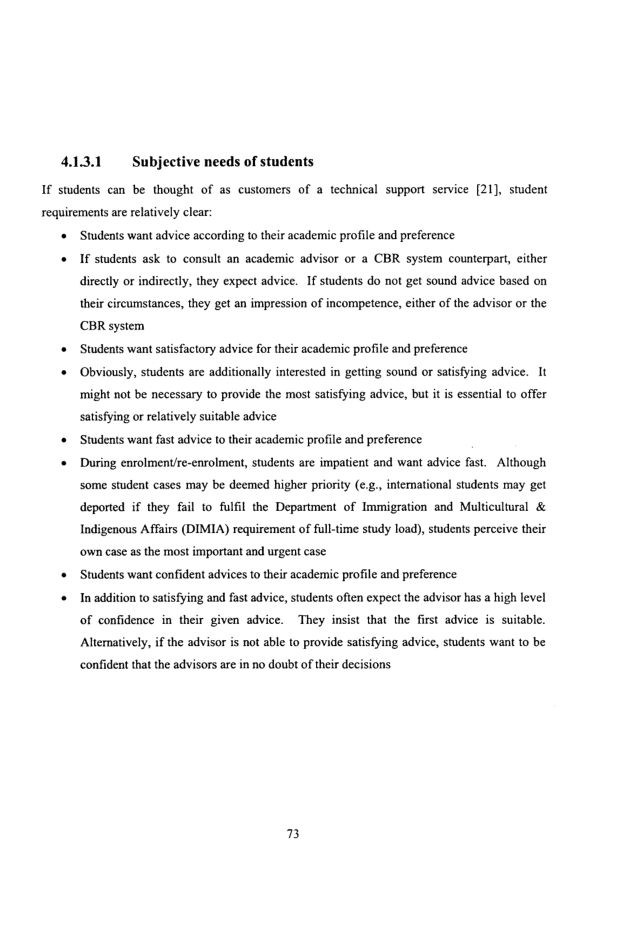
Source PDF · page 84 of 201Check original scan ↗
4.2 RMIT and Different Perspectives Approach
At RMIT, the term “program” or, more specifically, “academic program” refers to a program of
study leading to the award of a degree or certificate. The term “course” refers to a unit of study,
often called in Australia a “subject” or “unit”. RMIT grade systems classify five grades, in order
of highest achievement, as follows: High Distinction (HD), Distinction (DI), Credit (CR), Pass
(PA), and Fail (NN).
In the School of Electrical and Computer Engineering (ECE) at RMIT, the multi-major program
concurrently consists of five engineering majors: Communications (CO), Computer Systems
(CSE), Electronics (EL), Electrical (EE), and Software Systems Engineering (SSE). The
students study a common 1st year and start branching out via their choices of electives from the
2nd year onwards.
4.2.1 A review of program structure
Courses are placed into blocks, depending on their fields and whether they are compulsory or
elective. This block structure enables they easy tracking of student progress towards the
fulfilment of program requirements and program completion.
The normal load for each year is 96 credit points for full-time students. Given that most courses
carry 12 credit points, this equates to eight courses per year or four courses per semester under
normal circumstances. Overloading courses must be approved by authoritative program
coordinators (which is essentially an RMIT role for academic advisors).
74
View original scanned page
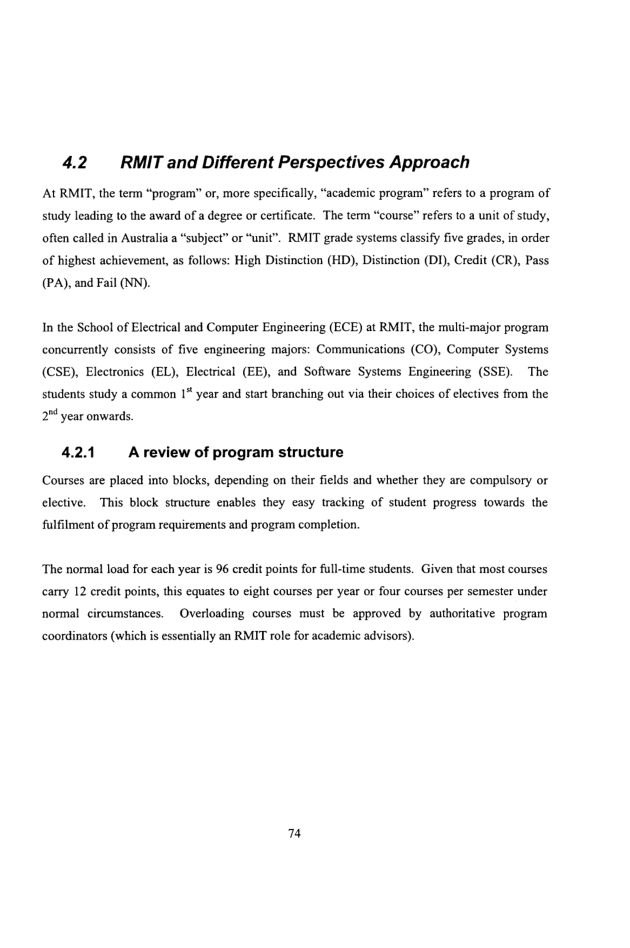
Source PDF · page 85 of 201Check original scan ↗
4.2.1.1 1st year
Every student shares a common 1st year structure and every course is compulsory:
• Core engineering foundation courses
• Mathematics
• Physics
• Design course
4.2.1.2 2nd year
Students begin to narrow towards a specialisation by selecting compulsory electives from two
streams:
• Design course
• Mathematics
• Core engineering foundation courses
• Compulsory technical electives (chosen from two out of four streams)
• Free elective
4.2.1.3 3rd year
Students decide on which of the two streams will be their major for the degree outcome. From
this year onwards, specialisation within majors becomes possible:
• Professional practice courses
• Core technical courses (based on the stream of preference)
• Technical electives (from other streams, effectively a minor if chosen wisely from the
same stream)
• Free elective
75
View original scanned page
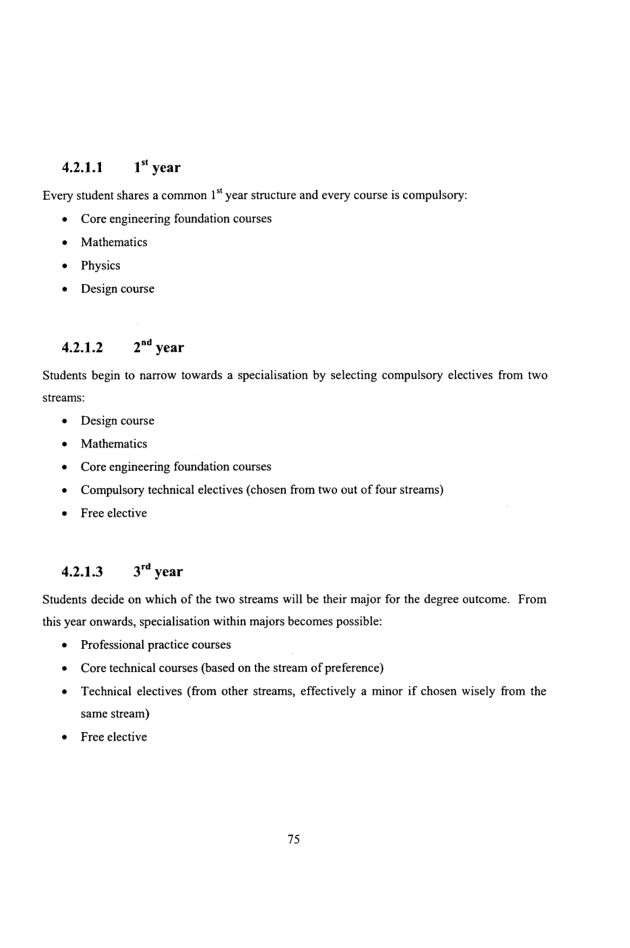
Source PDF · page 86 of 201Check original scan ↗
4.2.1.4 4th year
Most courses in this year will be electives from within their major, and students can choose to
specialise in one area or to spread their electives across other relevant fields to gain broader
knowledge, rather than depth:
• Vacation employment
• Design courses
• Stream technical electives
• Business elective
• Other stream technical elective
• Free elective
4.2.2 Governing Rules (applicable to all courses)
There are four governing rules as follows:
Students should finish within a minimum time of four years
Normal load per year is 96 credit points, or four courses per semester. Overloading or over
enrolling requires approval from the relevant authority
Students must fulfil corresponding prerequisites before being permitted to enrol in each course
Failed compulsory courses must be repeated and have the higher priority than other courses
(compulsory or elective)
4.3 Aiding in electives selection
Choosing electives can be daunting because the decision making process is often based on many
influencing factors. This is the characteristic of the problem that is most suitable for CBR.
As a proof of concept, CBR will be applied in the prototype system to recommend elective
selections based on some influential factors. Please note that the elective structure used is a “cut
down” version and does not reflect the full complexity of the actual program structure.
76
View original scanned page
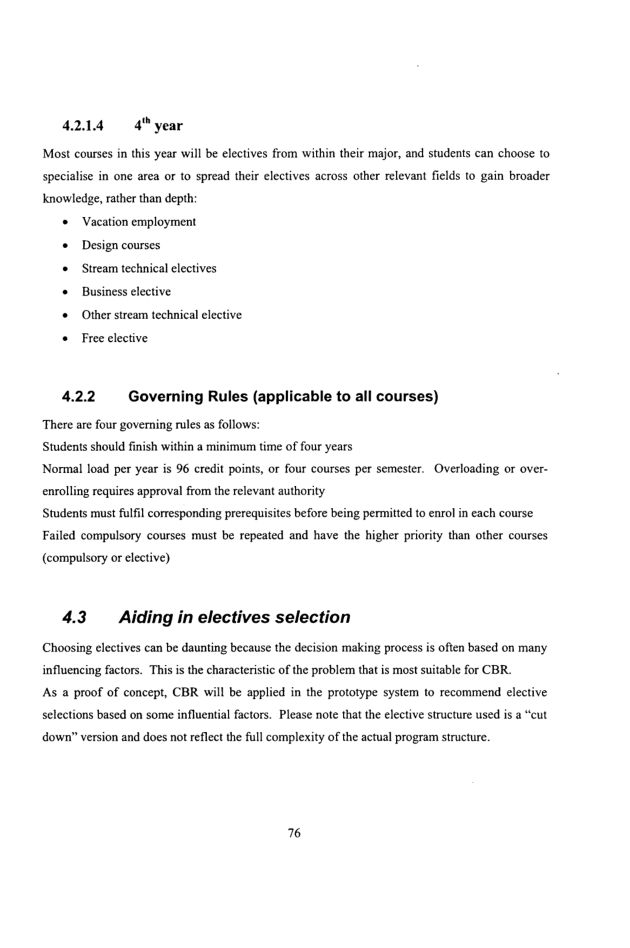
Source PDF · page 87 of 201Check original scan ↗
4.3.1 Why select electives?
According to http://web.mit.edu/catalogue/ch3-maior.html:
“Electives can be used for several different purposes. For example, many students who are
undecided about their eventual majors will use some part of their elective time to get more
information about the various departments or fields they are considering. Students more certain
of their professional goals will use electives to explore areas of secondary interest. Still other
students will choose to begin work on departmental or General Institute Requirements, deferring
subjects of a more supplemental nature until a later year.”
According to http://www.umass.edu/larp/AcademicPrograms/mlaelectives.html:
“Some students may wish to select electives in several of these areas to broaden their education.
Others may wish to take several of these electives in one of the concentrations, to develop a
special strength in a given concentration.”
The CBR system can be most useful when aiding students to select their final year electives or
free electives. As per stream electives, the system may be more complex since a hybrid model
between RBR and CBR may be required.
77
View original scanned page
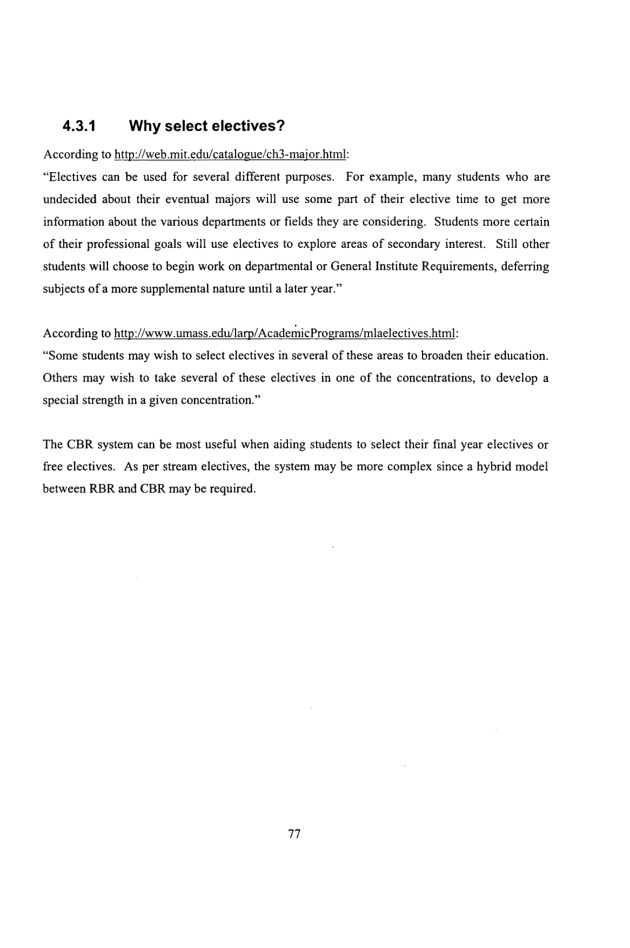
Source PDF · page 88 of 201Check original scan ↗
4.3.1.1 Decision Influences
The following factors usually affect a student’s individual decision when selecting electives:
• Personal interest (e.g., fields of expertise/specialisation/concentration)
• Peer preference, popularity (e.g., can be measured by the number or percentage of
students enrolled in any given year)
• Perceived degree of difficulty (e.g., word of mouth from peers or the program
coordinator). This can also be measured by either the pass rate or chance of getting a
good grade (course may be easier to pass but not to get HD). Thus, this degree will vary
according to a student’s individual profile
• Relevance to the current job market or industry demand
• Reputation of the lecturers - teaching and in-charge (e.g., expertise in the field of the
course, past history in teaching/assessment difficulty, presentation skills)
• Type of assessment (e.g., no exam?)
• Student’s personality (e.g., expert in a particular field, or an all-rounder with broad
general knowledge in many fields)
4.3.1.2 Factors Quantification
To construct a test case structure to reflect the above factors, each factor can be quantified as
follows:
• Personal interest: DSP (1), Mobile Comm. (2), Power (3), ^Controller (4),
Internetworking (5), Software (6)
• Popularity: this can be calculated from either the figures of the previous year or a pre-re
enrolment survey (which students must complete before the re-enrolment period).
• Both the pass rate and High Distinction (HD) rate should be calculated from the previous
year and stored as two separate sub-attributes.
• In collaboration with the Careers and Employment Service, job market trends should be
researched and manually entered before the re-enrolment period. The attribute values
78
View original scanned page
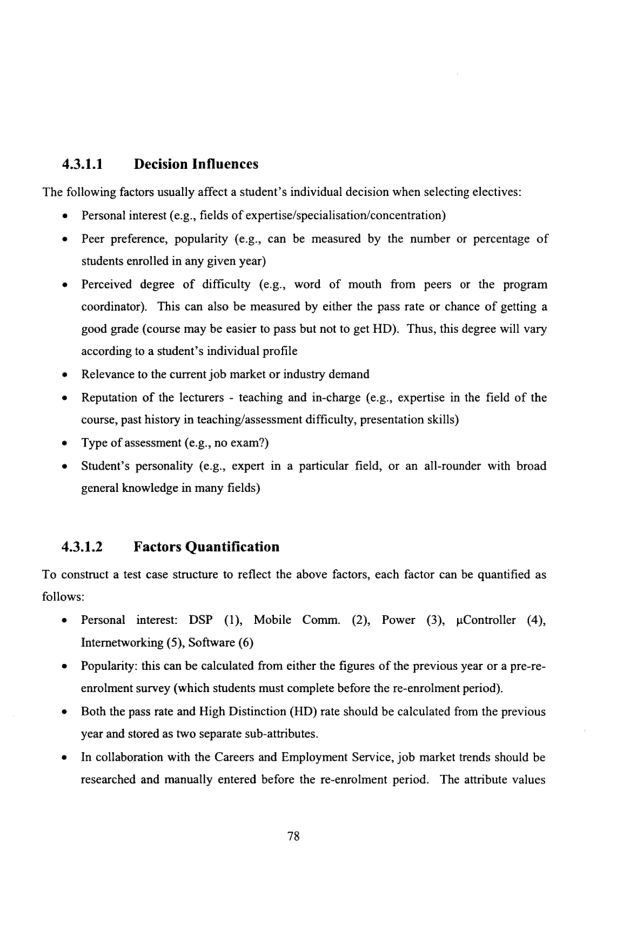
Source PDF · page 89 of 201Check original scan ↗
should be the same as or similar to those of “Personal interest”, with associated ranking
based on industry demand.
• Reputation of lecturers: sub-attributes can be grouped as either a factual (calculated or
obtained from other databases) or an opinionated (derived from student survey results in
previous years) type. An example of factual sub-attributes is the number of year since
teaching the first class or a particular course. Examples of opinionated sub-attributes are
field expertise, presentation skills, and tendency towards difficult assessments.
• Type of assessment: have exam/no exam (E1/E0), number of assignments (e.g., A= 0 -
4).
• Individual personality: student prefers to have broadened general knowledge in
diversified fields, or to become an expert in a specific field (broad/expert).
One option, at the re-enrolment session, is for the Conversational CBR (CCBR) system to ask
students a set of questions to determine the values of these attributes. These values will form a
problem case. In turn, this problem case will be matched with the CBR knowledgebase, in
which the same indices and data structure are implemented. “Index Structures for Data
Warehouses” by Marcus Jurgens, LNCS 1859, provides a good pointer for this process.
4.4 Indexing Cases
The INRECA developers found that a flat structure is sufficient to meet the search needs of most
end-users. By flat, it means that all attributes of the student case of interest are used to describe
every student case in the knowledge base. The alternative to a flat structure is an object
structure. For an academic advice case, an object structure might see its attributes as fields of
[interest, academic performance, or specialisation preference], where the fields of interest would
contain the preference order of [DSP, fibre optics, microwave, networking, satellite, etc.], and
academic performance would contain (GPA, WAM, peer ranking, etc.), while a flat structure
would contain [DSP, fibre optics, microwave, networking, satellite, GPA, WAM, peer ranking,
etc.], all at the same level. The object model allows us to describe a structure for a more
complex advice case representation. However, an object model structure may require a more
complex interface for the student and this, unless necessary, should be avoided. A flat
79
View original scanned page
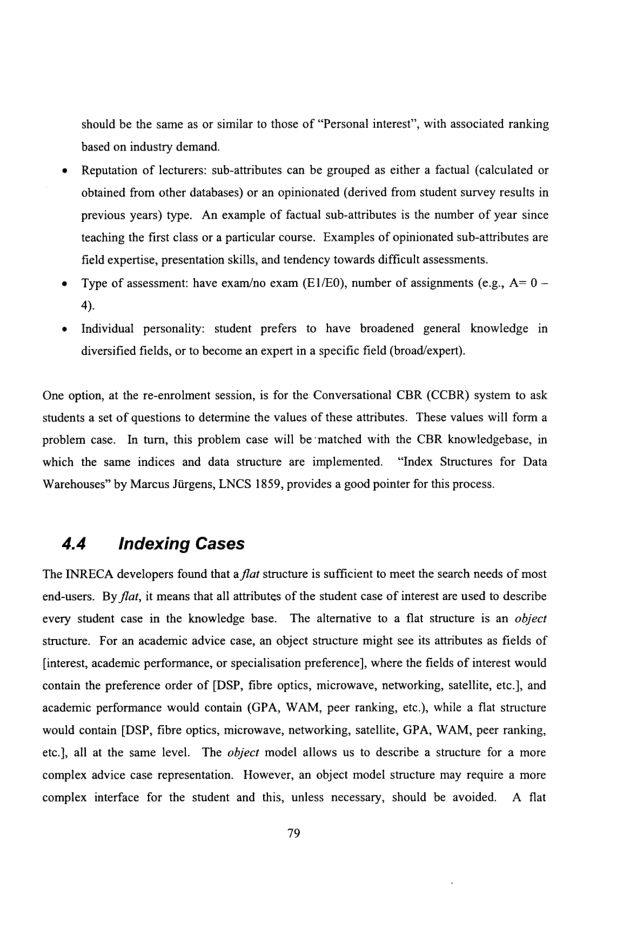
Source PDF · page 90 of 201Check original scan ↗
representation can simplify the student’s view of the catalogue search and, in most cases, give
the same level of functionality as the object representation. A flat model can also be stored
easily in a standard database system, of which many are available.
In order for the case-based reasoner to retrieve “similar” cases, labels (known as indexes) must
be assigned to a case to “identify” it as an appropriate case to be retrieved given a particular
student’s circumstances. Hence, indexes signify which cases are relevant (i.e., useful) and are
potentially able to provide academic advice to a student case. Deciding on the appropriate index
requires a good understanding of the academic advisement domain and the advice-giving goal.
Since indexes represent an interpretation of a student’s circumstances, a good index (appropriate
for the advice-giving situation) would allow relevant cases (with potential solutions) to be
retrieved quickly and accurately. However, choosing a good index may not be so simple since
there are no guidelines or established methods that exist for choosing good indexes.
4.4.1 Four qualities of good indexes
As a guide, there are four qualities of good indexes (Kolodner, 1993) described below.
4.4.1.1 Predictive features
Indexes should address the advice-giving goal of the cases. In the author’s prototype system, the
chosen indexes are fields of interest (INT), specialisation characteristics (CHRT), and previous
academic performance (PRFM). At the most basic level, these three indexes describe a student’s
circumstances.
4.4.1.2 Abstractness of indexes
Indexes should be abstract enough so that a case can be used in a variety of future situations. As
a proof of concept in the prototype system, the three indexes (INT, CHRT, PRFM) have been
chosen so that the case can be used in a broad and general collection of student circumstances.
Indexing the case according to an abstract description that captures what is important about the
80
View original scanned page
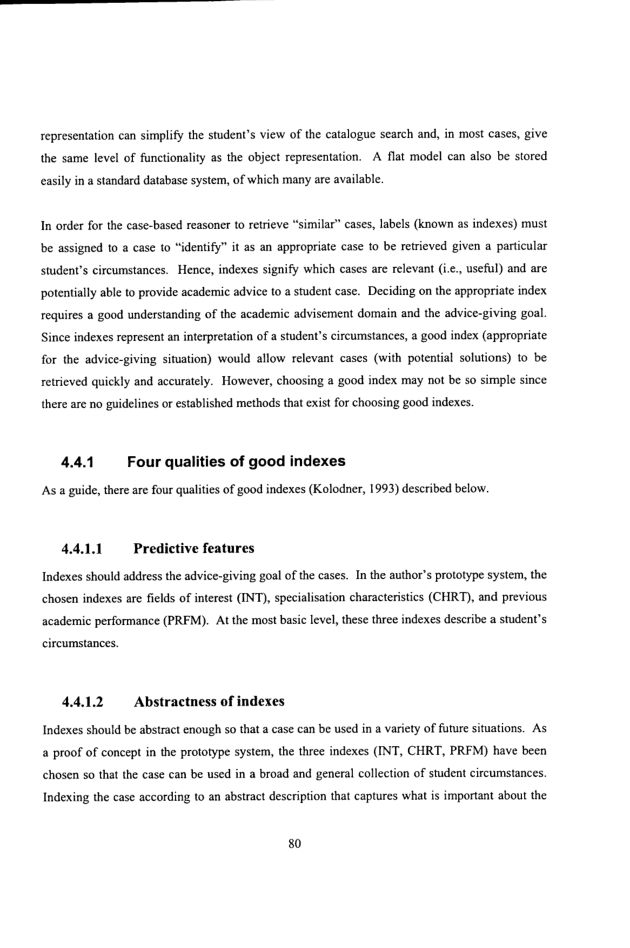
Source PDF · page 91 of 201Check original scan ↗
case allows a retriever to focus immediately on the features that point out its applicability. To
contrast this feature, take the PRFM index for example. The author could have used a particular
GPA or WAM (Weighted Average Marks) calculation instead. This would have constrained the
determination of “academic performance” to one aspect without taking into account other
influential factors. Choosing PRFM allows the calculation of academic performance to include
these so-called influential factors (such as course loads in each semester). These indexes or
descriptors point out the range of applicability of the case and make the case generally
applicable.
4.4.1.3 Concreteness of indexes
Indexes should be obvious and recognisable in future situations without further interpretation.
The INT index contains sub-indexes of DSP, OPTIC, MWAVE, NTWRK, and SATEL as fields
of interest. These fields can be recognised immediately by students. The specialisation
characteristic (CHRT) assumes three values: absolute specialisation, some specialisation, and
minimal specialisation (broad generalisation). CHRT is also recognisable to students with little
inference. PRFM is obtained from a uniform algorithm, so it is also concrete.
4.4.1.4 Usefulness of indexes
Indexes should be able to differentiate cases in useful ways and be able to give guidance about
the decisions that the case-based reasoner deals with. INT, CHRT, and PRFM have also been
chosen to make the kinds of predictions that will be useful in later reasoning. However, we can
only determine this after the actual implementation of the system. Then, we can evaluate the
usefulness of the indexes we have chosen.
In brief, the indexing problem is “the problem of retrieving applicable cases at appropriate times
- problem of assigning labels (called indexes) to cases that designate under what conditions each
case can be used to make useful inferences” [23].
81
View original scanned page
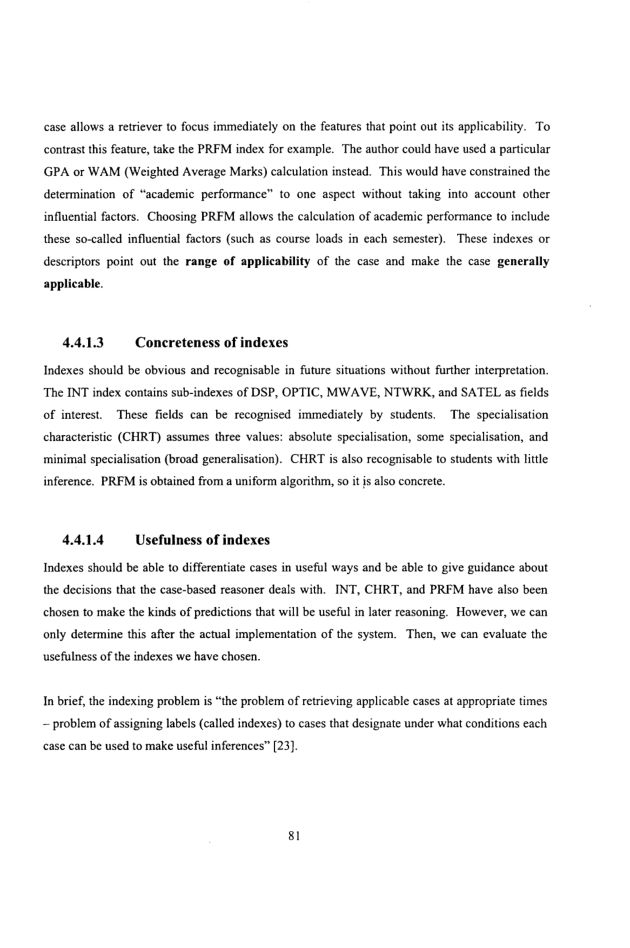
Source PDF · page 92 of 201Check original scan ↗
4.4.2 Matching Calculation
4.4.2.1 Defining Similarity
The assessment of the similarity between one advice case and another, and between one value for
a parameter and another, is always likely to be subjective. The expert’s view of similarity will
differ from the student’s and, as a result, the effectiveness of similarity calculations is best seen
in the appropriateness of the results. In each of the intelligent catalogue search applications
developed to date, it was necessary to go through a process of experimentation with the
similarity functions (INRECA, 99). In other words, standard (simple) similarities did not work,
and a set of tailored similarity functions had to be defined.
By prioritising similarity during retrieval, a standard case-based approach will implicitly ignore
the importance of retrieval diversity and this may reduce the quality of the retrieval results. It is
often not good enough for a recommender (an academic advisor) to return only the most similar
cases. It should also return a diverse set of cases in order to provide the student with optimal
coverage of the information space in the vicinity of their query (Smyth & McClave, 2001).
A degree of benefit can be expected when a system lacks any knowledge of a customer’s
preferences - that is, when the system does not perform any learning. An important variable in
determining the importance of customer feature-weight accuracy is the actual distribution of each
customer’s feature weights. Intuitively, one would expect a minority of features to be of high
importance, and a larger number of features to be less important (e.g., in academic advising, field
interest may be very important, whereas peer preference is less important, though not
inconsequential) (Branting, 2001).
This distribution of feature importance and four alternatives can be represented by the following
^-dimensional weight vectors:
Two-Level. For each feature, there is 25% probability that the feature weight is in the interval
[0.75..1.0] and a 75% probability that it is in the interval [0.0..0.25],
82
View original scanned page
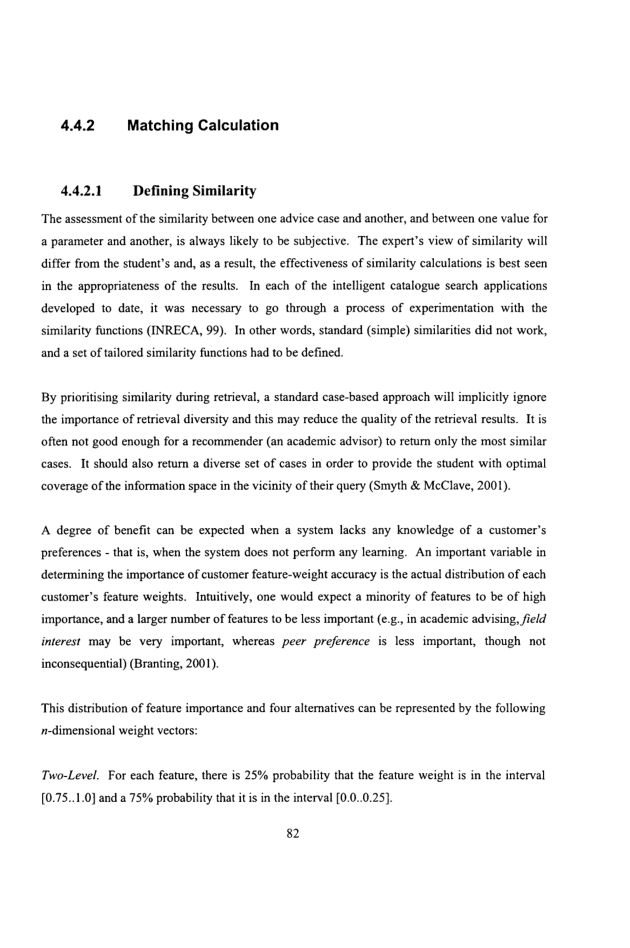
Source PDF · page 93 of 201Check original scan ↗
Exponential. For 0 <= i < n, exactly one feature has weight
Linear. For 0 <= i <= n-1, exactly one feature has weight 1 - .
1 + n
Random. Feature weights are uniformly distributed on the [0..1] interval.
Equal. All features are weighted equally.
Consider courses A, B, C, with the following values for the study field:
A: {D SP}
B: { DSP, Optics, Networking }
C: { Optics }
This asymmetric overlap metric looks at the size of the feature set intersection relative to the size
of the set in the query case. For example, the similarity between A and B is maximal because B
overlaps with everything found in A. The similarity between B and A is less because A only
contains 1/3 of what is found in B. This metric is intentionally asymmetric under the assumption
that a student looking for DSP knowledge would be satisfied by a course that covered both DSP
and Optics, but one looking for a course that combined Microwave and Satellite materials would
not necessarily be happy with a course that focused on one or the other (Burke, 2001).
4.4.2.Z Early Attempts
4.4.2.2.1 How to determine overall matching percentage
The database system should maintain a catalogue of what courses are contained in each field of
study (C O U R SESIN FIELD O FSTU D Y table).
There should be a table that maintains the fields of study and their unique primary keys
(FIELDS OF STUDY table).
83
View original scanned page
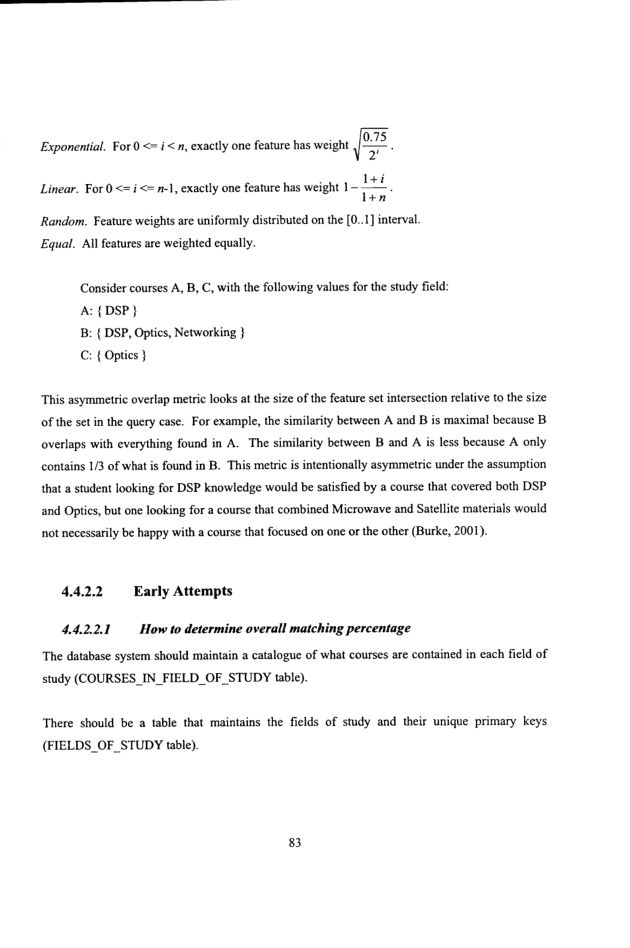
Source PDF · page 94 of 201Check original scan ↗
Then retrieve a list of courses from the COURSES IN FIELD OF STUDY table whose fields
of study are in the student’s top four choices.
For each course, first determine the matching weight for FLD/INT (field/interest).
The top choice would have a weight of 1.00 with a decrease of 0.25 for each of the subsequent
choices (i.e., the 4lh choice would have a weight of 0.25).
Depending on the importance weight of 7, 8, 9, or 10, the above value would be normalised. If
the weight is to be from 1 to 4, then the difference will be too significant. For example, 4 is
actually 400% of 1. I propose to have a discrete weight between 7 and 10. In this instance, 7 is
actually only 30% less than 10.
For assessment preference attribute, simply construct a vector of (EXAM, PROJ, ASGN).
Then, for each of the courses in the above temporary list use a simple IR matching algorithm to
find a matching percentage, and normalise this value according to the discrete importance factor
between 7 and 10.
Not taking into account the specialisation attribute and the grade expectation attribute there will
be two factors, one with an importance factor of 10 and the other of 9. Thus, add the two
normalised weights, and divide the sum by 10+9=19 to get the overall matching percentage.
4.4.2.2.2 Explanation o f algorithm
The first step is to define a description of the new problem to solve. This is actually the problem
section in a case, and resides in the problem space. The description can be a set of “distinct”
attributes that can characterise the features or the “personality” of each case. The description of
the new problem is then used to find the best possible match from the description of solved
problems.
84
View original scanned page
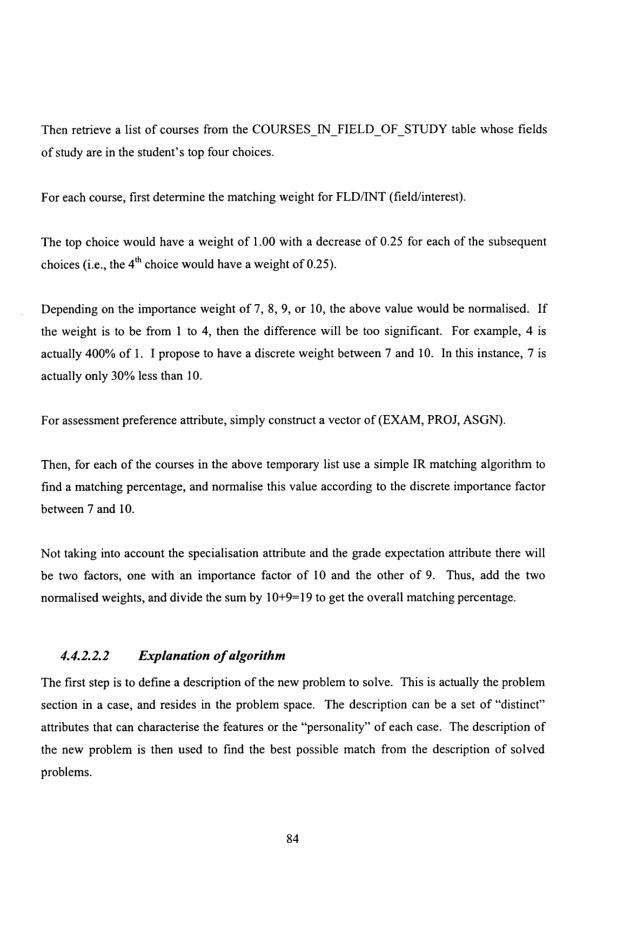
Source PDF · page 95 of 201Check original scan ↗
Once the best match is found, retrieve the corresponding stored solution in the solution space.
With the stored solution, the system has to perform adaptation or reparation to create a new
solution for the given problem. This adaptation can be rule-based. For example, removing the
courses whose prerequisites are not fulfilled and applying the rating/ranking based on secondary
attributes. Actually, the adaptation cycle can be thought of as “personalisation” based on a
student’s individual preferences: specialisation (expert or all-rounder), assessment preference,
grade expectation versus grade distribution in each course listed in the preliminary resultant
course lists (stored solutions), and academic history (to determine student’s potential) versus the
grade distribution of courses.
4.4.2.2.3 Nearest Neighbour Algorithm
The trivial nearest neighbour matching formula, which is the correlation between the two vectors
(vector 1 times vector 2), divided by the size of vector 1 plus the size of vector 2, seems to be too
trivial for matching the academic advice cases.
Nearest neighbour matching, as the name implies, should be ranked on the distance between
these two vectors. The closer they are, the better match they will make. The algorithm is simple.
Pick one of the vectors to be the reference point (it does not matter which one). For each of the
case attributes, find its difference by subtracting the reference value from the corresponding case
attribute. Then, for each of the attributes, square it to eliminate the effect of signs
(positive/negative). Sum each of the squares up and the distance is simply the square root of this
sum.
However, the best possible match will return zero distance, and we want this to be 100%
matching value. To do this, we set the initial value to 1. Then, for any non-zero distance, we
penalise the matching percentage by subtracting a ratio from it. The ratio is merely the distance
between these two vectors to the size of the problem vector (used as reference, as this will
remain constant throughout the whole matching process with this particular problem).
85
View original scanned page
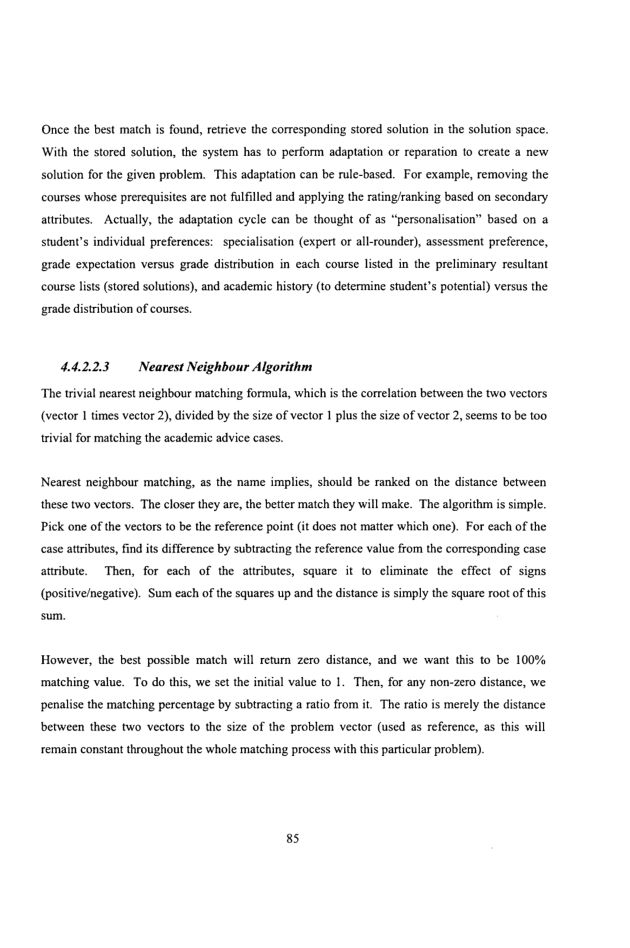
Source PDF · page 96 of 201Check original scan ↗
But, again, the INT vector has unique characteristics in itself. The highest preference is denoted
by a higher numerical value. Because of this convention, we can make use of these weights
(within INT vector only). Thus, it makes sense that the INT vector should be matched using
correlation between them. In the improved formula, we then calculate the matching percentage
from the correlation of the INT vector and the distance of the (PRFM, CHRT) vector. The
distance calculation is also improved by using the distance from the mean value instead. For the
time being, this mean is derived from each pair of vectors being matched. But, there is a
possibility that using mean values from the Knowledge Base may increase the reliability of the
formula even further, although this needs to be investigated.
Although INT contains five sub-attributes, it is essentially an attribute for the fields of interest.
PRFM and CHRT attributes can be deemed lower priority than the INT attribute. Thus, a weight
of 50% is assigned to the correlation percentage of INT vector, and 50% weighting is assigned to
the mean distance of (PRFM, CHRT) vector. The sum of these two components constitutes the
overall matching percentage, which is then used for ranking in the next step.
4.4.2.2.4 Details of early algorithm
1. Create description of new problem to solve
a. Obtain the top four choices of fields of interest from a student. This can form an
“INT” (or interest) vector with the top most choice assigned a value of 4, then
decrement by a step of 1 down to a value of 1 for the last choice. For non
selected field, a value of 0 is assigned. The vector has a form of (DSP, OPTIC,
MWAVE, WLESS, NTWRK, SATEL) to reflect the study fields in Digital Signal
Processing, Fibre Optics, Microwave, Wireless Communication, Networking, and
Satellites.
b. To capture the academic performance of students, calculate a GPA and a WAM.
(Would the inclusion of a difference of GPA-WAM be useful here?)
86
View original scanned page
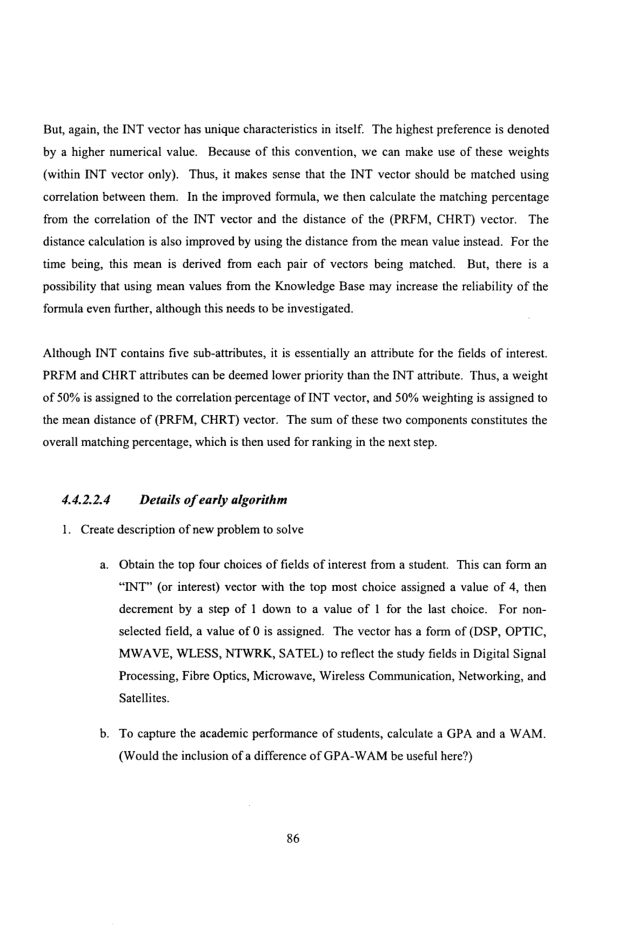
Source PDF · page 97 of 201Check original scan ↗
i. GPA excludes calculation of NN results and assigns value of 1 for PA, 2 -
CR, 3 - DI and 4 - HD. Divide the total sum with number of “passed”
courses to get the GPA.
ii. WAM includes NN results and assigns value of -1 for NN, 0 - PA, 1 -
CR, 2 - DI and 3 - HD. Then, divide the total sum with number of
attempted courses to get the WAM.
c. To capture the current progress level of students, record the Chrono-Year Level
(CHRON), Effective Year Level (EFFYR), and the Percentage o f “passed”
courses towards the overall requirement for graduation (PGRSS).
2. Use Nearest-Neighbour Matching technique to find the best match to the new problem in
the problem space. This returns the description of a solved problem.
3. Retrieve the stored solution of the solved problem from the solution space. This returns
academic advice previously given to the student whose profile is described in the solved
problem.
4. Perform case adaptation or reparation. For each course in the preliminary resultant list,
do the following:
a. Filter out the courses whose prerequisites are not fulfilled. This is likely to be
RBR.
b. Rank courses by calculating:
i. Assessment preference in the form of (EXAM, PROJ, ASGN) vector
ii. Grade Expectation versus Grade Distribution in each course. Ensure the
grade distribution is shown as a cumulative percentage. For example, if a
course has 10% HD, 20% DI, 30% CR, 20% PA and 20% NN, the
cumulative percent of DI is 20% and for CR is 60%.
87
View original scanned page
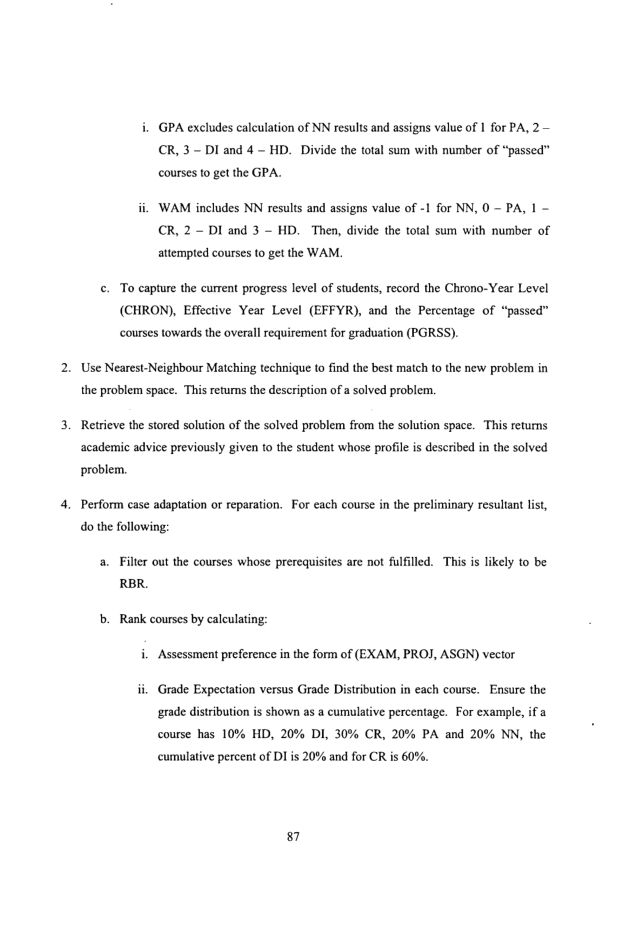
Source PDF · page 98 of 201Check original scan ↗
iii. Academic History (to indicate potential performance) versus Grade
Distribution of courses (refer to point ii above.)
c. Apply the Specialisation Preference or CHRT parameter.
Values for CHRT
i. An all-rounder with broad knowledge across diversified fields (-2)
ii. Broad knowledge in many fields but with some small specialisation (-1)
iii. No preferences at all (0)
iv. High specialisation in a field, but with broad knowledge in few other
fields (1)
v. Absolute specialisation in one field with minimal knowledge in other
fields (2)
Weighting assignment
i. Value-2 assigns weight of 10, 9.9, 9.8 and 9.7
ii. Value -1 assigns weight of 10, 9.5, 9 and 8.5
iii. Value 0 assigns weight of 10, 9, 8, 7
iv. Value 1 assigns weight of 10,8,6 and 4
v. Value 2 assigns weight of 10,4,2 and 1
These weights are then applied for the top four choices of the fields of interest.
d. Use point b and point c above to rank the courses.
Display the ranked course list as the academic advice (the solution) for the current
student (the description of new problem to solve).
View original scanned page
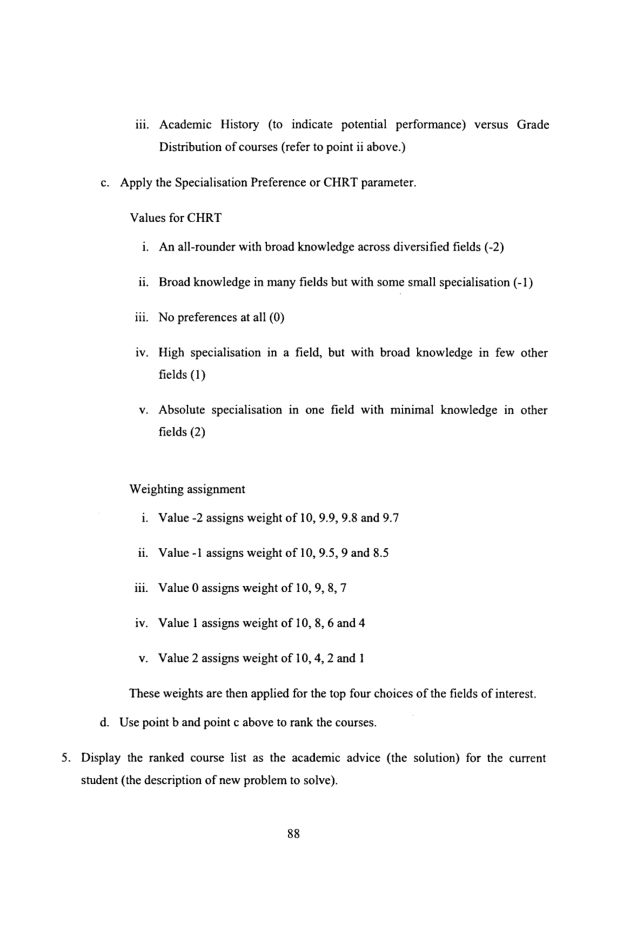
Source PDF · page 99 of 201Check original scan ↗
Assuming an attribute value based case representation, a corresponding similarity measure
consists of three basic elements (Stahl, 2002):
1. Local similarity functions used to compute the similarity between query and case attribute
values. Describe why statistical correlation is suitable for INT and “Distance of Means”
suits PRFM & CHRT.
2. Attribute weights representing the relevance of each attribute for the similarity
assessment (Refer to the Nearest Neighbour Algorithm above)
3. An amalgamation function responsible for the computation of a final similarity value for
a particular query-case pair based on the local similarities and attribute weights (Refer to
the Nearest Neighbour Algorithm above)
4.5 The “Prototype System”
The main advantage of CBR over other knowledge engineering techniques is that typical users
should be able to read a case and understand it without much background information.
Unfortunately, due to time constraint, this main feature was not exploited, and the prototype
system was developed as a proof of concept to show how CBR could work in general in this
academic advisement context.
4.5.1 Decision Breakdown
Academic advisement can be broken down into three independent decisions:
1. Core courses that must be taken to finish the program requirement
2. Compulsory electives that dictate the amount of elective credit points that must be
reached, although students have a certain level of freedom to choose the exact courses to
satisfy this group of electives
a. Technical electives that are highly related to engineering, either as foundation or
specialisation
i. Stream electives that essentially determine the major can also make up the
minor as well
89
View original scanned page
Source PDF · page 100 of 201Check original scan ↗
ii. Non-Stream electives that include physics in the 1st year and mathematics
throughout the entire program
b. Non-Technical electives (e.g., context curriculum courses, business courses)
3. Free electives that allow students to pursue other non-technical interests in an academic
environment
Given the rather complex nature of stream electives selection, CBR can be used here to develop
an automated academic advising system. For example, certain attributes such as fields of interest
(INT), student academic performance (PRFM), and specialisation characteristics (CERT) can be
used to uniquely identify and index cases. This makes up the problem space in CBR
terminology.
The actual choice of courses that a student with a particular profile (i.e., problem) selects can
then be stored as the solution for this problem. This is a part of the solution space in CBR
terminology.
4.5.2 3-pass process of Stream Elective decision
Given that academic advice on stream electives can involve a complex decision making process,
this process should be broken down into small parts involving a set of simpler decision to be
made one at a time. To handle decision making for stream electives, there should be multi-pass
processes that can subsequently filter out irrelevant cases.
Suppose that each existing case in the database (knowledge base) contains the following
information:
• The history of attempt for each course
90
View original scanned page
Source PDF · page 101 of 201Check original scan ↗
• Academic history or results obtained for each course in the program
• Preference of a major stream and a minor stream. During each re-enrolment period,
students can choose to either verify/confirm or alter their current stream preference
Consider the different passes when obtaining a problem case:
The first pass should be rule-based and this should filter out courses that fail prerequisite tests.
The output of this pass should store the eligible courses and stream preference in a structure of
data (to be defined).
The initialisation of second pass converts this structure into generic attributes and left specific
streams or courses from consideration. For example:
• Has the student passed the 1st year course in the major stream?
• Has the student passed the 1st year course in the minor stream?
This approach would enable the system to capture the behaviour/characteristics of students in
terms of the significance of the courses (e.g., major electives/minor electives).
The output of the initialisation should return a vector containing these attributes. This vector is
then fed into a case-based system, which contains similar attributes. The advice or the solution
part of each of the existing case in the CBR knowledge base should be in the following format:
• Student should enrol in the 1st year courses corresponding to their major stream of choice
• Student should change the minor stream into the major stream by enrolling in the 2nd year
courses of the new major stream
An attribute of how popular each past advice is students should be stored in the knowledge base
and be updated after the current user/student finalises his/her re-enrolment. This attribute can be
used as part of the ratings.
91
View original scanned page

Source PDF · page 102 of 201Check original scan ↗
The CBR system in this second pass should - quite safely - be able to utilise the basic
information retrieval (IR) algorithm, which involves a dot product divided by the product of two
vectors’ sizes.
The third pass would take into account that some courses might be harder than others. The
initialisation of the third pass would create a temporary “problem” vector, which is essentially a
combination of the structure in the first pass and the solution vector from the second pass. This
“temp” vector is then fed into the CBR system in the third pass. This would enable us to observe
a student’s reaction/response to the specific advice (i.e., specific courses to be taken), the given
student’s individual performance in his/her choice of courses, and preference and advice based
on the significance of the courses.
4.5.3 Common Rules for Compulsory Elective decision
Within compulsory electives decision making for full-time students, there are some governing
rules that must be enforced:
• The advised list of courses should maximise the chance for students to complete the
program within the minimum possible time
• The total credit points allowed in any given enrolment year should be the maximum
possible number of points, which is less than or equal to the credit points prescribed for
full-time study load (e.g., 96 credit points for current program structure in RMIT)
• Technical electives must not be undertaken where their prerequisite courses (core and/or
technical electives) have not been successfully completed. Electives should
automatically be readily available to students where there are no prerequisite courses
• Core courses should always take precedent over compulsory electives, which in turn
should always take precedent over free electives
• Within compulsory electives, technical electives should always take precedent over non
technical electives
• Within technical electives, stream electives should always take precedent over non
stream electives
92
View original scanned page
Source PDF · page 103 of 201Check original scan ↗
• Students should have successfully completed all compulsory electives from earlier
academic years before attempting the compulsory electives belonging in the following or
later academic year
• If a grade of Pass (PA) or better has been achieved for a course, this course must not be
taken again. This is specific to Australia, where government funding will not financially
support students who attempt the same course for a possibly higher grade, as may be
allowed in the USA. International students are similarly restricted by visa rules in
Australia.
Students are allowed to take more compulsory electives if fewer than the usual core courses are
being attempted in the same enrolment year. However, the maximum limit based on Rule 2 must
be imposed.
4.5.4 External input for Compulsory Elective decision
To customise academic advice on an individual student basis, some personal preferences are
required. An obvious example would be personal likings in particular fields of technology.
Another factor, which may be deemed indirect or too vague, is influence from friends,
colleagues, and study groups. Often, students tend to stick to their study group, which is likely
formed during the 1st year of the program. Although it was hard to capture, quantify, or
represent this aspect, it would have a significant effect on students that were not scholarly sound
and had to rely on aid from their friends most of the time.
4.5.5 Substructure of course
The structure of each stream elective course should comprise of its own sub-attributes (e.g.,
course ID, stream it belongs to, academic year level it belongs to, and its prerequisite course -
assuming there is only one immediate prerequisite course for each course entity). Thus, based on
Matrix A-L example, each course entity can be represented as (course ID, year level, stream ID,
prerequisite), for example, (1C, 1, C, 0), (2A, 2, A, 1A). Please note that 0 in the prerequisite
93
View original scanned page
Source PDF · page 104 of 201Check original scan ↗
attribute denotes NULL value, meaning there is no prerequisite for that particular course entity.
For simplicity, this representation ignores co-requisite courses in the meantime.
4.5.5.1 Excel Prototype 3-year program
Initially, a Microsoft Excel spreadsheet prototype was developed to gain a basic understanding
on the overall operation of CBR.
4.5.5.1.1 Test case structure using fixed number o f measures in a matrix.
Program X (fixed program, for simplicity) has three academic years, each of which contains five
courses, as outlined below.
There are three series of core courses, namely A, B, and C.
Series A and B go all the way to final year, whereas Series C is compulsory for 1st and 2nd years
only.
There are also three series of stream electives, namely D, E, and F.
Two stream electives can be chosen in 1st year to allow students to explore their preferences.
From the 2nd year onwards, only one stream must be selected from the two streams undertaken in
the 1st year.
There are three 2nd year free electives (namely G, H, and I) and three 3rd year free electives
(namely J, K, and L).
Students must pick one from each set when they are enrolled in the relevant academic years.
Year 1:
Core courses: 1A, IB, 1C
94
View original scanned page
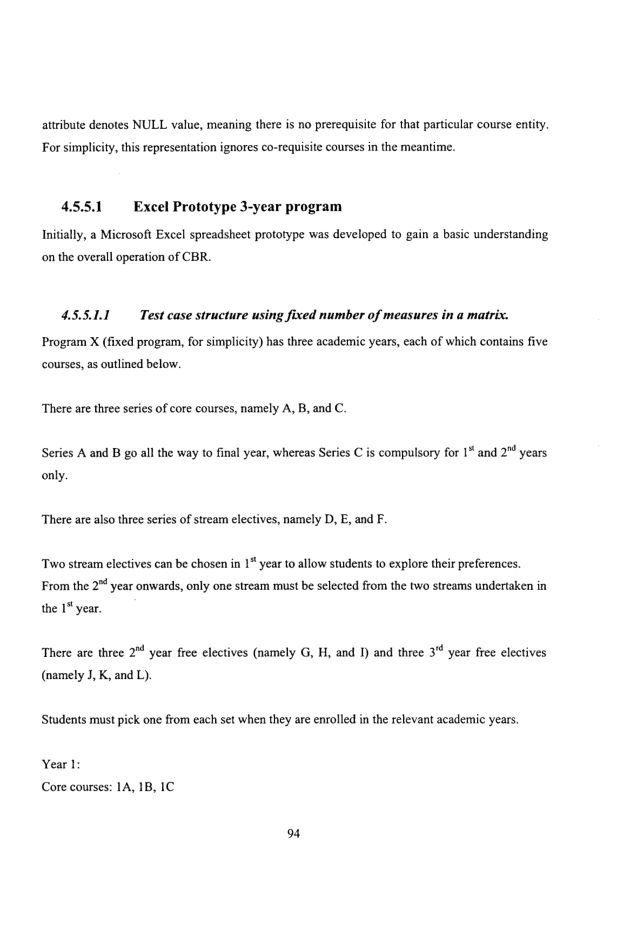
Source PDF · page 105 of 201Check original scan ↗
Pick 2 stream elective from: ID, IE, IF
Year 2:
Core courses: 2A, 2B, 2C
Pick 1 stream elective from: 2D, 2E, 2F
Pick 1 free elective from: 2G, 2H, 21
Year 3:
Core courses: 3A, 3B
Pick 1 stream elective from: 3D, 3E, 3F
Pick 2 free electives from: 3J, 3K, 3L
Given that the advice on core courses take precedence over advice on electives, and that they can
be enforced using rules in RBR, CBR should only be applied to the advice on stream electives
and free electives only.
Thus, academic history can be extracted from the transcripts and then fed into the CBR as inputs.
The first pass should also feed the history to a RBR system to determine the courses availability.
This will form another set of inputs for the CBR system.
The output part of each case should then show the strongly recommended electives that students
should be taking in the following enrolled year.
Other important information that is needed in each case is a student’s preference on the major
stream. This measure can assume a value of D, E, or F.
The last measure would be the academic year of each student. This can be determined by the
majority of courses this student undertook in the previous year.
Thus, the case structure would look something like this:
95
View original scanned page
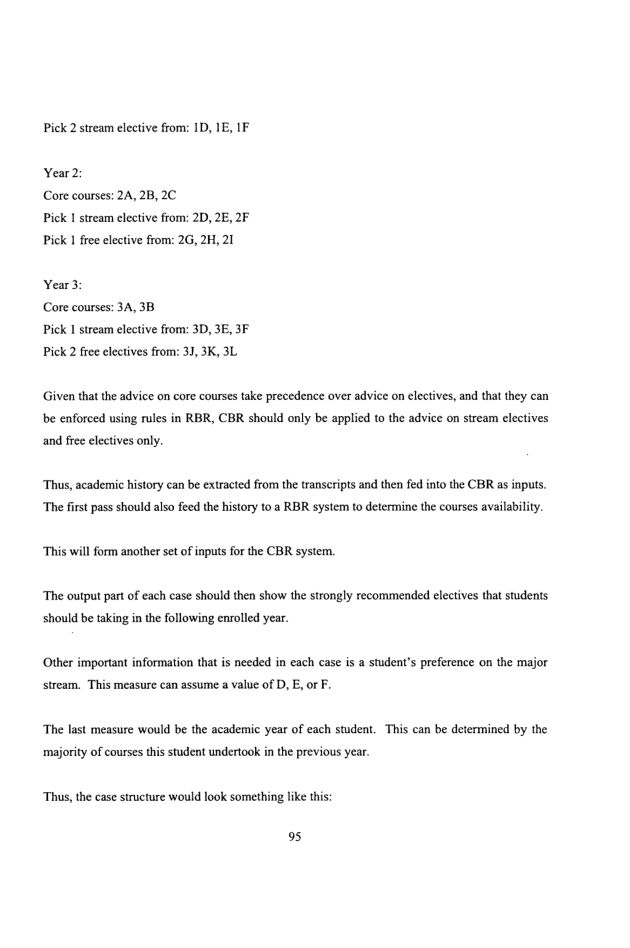
Source PDF · page 106 of 201Check original scan ↗
• Input part (indices should be built for this part only):
o Results of ID, IE, IF, 2D, 2E, 2F, 2G, 2H, 21, 3D, 3E, 3F, 3J, 3K, and 3L
o Availability of ID, IE, IF, 2D, 2E, 2F, 2G, 2H, 21, 3D, 3E, 3F, 3J, 3K, and 3L
o Stream Preference
o Previous Academic Year
• Output part:
o Strong recommendation list of ID, IE, IF, 2D, 2E, 2F, 2G, 2H, 21, 3D, 3E, 3F,
3J, 3K, and 3L
• History transcripts are recorded as Pass (1) or Fail (0) only.
• Available courses are recorded as “can be taken” (1) or “cannot be taken” (0). This
simply shows every possible course that students can take, regardless of academic level,
although prerequisites are kept in mind.
• More complex CBR can then sort the available courses according to the rankings/ratings.
The limit on the maximum number of enrolled courses each year will be enforced with
highest priority.
• Academic advices are recorded as “should be taken” (1) or “should not be taken” (0).
Assumptions:
• Student Number is not recorded as a measure to ensure simplicity. But, this ignores a
student’s individual scholastic capability.
• 1A is a prerequisite of 2A, which is in turn a prerequisite of 3A. The alphabet denotes
the sequence of prerequisites.
• For stream electives (D, E, F), assume that stream 0 is the most popular and stream F is
the LEAST popular.
Students must also be enrolled in five courses each year unless they are in their final year and
have fewer than five courses to complete before graduation.
4.5.S.2 Test Structure of the Rich Matrix
• FED denotes field of study and assumes the following predefined test values:
96
View original scanned page
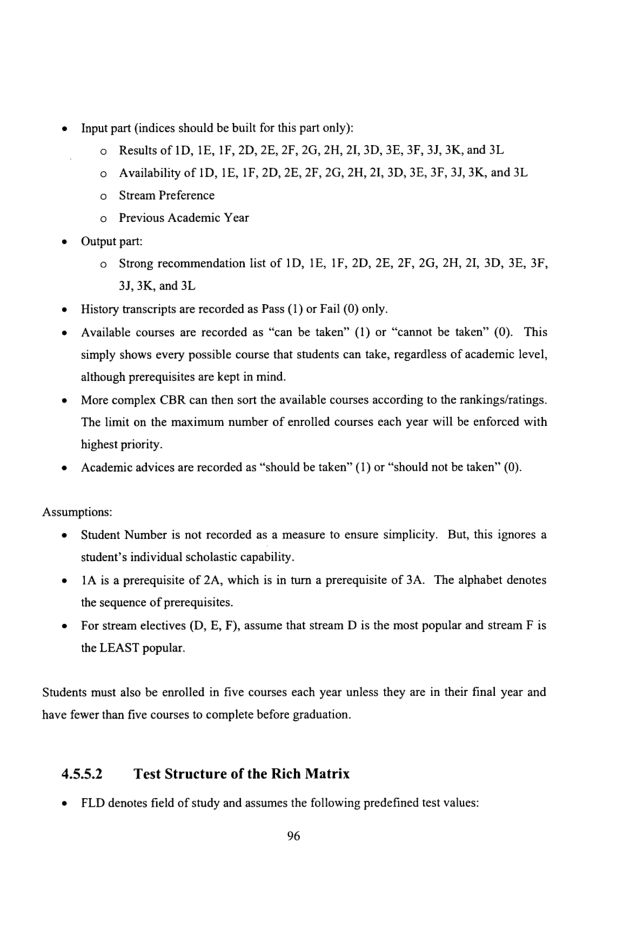
Source PDF · page 107 of 201Check original scan ↗
o Mobile Communication
o Microcontroller
o Internetworking Protocols
o Software Engineering
• POP denotes Popularity or Peer Preference as obtained during the pre-re-enrolment
survey.
• DIFF denotes perceived degree of difficulties and is measured in two ways:
• PASS denotes the pass rate
• HDDI denotes percentage of getting good results (e.g., Grade of Distinction and above,
DI & HD, for RMIT)
• LECT denotes the experience and reputation of teaching lecturers and can be broken
down into two groups, then into sub-attributes.
• Factual information can be calculated:
o YRSCRR denotes the number of years since starting their teaching career
o YRSCRS denotes the number of years since lecturing in this particular course
• Opinionated data are obtained from End-of-Course student survey in the immediate past:
o EXPT denotes the lecturer’s perceived competency as an expert in the field of
study of the course
o PRST denotes the effectiveness of the lecturer’s presentation skills and styles
o TOUGH denotes the lecturer’s tendency towards authoring tough and difficult
assessments
• ASSM denotes the type of assessments of the course:
o EXAM denotes the presence of a final examination and assumes values of “Have
exam” (1) and “No exam” (0)
o ASGN denotes the number of assignments. For simplicity, the maximum number
of assignments is set to two. Thus, ASGN can assume values of 0, 1, or 2
4.5.5.2.1 Student Dialogs
Dialog with the student is the key to a successful implementation of an intelligent catalogue
search application. Some questions need to be answered before a developer can prepare the
View original scanned page
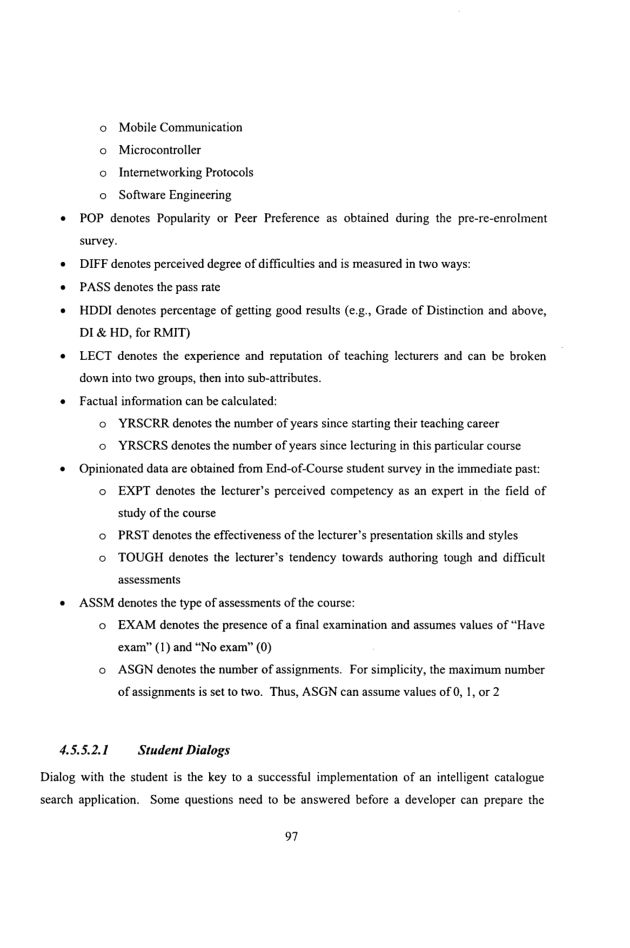
Source PDF · page 108 of 201Check original scan ↗
dialogs to support the student in using the search system. Do students need to weight the
parameters for which they specify values? (To answer: What validation is required for inputs to
the search? What explanation of the search parameters is needed? What explanation of the
results is needed by the student? What extra features will the student need to make use of the
query or results featured in the system?) The answers may need to be obtained by consulting
students directly or by consulting academic staff that deal with student queries on a daily basis.
Consequently, the catalogue application should be open to validation based on feedback from its
use in the “field”. This step is important to ensure the catalogue’s long-term acceptance and
success (INRECA, 99).
4.5.S.3 Conversational CBR
CCBR needs to find out the following:
• INT denotes personal interest and takes the same values as FLD
• MKT denotes the current job market or industry demand, as researched by external
Careers Consultants, and assumes the same predefined test values as FLD
• CHAR denotes a student’s character, personality, or learning styles, whether it is to
become an expert in a particular field (1), to be an all-rounder with broad knowledge
across diversified fields (-1), or no preference at all (0)
• PEER denotes whether a student wants a popular course (1), or non-popular (0).
• LECT denotes a profile of lecturers that a student wants to study under
• ASSM denotes the type of assessment that a student prefers
The Course Set forms the advice or the solution that the CBR system returns.
For test purposes, each field as denoted in the INT attribute has two electives for students to
choose from. For example, Course Cl and Course C2 belong to Internetworking Protocols or
Field C. For simplicity, we assume that the prerequisite has been checked during the RBR pass.
98
View original scanned page
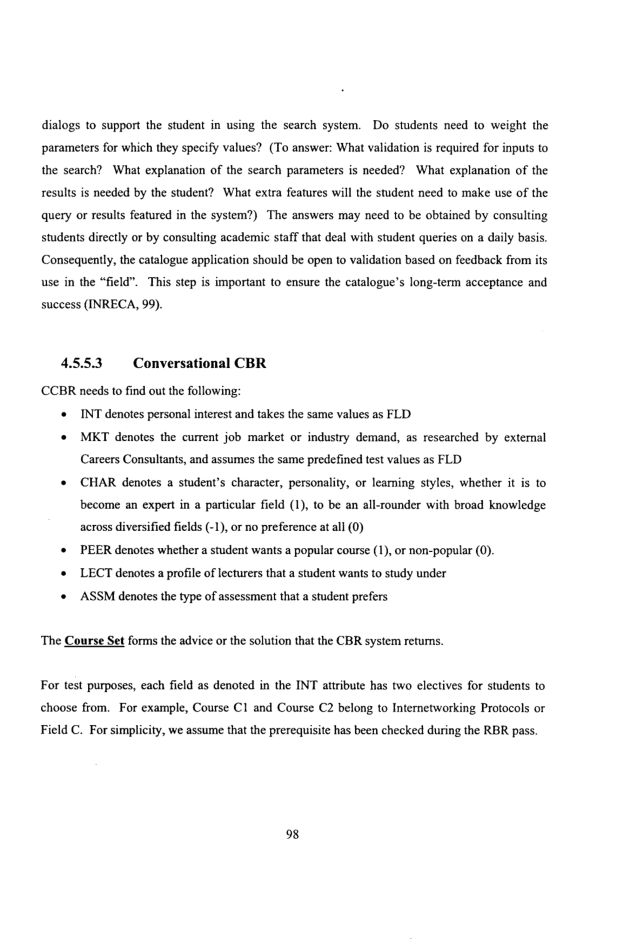
Source PDF · page 109 of 201Check original scan ↗
Once CCBR obtains the necessary preference values for each attribute, this is calculated against
the attributes of each course. The simple IR algorithm may suffice in providing the ranking.
This is how they are going to be used:
• INT and MKT are calculated against FLD
• CHAR is to be investigated further
• PEER is calculated against POP
Sub-attributes of LECT and ASSM are to be calculated against their counterparts, respectively.
The next step is to find how the CHAR attribute fits into the calculation quantitatively, and to
investigate how efficiently the simple IR algorithm can provide the ranking/rating of each
course.
4.5.5.3.1 CCBR Questions for students
Students can tick the checkbox for the questions they think are relevant or important to them.
Note: Ranking arranges them so they have a position in relation to one another, or to give the
order of importance among all factors. Rating is to give weighting of each factor and is in the
form of a scale.
Please rank the top four choices in the fields of study (FLD or INT) that you are interested in (4
being the most interested, and 1 being the least interested)
• Mobile Communication
• Microcontroller
• Internetworking Protocols
• Software Engineering
• Fibre Optics •
• Digital Signal Processing
• Power Engineering
• Biomedical Devices
99
View original scanned page
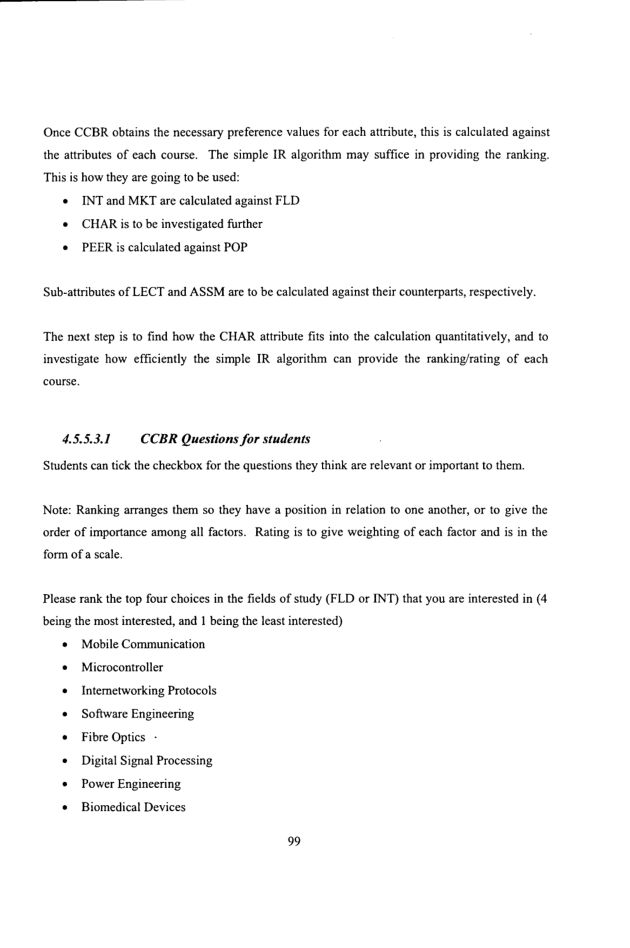
Source PDF · page 110 of 201Check original scan ↗
Please select your preference towards the range of knowledge (CHAR).
• An all-rounder with broad knowledge across diversified fields (-2)
• Broad knowledge in many fields but with some small specialisation (-1)
• No preferences at all (0)
• High specialisation in a field, but with broad knowledge in few other fields (1)
• Absolute specialisation in one field with minimal knowledge in other fields (2)
Please choose your preferred methods of assessment (ASSM):
• Would you like to have an exam (EXAM)? Yes (1) or No (0)
• Would you like to have a major project? Yes (1) or No (0)
• How many assignments would you prefer to have (ASON)? 0, 1, or 2
Which of the following profiles best describes your expectation? This is used to aid the
academic advisement only, and not to incriminate students in anyway.
• I expect to get HDs in all courses.
• I expect to get DIs or HDs for most of my courses.
• I expect to get CRs or DIs for most of my courses.
• I expect to get Pas or CRs for most of my courses.
• I am happy to get a pass (PAs) in most courses.
After students pick their questions and answers, collate each question to make a list of important
factors and then ask students to rank them. Each of the four factors above will have to be
assigned a weight. If the weight is to be from 1 to 4, then the difference will be too significant.
For example, 4 is actually 400% of 1. I propose to have a discrete weight between 6 and 10. In
this instance, 6 is actually only 40% less than 10.
Now, look at the matching technique.
100
View original scanned page
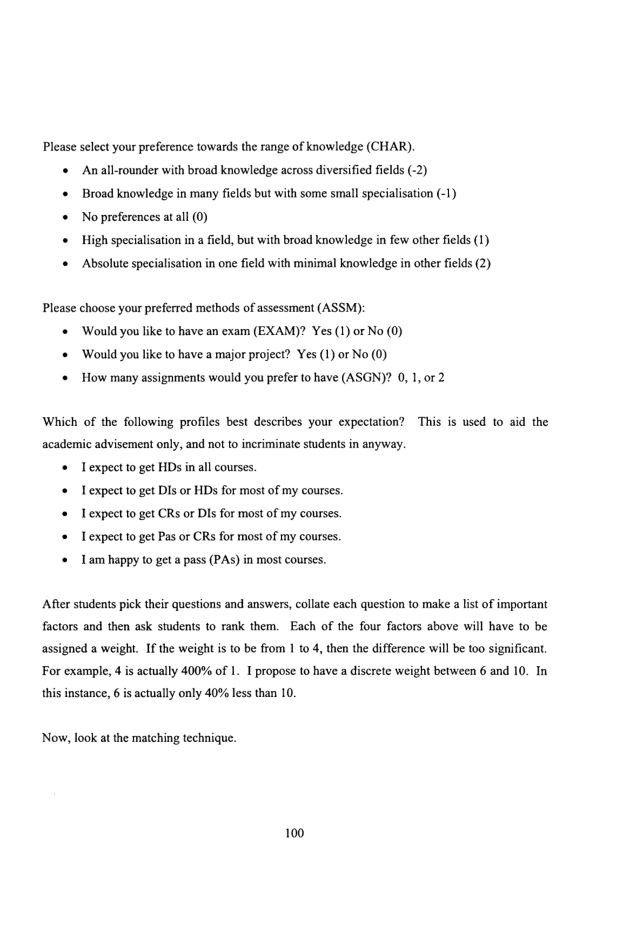
Source PDF · page 111 of 201Check original scan ↗
A student’s interest is matched using the simple IR algorithm. A course can be classified in a
few different fields. Its tendency in each field can be represented using a weighting value.
When matching, the student’s interest rank vector is calculated against the course’s field vector
to determine the matching percentage. This percentage is then normalised to have the weight (6-
10) according to the overall rank above.
Expertise factor has a discrete value between -2 and 2. Exactly how this will be calculated to a
matching percentage is still to be determined.
This is similar to factor 1. Methods of assessment can be represented using a vector. This vector
is then matched with a student’s preferred method of assessment vector using a simple IR
algorithm. The matching percentage is then normalised accordingly to a value between 6 and 10.
We have to quantize the grade range. For example:
HDs -> 86-100%
DI/HD ->77-85%
CR/DI ->67-76%
PA/CR -> 58-66%
PAs -> 50-57%
Then, the course’s history grade statistics are compared to determine where in the above ranges
each course’s highest concentration of grades lies.
For those students who do not tick any questions (i.e., do not really care or cannot decide), the
system may suggest they follow the popularity of courses or peer preference.
4.5.S.4 Proof of Concept - Test Cases
Legends of Test Cases using MS Excel
Courses in INT (interests)
• DSP: D l, D2, D3
101
View original scanned page
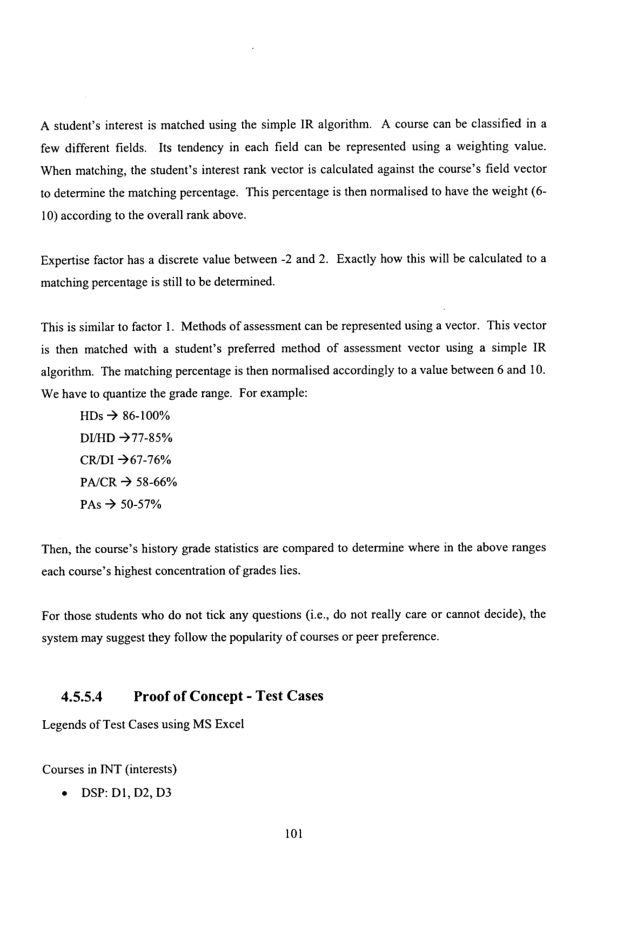
Source PDF · page 112 of 201Check original scan ↗
• OPTIC: 0 1 ,0 2 , 03, OM2, 0M3
• MWAVE: 0M 2, 0M 3, M l, M2, MN3
• NTWRK: MN3, N l, N2, NS3
• SATEL: NS3, SI, S2, S3
Note: Courses with a single alphabet denote a specialised course in its field.
Note 2: The number in the course code denotes that year level.
Sequence of Prerequisites
D1 -> D2 -> D3
O l 02 -> 03
01,Ml 0M2 0M3
M l M2
M1,N2 -> MN3
N1,N2,S2 -> NS3 (note: Nl is NOT a prerequisite for N2)
SI -> S2 -> S3
PRFM (performance or aptitude level): 1-weak, 2-average, 3-good
CHAR (specialisation preference): 1-broad knowledge, 2-some specialisation, 3-absolute
specialisation
The test cases raise an issue of indexing.
Given that each case will have multi-dimensional indices, a special type of DBMS will be
required to efficiently retrieve (or match) cases.
For the illustration and prototype, we may have to go through each record (i.e., case) in DBMS,
calculate the matching percentage using the simple IR formula, and then retrieve the case whose
percentage is the highest.
102
View original scanned page
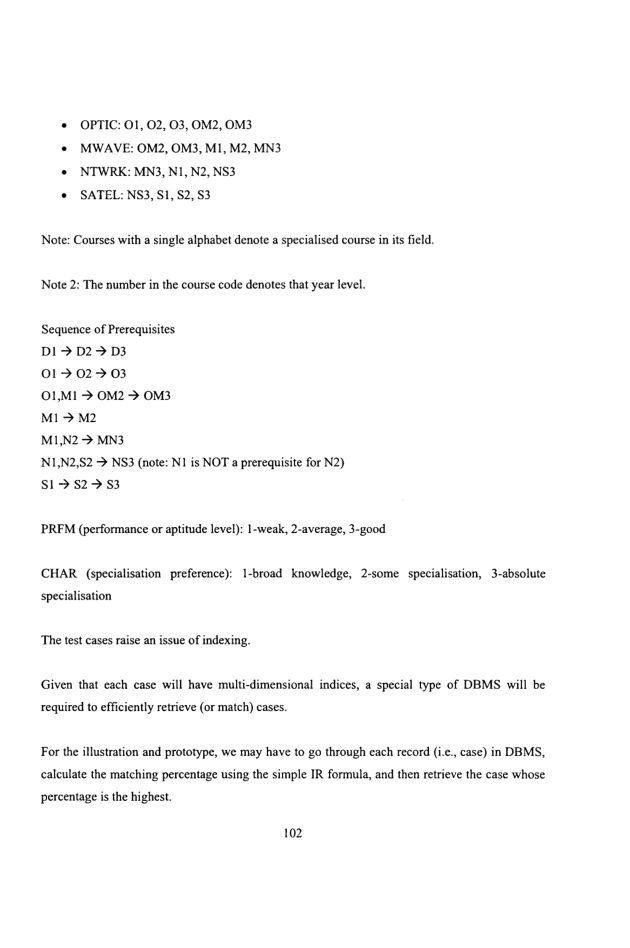
Source PDF · page 113 of 201Check original scan ↗
When trying to match the PRFM (student’s performance) with DIFF (difficulty of courses), the
expert would probably be giving advice according to these “rules”:
• If PRFM=3, student can do any courses, and thus INT and CHAR play an important role.
• If PRFM=2, student should be doing courses with DIFF of 2 or 1. Under some
circumstances, they can probably be allowed to enrol into courses with DIFF=3. INT and
CHAR may have less effect here.
• If PRFM=1, student must really be doing courses with DIFF=1. Under no circumstances
will they be allowed to do courses with DIFF=3, but the probability of enrolling into
courses with DIFF=2 remains. In this case, DIFF probably overrides INT and CHAR.
Without using DIFF for eight courses, there are three possible outcomes for each of DIFF,
CHAR, AVG, and EFFYR, and thus, 3A4 = 81 cases.
51
For INT, given five choices, we are to pick three choices in order. This is 5P3 or = 60
(5 -3 )
cases. Thus, without DIFF, there are 4,860 distinct cases.
Inclusion of DIFF creates three possible cases for each course and, thus 3A8=6,561 cases, i.e.,
4860*6561=31,886,460 or 31 million distinct cases.
For simplicity, DIFF will remain constant between semesters, so 6561 factor will be kept as 1
instead. The course list is proposed to contain two difficult courses (DIFF=3), three average
courses (DIFF=2), and three easy courses (DIFF=1).
AVG will only be useful when real student data is available. With a real data set, correlation
between the average number of attempts and student performance can then probably be
investigated. For the time being, we can ignore this attribute.
If we deal with students with a clear pass, we can also ignore the effective year level (EFFYR).
103
View original scanned page
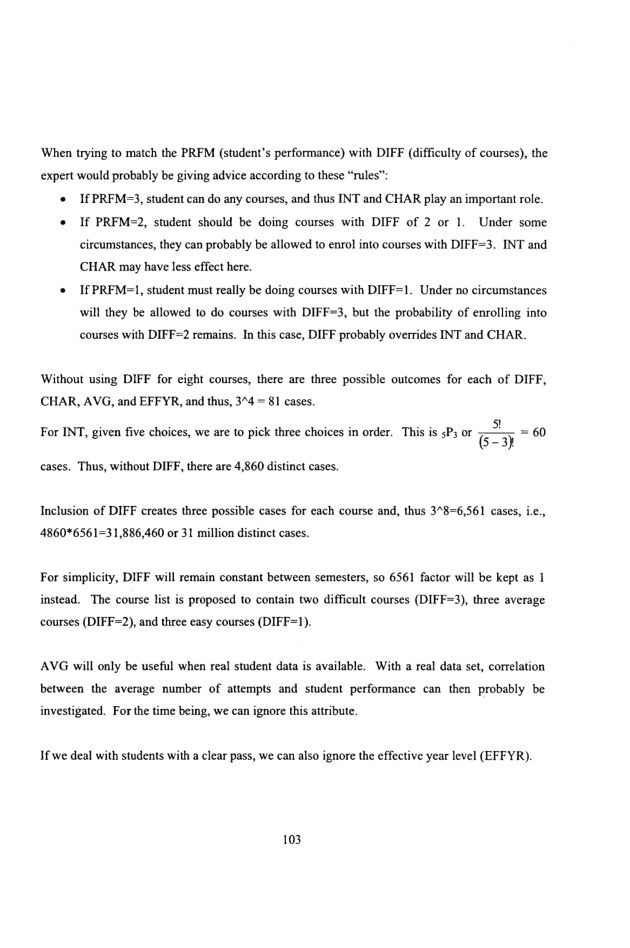
Source PDF · page 114 of 201Check original scan ↗
Thus, we would have 60 (INT) x 3 (PRFM) x 3 (CHAR) = 540 cases. However, because there
are no year levels stored as an index, we may have to break up the CBR down to three sub
systems, one for each of the year level.
4.5.6 Description of the prototype Case-based Reasoning
Academic Advisement system
This prototype system has been developed to demonstrate the application of CBR in academic
advising. The system can be test-driven at http://cbr.tanat.net/. The system was developed
using PHP scripting language and MySQL database.
Upon entering the front page of the system, links to three different test sets of knowledge base
are provided. On the same page, a table of sample test problems are shown. Users can click on
provided links to launch the academic advisement page. Each link has its own designated test set
knowledge base.
Once the academic advisement page is loaded with a specific test problem and a designated
knowledge, users are presented with three tables outlining the top ten ranking of the retrieved
knowledge cases. Each table uses a different algorithm to calculate the ranking percentage. The
three algorithms are Trivial IR, Euclidean Distance, and Improved Combination, as described
earlier.
Once the retrieved cases are ranked, these top ten cases were fed into a rule-based system to filter
out courses that were deemed to be more difficult than the advised student’s perceived past
academic performance. For each course, this pass also recorded the highest-ranking percentage
of the case in which the course first appeared in the advised set.
This stage also took into account the frequency of occurrence of each course in the top ten cases,
as well as the weighting according to the case order that they appeared. This value was referred
to as a “weighted sum” of advised course occurrence. The role of weighted sums is to break the
tie between two or more courses with the same ranking percentage.
104
View original scanned page
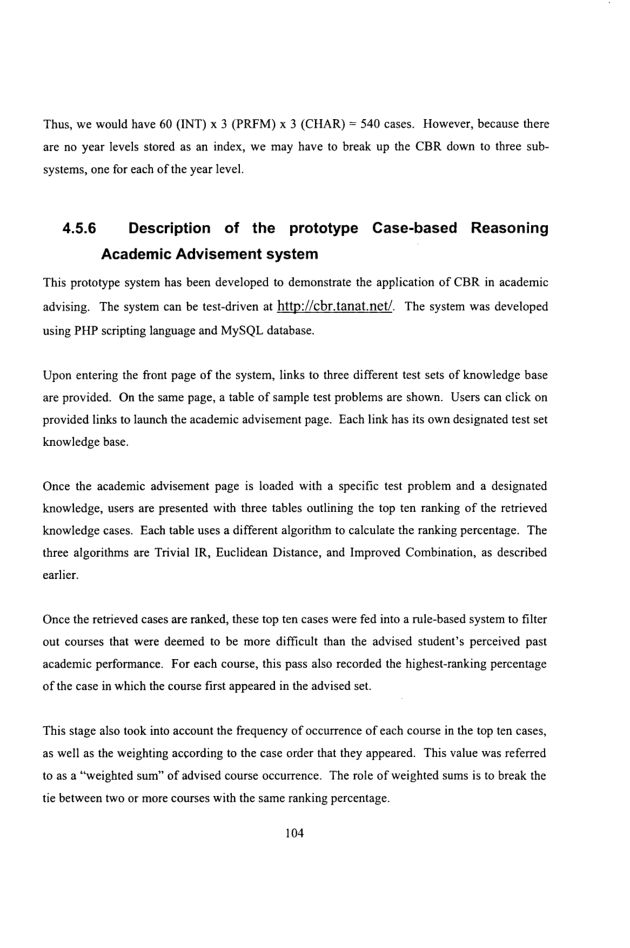
Source PDF · page 115 of 201Check original scan ↗
The final stage shows the actual academic advice against each available course with simple
reasons to support its argument.
The system can currently show courses under four categories:
• The RED text denotes courses whose prerequisites have not yet been fulfilled.
• Courses that are not recommended due to their perceived difficulty being greater than the
student's demonstrated academic performance. This is denoted in ORANGE text.
• The GREEN text denotes a recommended course with its rating (ranking percentage) and
a sub-rating (the tie-breaking weighted sum).
• Other possible courses that students may consider taking if they prefer are denoted in
BLUE text.
4.5.7 Initial Direction
Initially, the author was concentrating on the CBR application, which is driven by the student
profile. The algorithm is as follows:
• Obtaining student’s profile and make this a “problem” profile
• Find the best possible match of the “problem” profile in the database of “knowledge”
profiles
• Once the best match or matches of profiles are retrieved, show the pattern or the list of
courses undertaken by previous students of such profiles
4.5.7.1 A note about initial direction
In regards to grade results, the student’s expectation should be obtained. In turn, this is matched
with the historical academic performance level of each student in the previous terms. In order to
calculate the performance level, higher significance (i.e., higher weighting) should be applied to
the recent terms to determine the current student’s performance, as well as to capture any
potential performance pattern in the past.
105
View original scanned page
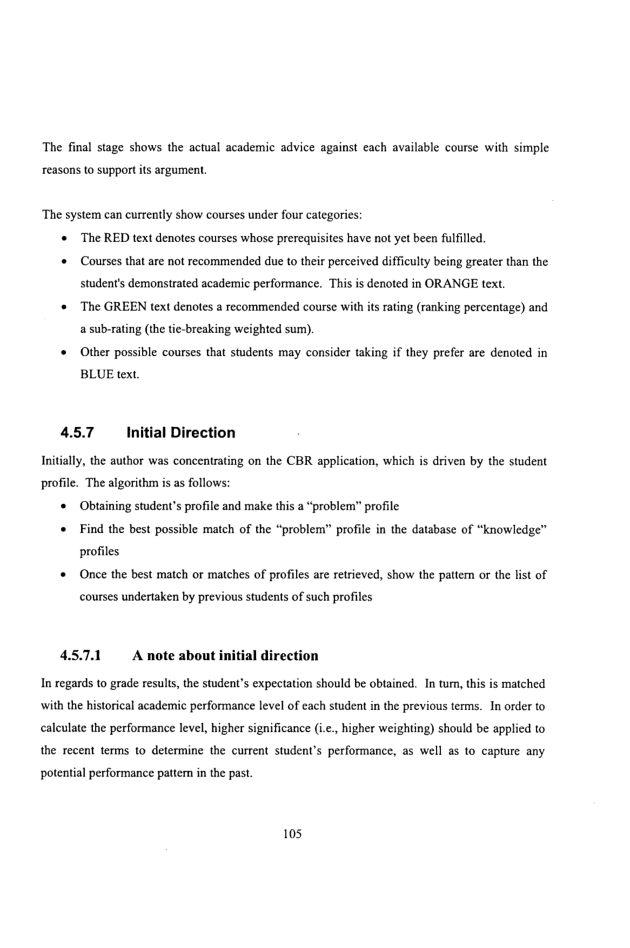
Source PDF · page 116 of 201Check original scan ↗
The RMIT full-time load for one academic year is 96 credit points (CP). This consists of eight
courses of 12 CP each. Other universities (e.g., Swinburne) make their subjects (which are
equivalent to RMIT courses) have a weighting of 12.5 CP each. Thus, one full-time year load
has a round figure of 100 CP. Perhaps this would make it a bit easier to quantize a range of
grades - that is, we could calculate the percentage of each of the grades (HD, DI, CR, PA, NN).
An interesting question arises when comparing the profile of a student who has obtained four
HDs and four Pas, and another student with four DIs and four CRs. Given that the credit points
of each course are equal (e.g., 12 CP), the Grade-per-Average will be apparently the same, but
which student should be deemed more academically competent?
4.5.8 Change in Direction
The direction was changed at a later stage to investigate the course profile driven approach. The
algorithm:
• Determine a list of all currently eligible courses that a student can enrol in using RBR
with the student’s Academic History/Transcript
• For each possible course, determine the profiles of students previously undertaking the
course
• Calculate the matching percentage, a.k.a. ranking, between these profiles and the
student’s profile
• Show the order of courses based on the likelihood that this student profile would be
taking each course.
4.5.8.1 A note about change in direction
Some real sets of courses should be used to demonstrate the statistically skewed pattern in the
past. There may be a possibility of using historical data from the ECE student admin database.
The only catch is to map the student numbers in the database to non-existing values, to ensure
the anonymity of students remain intact.
106
View original scanned page
Source PDF · page 117 of 201Check original scan ↗
The CBR should be storing the profiles of the students that previously attempted each course. In
each course, calculate the exact number of students choosing this course, as well as the
percentage of this profile among all of the other profiles associated with this course. The
percentage gives a good indication of the popularity of this course for students in this profile.
This can be made a criterion for ranking.
A good CBR should have a good variety/diversity/distinction. This can be achieved from a high
number of students, which in turn will result in a large number of cases. For the prototype
system, this should be controlled in order to limit the number of test cases to a reasonable
quantity.
Given that there are only two main elements involving enrolment (i.e., students themselves and
courses available), other distinct perspectives for using CBRs cannot be determined at this time.
Other possibilities may involve a hybrid model of these two perspectives with varied factors of
importance. The factors of importance can probably be used to determine the execution
sequence of the algorithms.
107
View original scanned page

Source PDF · page 118 of 201Check original scan ↗
4.5.9 System Modelling
4.5.9.1 System Architecture
Figure 4-1: below shows the major modules in the prototype system. It also shows which
components interact with each other.
Server
Data Retriever
C ase b ase
Similarity Calculator
Recommender Agent
Student
Figure 4-1: System Architecture
108
View original scanned page
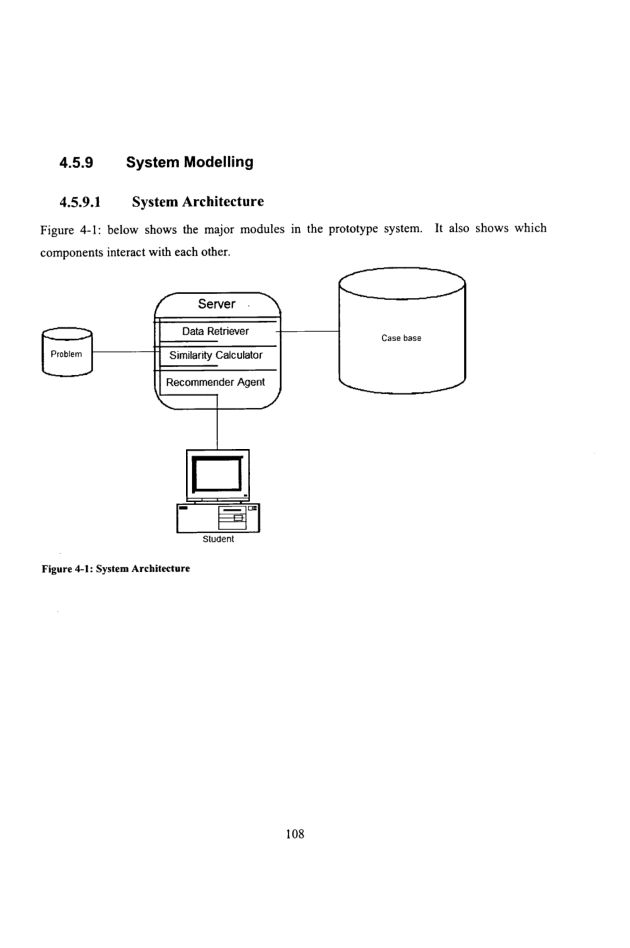
Source PDF · page 119 of 201Check original scan ↗
4.S.9.2 Object Model
Figure 4-2 below shows the aggregation between knowledge base and smaller objects that make
up one case.
K n p w W j a B a s e j
♦G a t C s a e t } j
' R n e - i e v e C a s e t I j
% Optics
. St-Mkrowave
? PaezP^fOfmanc^. Ndtwoiktftg
*. Soeosicatkin
*Ge$trsSeresl! j
♦Setkuaresti )
HtatchW erest’S 1
Courses I
'G eK cyrsesi k >
^SetCoursesl t *
'O'1'
Figure 4-2: Object Model
109
View original scanned page
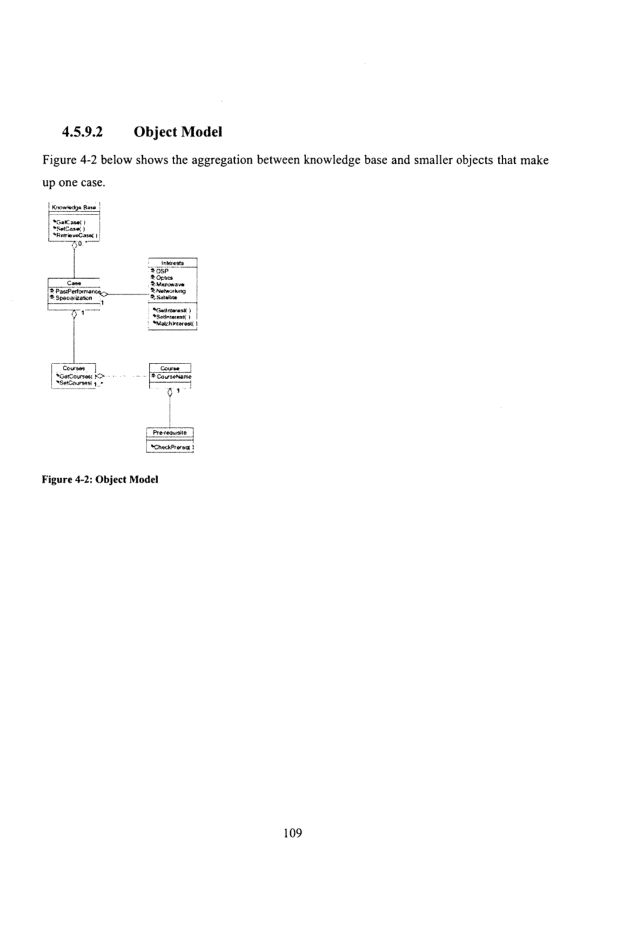
Source PDF · page 120 of 201Check original scan ↗
4.S.9.3 Entity-Relationship Diagram
Figure 4-3 below shows the Entity-Relationship (ER) diagram of the database, as the knowledge
or case base is stored in MySQL database software.
Knowledge Case Interests
H-contains- 1
- H- -consists -©f— H-
PRFM DSP
CHRT OPTIC
r - MWAVE
=c NTWRK
SATEL
consuls of
Course
PK Name
reqi
Prequisite
PK.FK1 Name
Figure 4-3: ER diagram
110
View original scanned page
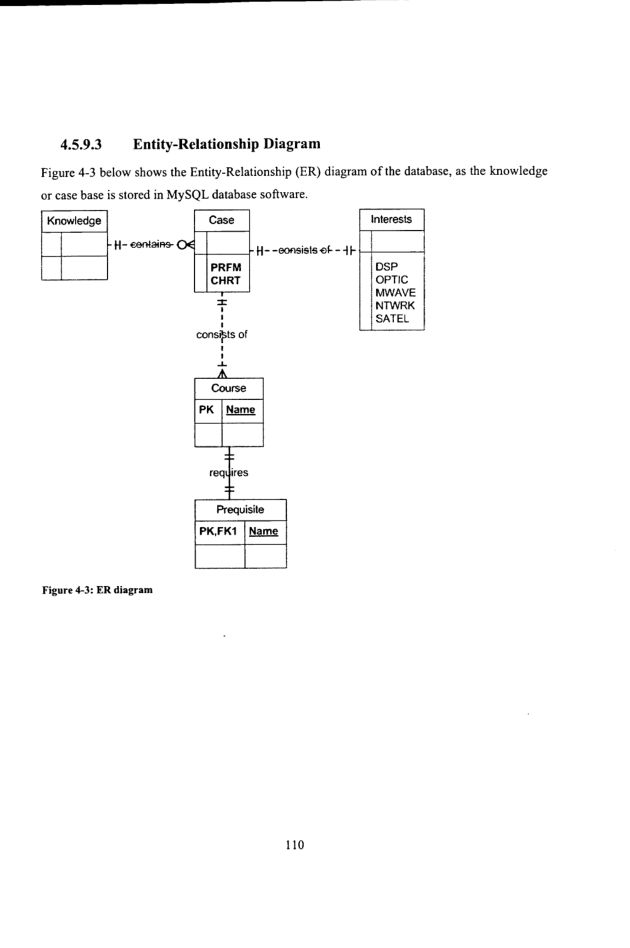
Source PDF · page 121 of 201Check original scan ↗
4.S.9.4 System Operation
Figure 4-4 below gives the system flow of control in the form of a UML Activity Diagram. This
is the high level flow and shows the sequence of major operations and the two main loops in the
prototype system.
Get Student s Calculate Similarity Retrieve similar
love to the next Obtain one ca se Rank retrieved
from the result set
Retrieve
r e c o m m e n d e d
courses
Obtain one course
from the result set
Fulfil pre Add c a s e weight to
requisite ? co u rse weight
Anym ore co u rses left
in th e result set ?
nym ore similar c a s e s m
th e result se t ?
Rank co u rses
based on R e c o m m e n t
accum ulated co u rses
weights
Figure 4-4: Flow of Control
111
View original scanned page
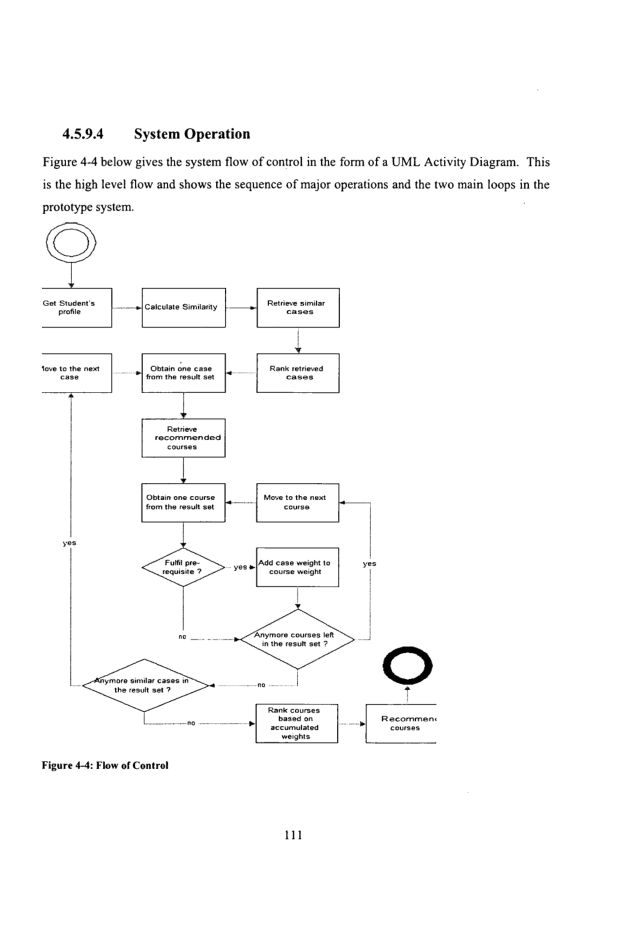
Source PDF · page 122 of 201Check original scan ↗
4.5.10 Prototype Versions
The prototype versions merely serve as a proof of concept. Only the pure numerical calculations
are used for similarity matching. The obvious drawback here would need the cases be coded and
decoded between textual attributes and their respective numerical representation.
4.5.10.1 Trivial IR
This calculation uses Trivial Information Retrieval technique, implementing a simple Nearest
Neighbour formula. This is particularly useful for the measures that demonstrate statistical
correlation behaviour.
4.5.10.2 Euclidean Distance
This algorithm is merely a calculation of distance between two vectors. This is an adaptation of
the Pythagoras triangle theorem, but with more than three dimensions. It is suitable for a set of
measures that are not interrelated to one another.
4.5.10.3 Improvement Calculation
The improved algorithm is actually a combination of statistical correlation of Student Fields of
Interest (INT) measures and a calculation of Vector Distance from a Reference Point. This
algorithm is the combined and improved version of the first two algorithms. Given the Student
Fields of Interest (INT) needed to capture the relative preference order among them, the
statistical correlation method seemed to be the most appropriate in such a situation. As for the
other two measures, Student Specialisation Preference (CHRT) and aggregated Student
Academic Performance (PRFM), the vector distance method seemed appropriate, as they are
mutually exclusive. A slight improvement in the vector distance formula was to calculate a
reference point so the ranking became more consistent. This reference point was calculated as a
mean value of all the existing values in the knowledge base.
112
View original scanned page
Source PDF · page 123 of 201Check original scan ↗
4.5.10.4 Fuzzy Matching (Future Improvement)
4.5.10.4.1 Possibility Measures and Necessity Measures
If the value of a variable is described using a possibility distribution, it often needs to determine
to what degree it matches a given condition. Such needs arise in fuzzy logic control as well as in
fuzzy databases. In fuzzy database systems, imprecise information may be represented using
possibility distributions. Retrieving information from a database involves posting a question
(called a query) to the database management system. The question typically involves conditions
about the kind of information we are interested in retrieving. Hence, processing these database
queries for retrieving imprecise information requires the capability to match conditions in a
query with possibility distributions in a fuzzy database.
In general, matching a possibility distribution of a variable x with a condition “x is A” involves
asking the following two related questions:
(Ql) Given the possibility distribution ofx (denoted IT(x)), is it possible for x to be A?
(Q2) Given the possibility distribution Il(x), is it necessary for x to be A?
These two questions will be first illustrated using a non-fuzzy example. Suppose we know the
following:
Jack’s GPA is between 2.00 and 2.50
Consider the following condition:
Whether a student’s GPA exceeds 2.20
Does the possibility distribution of Jack’s GPA match the condition? Due to the imprecise
information about Jack’s GPA, a black-and-white answer to the question cannot be found. More
specifically, it is possible for Jack’s GPA to exceed 2.20; however, this is not necessarily the
case. Hence, the answer to the first question listed above (Ql) is “yes,” but the answer to the
113
View original scanned page
Source PDF · page 124 of 201Check original scan ↗
second question (Q2) is “no.” Obviously, if we are interested in the condition that “whether a
student’s GPA is between 2.10 and 2.30,” our answers to both questions are positive for Jack
(i.e., it is possible as well as necessary for Jack’s GPA to be in the interval [2.10, 2.30]).
In the example above, the answers to Q1 and Q2 are either “yes” or “no” because neither Jack’s
GPA nor the conditions about a student’s GPA are fuzzy. In general, however, the answer to
each question is a matter of degree. The answer to Q1 is called a “possibility”, and the answer to
Q2 a “necessity.”
4.5.10.4.2 Example
If we are given a possibility distribution of a student’s marks, and we want to find all poor
students, we can calculate the possibility degree and necessity degree5 as follows:
Poss(Poor | f ix ) = supx[min(rix , Ppoor(x))] Equation 1
Nec(Poor | fix ) = infx[max(nx , l - p p00r(x ))] Equation 2
§ From http://www.dbai.tuwien.ac.at/marchives/fuzzy-mail/1233.html
Necessity is the counterpart of belief and possibility is the counterpart of plausibility in possibility theory.
Possibility theory is a special branch of evidence theory that deals only with bodies of evidence whose focal
elements are nested.
The following are true:
Nec(A intersection B) = min(Nec(A), Nec(B))
Pos(A union B) = max(Pos(A), Pos(B))
This is a simple way to think of them:
Necessity for A is the sum of probabilities for every element that is contained in A.
Possibility for A is the sum of probabilities for every element that contains A.
For more information, please read Klir G. and Bo Yuan, Fuzzy Sets and Fuzzy Logic, Theory and Applications,
New Jersey, Prentice Hall, 1995
114
View original scanned page
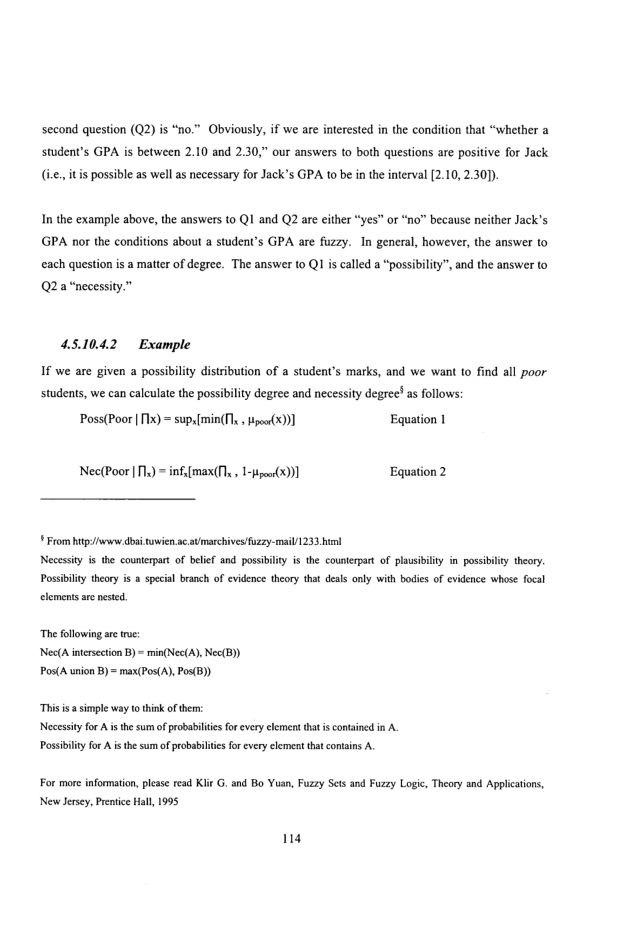
Source PDF · page 125 of 201Check original scan ↗
Let the universe of discourse of a student’s marks be { 20, 30, 40, 50, 60, 70, 80, 90, 95 }, and
the marks possibility distribution of a student (denoted J) be:
rimarks(7) = 0.2/30 + 0.5/40 + 1/50 + 0.8/60
Suppose that the membership function for the linguistic term Poor is defined as a discrete fuzzy
set as follows:
Poor = 1/20 + 1/30 + 1/40 + 0.8/50 + 0.4/60 + 0.2/70
Using equation 1, we calculate the possibility degree fro student J to satisfy the condition “poor
student,”:
Poss( Poor | rimark*/) = max {0.2 A 1,0.5 A 1,1 A 0.8, 0.8 a 0.4}
= max {0.2, 0.5, 0.8, 0.4}
= 0.8
To calculate the necessity measure, we first calculate the complement of the possibility
distribution of a student/’s marks:
l-rimarks(7) = 1/20 + 0.8/30 + 0.5/40 + 0/50 + 0.2/60 + 1/70 + 1/80 + 1/90 + 1/95
The necessity measure is obtained using equation 2
Nec(Poor | rimarks7)=min{l v 1, 1 v 0.8, 1 v 0.5, 0.8 v 0, 0.4 v 0.2, 0.2 v 1, 0 v 1, 0 v 1, 0 v 1}
= min {1,1,1,0.8, 0.4, 1 ,1 ,1 ,!}
= 0.4
Therefore, the possibility that student J is academically poor is 0.8, while the necessity that
he/she is academically poor is 0.4 .
115
View original scanned page
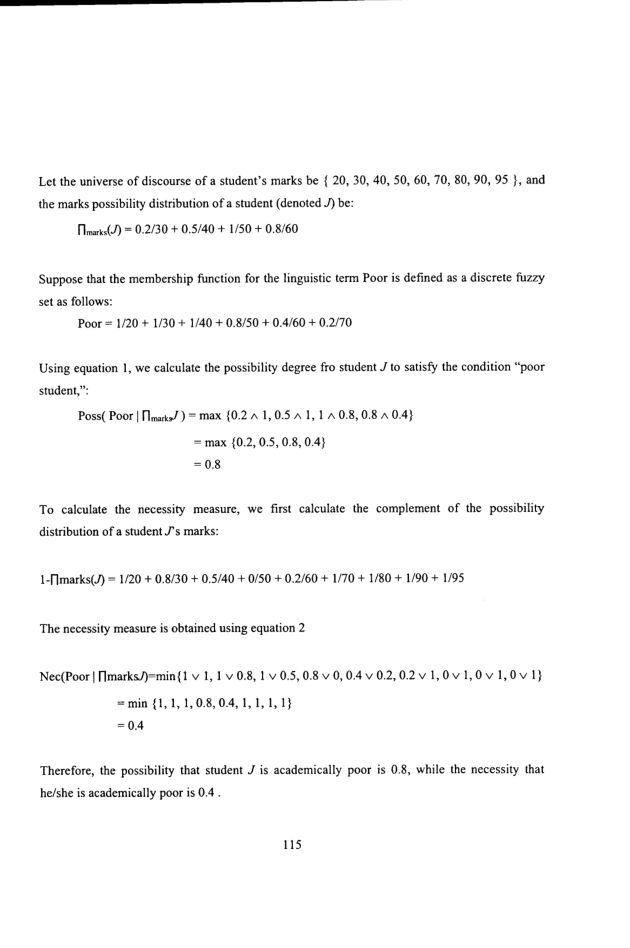
Source PDF · page 126 of 201Check original scan ↗
4.6 Case Refining (Filtering of retrieved solutions)
At this point, the three algorithms for Nearest Neighbour matching are:
1. The combination of Correlation of Interest vector and the distance of non-interest
attributes to their mean values
2. Distance of two vectors (i.e., using one vector as a reference point and find the distance
of the other vector of this point)
3. Trivial Information Retrieval (IR) algorithm, utilising correlation only
It is worth noting that all three algorithms tend to return the same ranking for the top three ranks
and, in many cases, the top five. The variation seems to show itself from Rank no. 6 onwards.
The matching percentage is also used to compare the cases within the same algorithm only. A
comparison using the matching percentage across two or more algorithms would be deemed
meaningless.
Once the top X number of cases are ranked (X = 10 at this stage), it is logical to filter out some
courses to refine the solution further. In the example of the prototype academic advisement,
PRFM (Performance attribute) is used to recommend whether or not each student should
undertake courses which are deemed more academically demanding by matching with the DIFF
(Difficulty attribute) of each course. This process is essentially equivalent to the Case Refining
process in INRECA methodology.
The algorithm is simple. Loop through the array of the top X ranks. For each of the
recommended courses, check to see whether the student’s PRFM exceeds, or is at least equal to,
the course’s DIFF. If so, this course is recommended. If the advice does not yet contain enough
courses (i.e., number of recommended courses is below number of courses to be taken), then
proceed to the next rank and perform the same PRFM vs. DIFF checking. In the prototype
system, number of courses to be taken is three.
116
View original scanned page
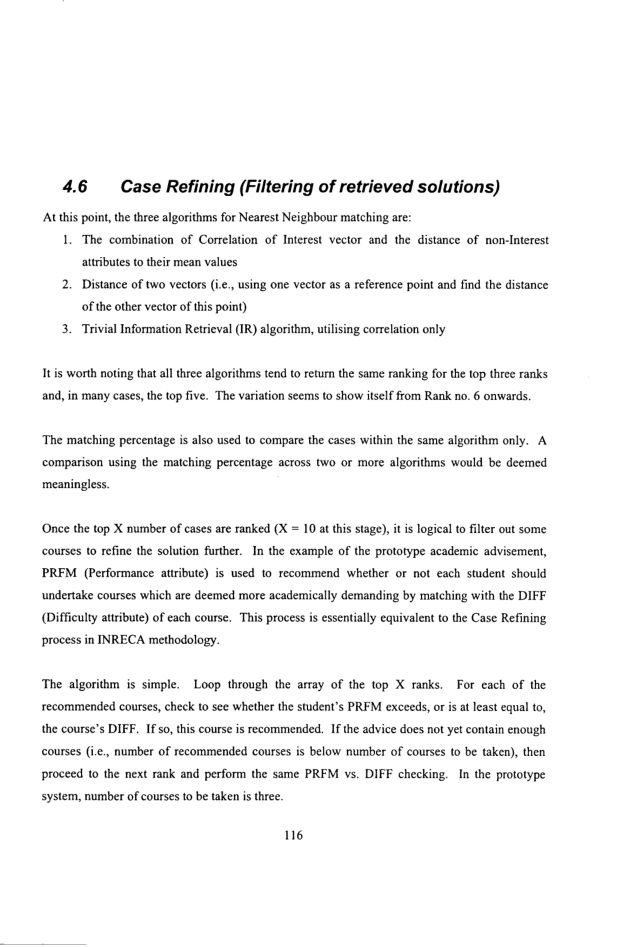
Source PDF · page 127 of 201Check original scan ↗
An issue arises when the advice set is filled with two courses so far and is proceeding to the next
rank to find the next and last possible best course. What if there are two or more courses found
to be suitable? Which one is to be chosen? This issue is illustrated in the Problem no. 6 (index =
0130223). More filters (i.e., more rules) may need to come into play here in order to determine a
plausible recommendation of this tie.
Given that the proposed algorithm in the previous page was flawed in the sense that the ranking
percentage was not utilised, the improved version is as follows:
The advice matrix consists of three categories: the number of occurrences of each course in the
top ten ranks, highest percentage obtained from the best rank that each course was a solution, and
the weighted count of occurrences.
The last item is based on the following ideas:
• The ten ranks should have their own weights
• For each weight, there should be a based value, say X, and a step value, say Y
• The lowest rank will have a weight of X+Y and the highest rank: X+10Y
Suppose that courses that appear in the top five ranks would be TWICE as significant as the one
appearing in the last five ranks.
That is,
2[(X+Y)+(X+2Y)+(X+3Y)+(X+4Y)+(X+5Y)]=[(X+6Y)+(X+7Y)+(X+8Y)+(X+9Y)+(X+10Y)].
This equates to X=2Y.
To make things simple, the sum of weights (X+Y) up until (X+10Y) is 1.
Solve these equations and we get X=2/75 and Y=l/75.
117
View original scanned page
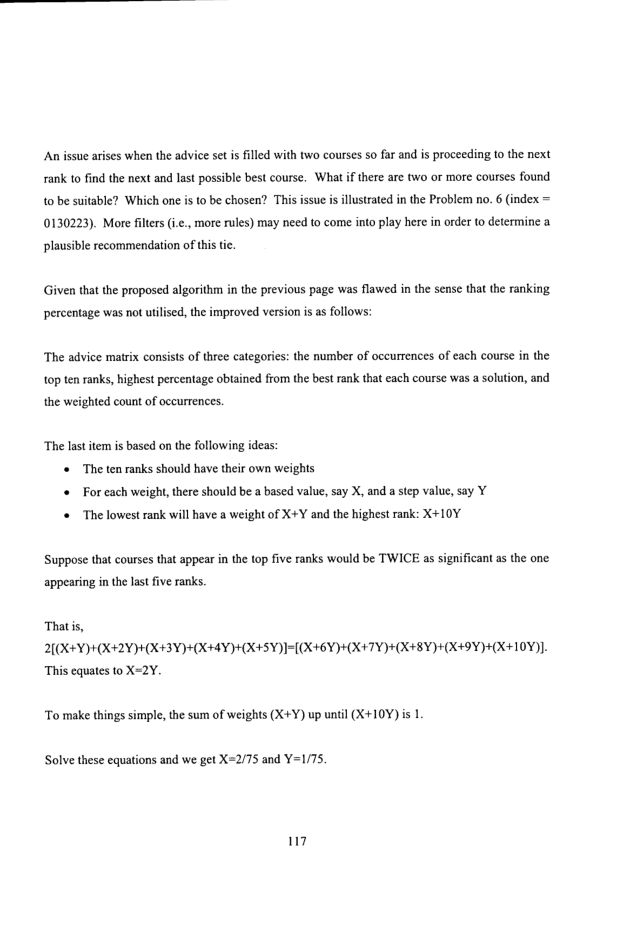
Source PDF · page 128 of 201Check original scan ↗
Then, for each time the course appears in each rank, we would add these weights to get the
weighted count of occurrences.
The prototype system has been improved to provide the advice along with basic reasons for each
advice.
The advice matrix is now sorted by the ranked percentage as the first sort key. If there is a tie in
any ranks, then the weighted count is used to break this tie. This is to ensure that each ranking
contains only one distinct element.
To make the advice slightly more readable, each advice is colour-coded as follows:
• RED denotes courses whose prerequisites have not yet been fulfilled
• ORANGE denotes courses that are not recommended due to its perceived difficulty being
greater than the student's demonstrated academic performance
• GREEN denotes recommended courses with ranked order
• BLUE denotes other possible courses for the student’s consideration
4.6.1 Comparison-Based Recommendation
Feedback strategies can be classified in terms of the type of feedback they aim to capture
(feature-level vs. case-level feedback) and the cost to the student (low-cost vs. high-cost) [29].
Four different feedback strategies have been incorporated into recommender systems to a lesser
or greater extent. Value elicitation and tweaking are feature level techniques in the sense that the
student is asked to provide information about the features of a recommended case. In the former,
they must provide a specific value for a specific feature (e.g., show the electives whose
prerequisite is DS207), while the latter requests that they simply express a directional preference
for a particular feature value (e.g., show the electives that belong to higher year than the current
recommendation or electives that have and increased perceived difficulty level). In contrast,
ratings-based and preference-based feedback methods operate at the case level. In the former,
the student is asked to rate or grade the recommended cases according to their suitability, while
in the latter the student is simply asked to select one of the current set of recommendations that is
118
View original scanned page
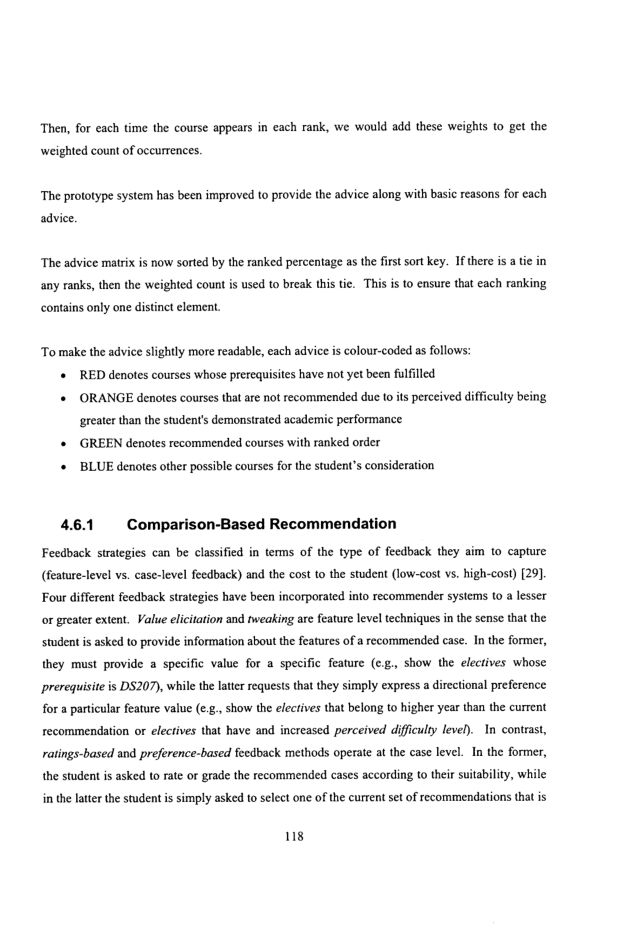
Source PDF · page 129 of 201Check original scan ↗
closest to their requirements and circumstances (or farthest from their
requirements/circumstances).
4.7 Validation
4.7.1 Stability under change
The prototype system can now take existing cases from three different knowledge bases. The
difference in each knowledge base is on the number of the permutations of the INT profiles. For
example, Knowledge 15 has a number of 15 permutations of INT profile out of all 60 possible
permutations (5P3).
When reducing the number of these permutations from 20 down to 15, the system still ranks the
cases with exactly the same order as in Knowledge 20, excluding any cases that are no longer
present in Knowledge 15.
Unfortunately, in order to test this effectively, the problem set should be developed with the
highest number of INT permutations in mind. Upon reducing these permutations, the stability
under change can then be tested for this criterion.
The current problem set was developed for Knowledge 20, and it can show the stability of the
system when working with Knowledge 15. Another problem set is to be devised for Knowledge
47. This set can be used to test the system, given Knowledge 20 or Knowledge 15.
4.7.2 Plausibility when the student’s perceived performance is
lower than the course’s difficulty
To test this, the performance or PRFM attribute is set to either 2 or 1 to see the recommendation
it affects against courses with difficulty level of 3.
119
View original scanned page
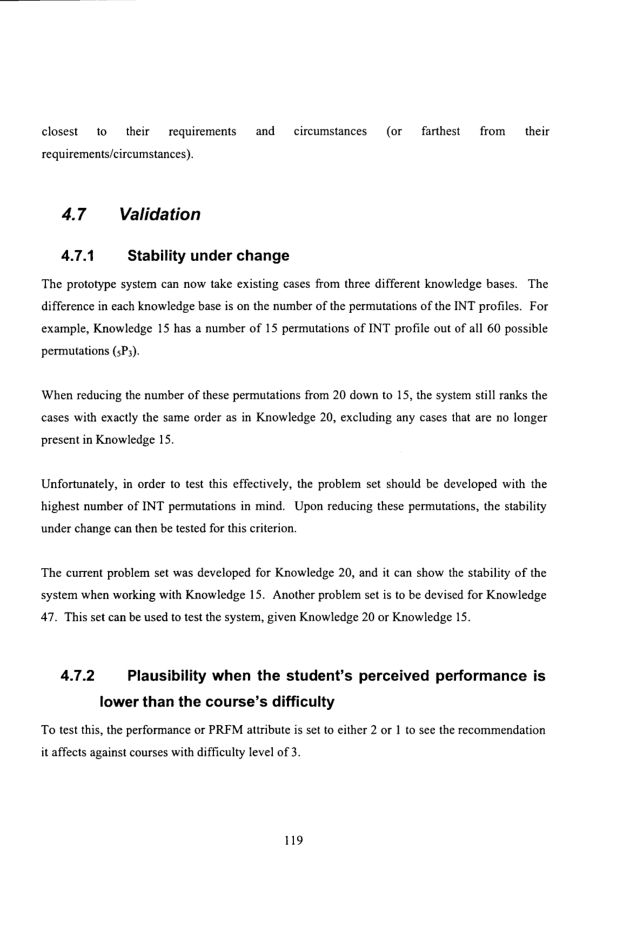
Source PDF · page 130 of 201Check original scan ↗
Prerequisites to all courses are assumed fulfilled. That is, no blocking on unfulfilled
prerequisites will occur in this test.
120
View original scanned page

Source PDF · page 131 of 201Check original scan ↗
The difficulty vector (Dl, 02, 0M3, M4, NM5, N6, NS7, S8) is set to (1,2, 1, 3, 2,3, 1, 2).
The format of the attributes vector is (DSP, OPTIC, MWAVE, NTWRK, SATEL, PRFM,
CHRT).
4.7.2.1 Test case (0,2, 0, 3,1, 2,3)
Translation of the attributes vector:
• Interests: Networking, Optics, Satellite
• Performance: 2
• Absolute specialisation
A logical advice would be to recommend N6, NS7, NM5, initially. But, N6 has a difficulty of 3.
The final logical advice should be NS7, NM5, 02. The CBR system recommends NS7, OM3,
and 02, with NM5 available as the fourth choice.
4.12.2 Test case (0,3, 0,1, 2,1,1)
Translation of the attributes vector:
• Interests: Optics, Satellite, Networking
• Performance: 1
• Minimum specialisation and more diversity across the fields
The initial logical advice is 02, S8, and N6. But, all of these are more difficult than the student’s
perceived performance, so the next advice is OM3, NS7, NM5. NM5 has a difficulty level
higher than 1, so the final advice can be OM3, NS7 and D1 (as the only other course, M4, is
level 3 difficult). The prototype recommends NS7, OM3, and D l, which is a very close match to
the logics.
121
View original scanned page
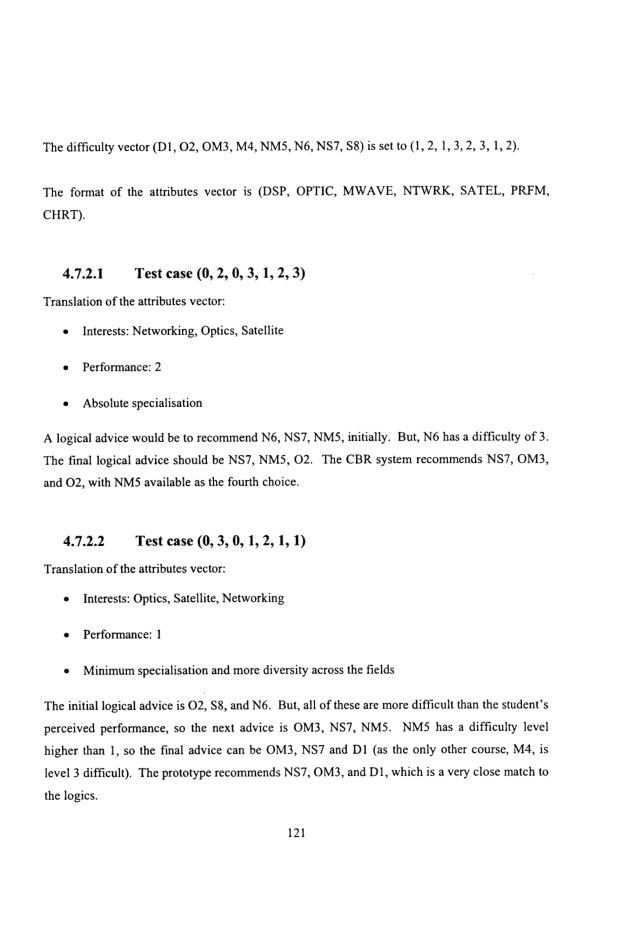
Source PDF · page 132 of 201Check original scan ↗
4.7.Z.3 Test case (3, 2, 0, 0,1, 2,2)
Translation of the attributes vector:
• Interests: DSP, Optics, Satellite
• Performance: 2
• Some specialisation
The first logical advice would be D l, 02, and OM3. Given that all of these courses are within
the student’s perceived capability, this advice is also final. The system gives very similar advice
of D l, OM3, and 02 as well.
4.7.2.4 Test case (0, 3,1, 2, 0,1, 3)
Translation of the attributes vector:
• Interests: Optics, Networking, Microwave
• Performance: 1
• Absolute specialisation
The logical advice begins with 02, OM3, and N6. But, 02 and N6 are deemed too difficult for
the student, so the next advice is OM3, NM5, and M4. But, NM5 and M4 are still too difficult.
The final advice would be OM3, NS7, and Dl (as the other remaining course, S8, is also too
difficult). The system also recommends a perfectly matched advice of OM3, NS7, and Dl in the
same ranking as well.
4.7.2.5 Test case (0,1, 0,3, 2,1,3)
Translation of the attributes vector:
• Interests: Networking, Satellite, Optics
122
View original scanned page
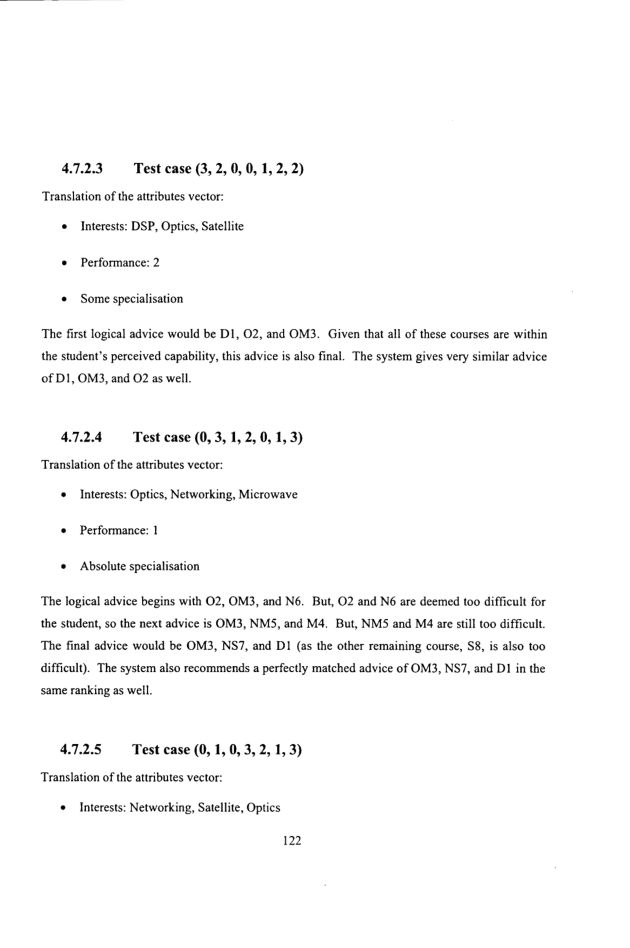
Source PDF · page 133 of 201Check original scan ↗
• Performance: 1
• Absolute specialisation
The first human advice would be N6, NS7, and NM5. Because N6 and NM5 are too difficult,
the second advice is NS7, S8, and 02. But, S8 and 02 are also deemed too difficult. The last
advice would be NS7, and any order between D1 and 0M3 (as the other course, M4, is also too
difficult). The system ranks NS7, 0M3, and D l, which is very reasonable.
4.12.6 Test case (0,1,3, 0, 2, 2,3)
Translation of the attributes vector:
• Interests: Microwave, Satellite, Optics
• Performance: 2
• Absolute specialisation
Initially, the human advice would be M4, OM3, and NM5. But, M4 has a difficulty level of 3.
The next and final advice would be OM3, NM5, and S8. The prototype system recommends
OM3, NM5, and NS7 (with S8 as a tie with NS7, but it has a lower sub-ranking score).
4.12.1 Test case (0, 0 ,1 ,2 ,3 ,2 ,1 )
Translation of the attributes vector:
• Interests: Satellite, Networking, Microwave
• Performance: 2
• Minimal specialisation with more diversity across fields
The best logical advice would be NS7, NM5, and OM3. The CBR system recommends NS7,
NM5, and S8 (with OM3 as the next available choice).
123
View original scanned page
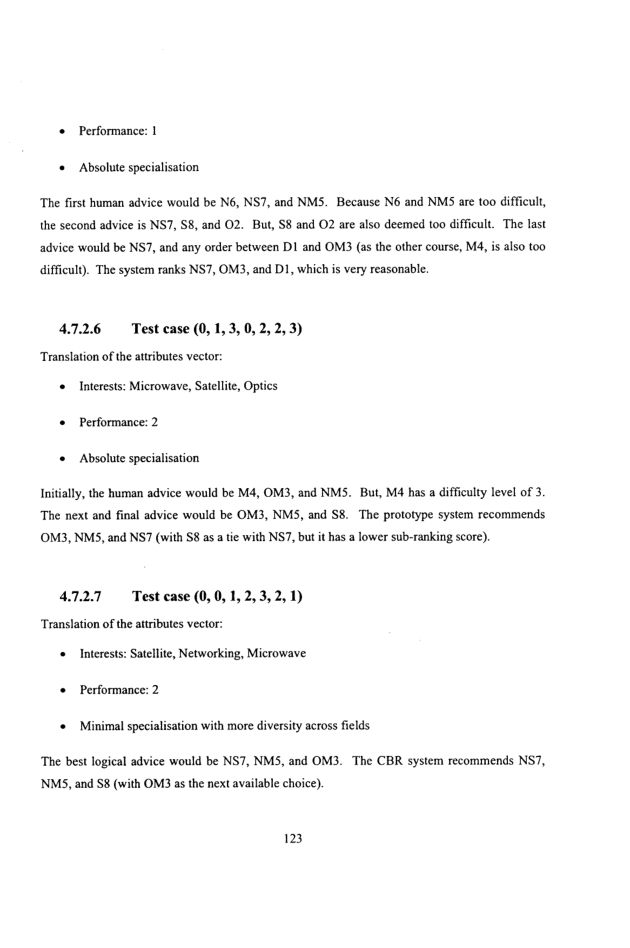
Source PDF · page 134 of 201Check original scan ↗
4.7.2.S Test case (1, 2, 0, 0, 3,1, 2)
Translation of the attributes vector:
• Interests: Satellite, Optics, DSP
• Performance: 1
• Some specialisation
The first advice would be SB, 02, and DI. Because SB and 02 have higher difficulty level than
the student’s performance, the next advice would be NS7, 0M3, and D l. The system also gives
exactly the same advice in both choices and their ranking order.
From the comparison table D-l (Appendix D), the improvement version has performed
reasonably better than the other two algorithms, in both overall matching percentage and the
ranking, as seen in table 4-5.
4.7.3 Plausibility when the prerequisites of the recommended
courses have not yet been fulfilled.
To test this, the prerequisites of certain courses will have the status of unfulfilled (i.e., it has a
value 0 in the prerequisite vector). Out of the test cases below, the first four cases will have the
prerequisites vector (Dl, 02, 0M3, M4, NM5, N6, NS7, SB) set to (1, 0, 1, 1, 1, 1, 1, 0). The
remaining four cases will be tested against the prerequisites vector of (1, 1,0, 1,0, 1,0, 1). The
PRFM attribute will be 3 so the recommended courses are not affected by the level of difficulty.
The format of the attributes vector is (DSP, OPTIC, MWAVE, NTWRK, SATEL, PRFM,
CHRT).
4.7.3.1 Test case (0, 2, 0 ,3 ,1 ,3 ,3 )
Translation of the attributes vector:
• Interests: Networking, Optics, Satellite
124
View original scanned page
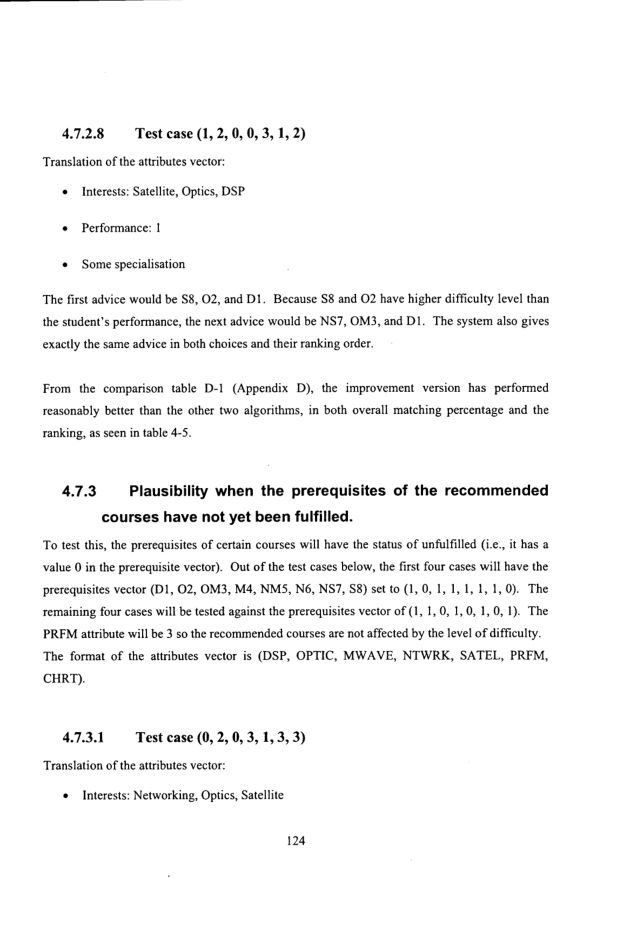
Source PDF · page 135 of 201Check original scan ↗
• Performance: 3
• Absolute specialisation
The logical advice would be to recommend N6, NS7, NM5. The CBR system recommends NS7,
OM3, and N6, with NM5 available as the fourth choice.
4.7.3.2 Test case (0, 3, 0,1, 2,3,1)
Translation of attributes vector:
• Interests: Optics, Satellite, Networking
• Performance: 3
• Minimum specialisation and more diversity across the fields
The initial logical advice is 02, S8, and NM5. But, 02 and S8 are blocked by unfulfilled
prerequisites. The next advice would be OM3, NS7, and NM5. The system recommends NS7,
OM3, and NM5, which is sensible under the circumstances.
4.7.3 J Test case (3,2, 0, 0,1,3,2)
Translation of the attributes vector:
• Interests: DSP, Optics, Satellite
• Performance: 3
• Some specialisation
The first logical advice would be D l, 02, and OM3. But, 02 is blocked by prerequisite
incompletion. The second advice would then be D l, OM3, and NS7. (Remember that S8 is also
blocked.) The system gives exactly the same advice of D l, OM3, and NS7.
125
View original scanned page
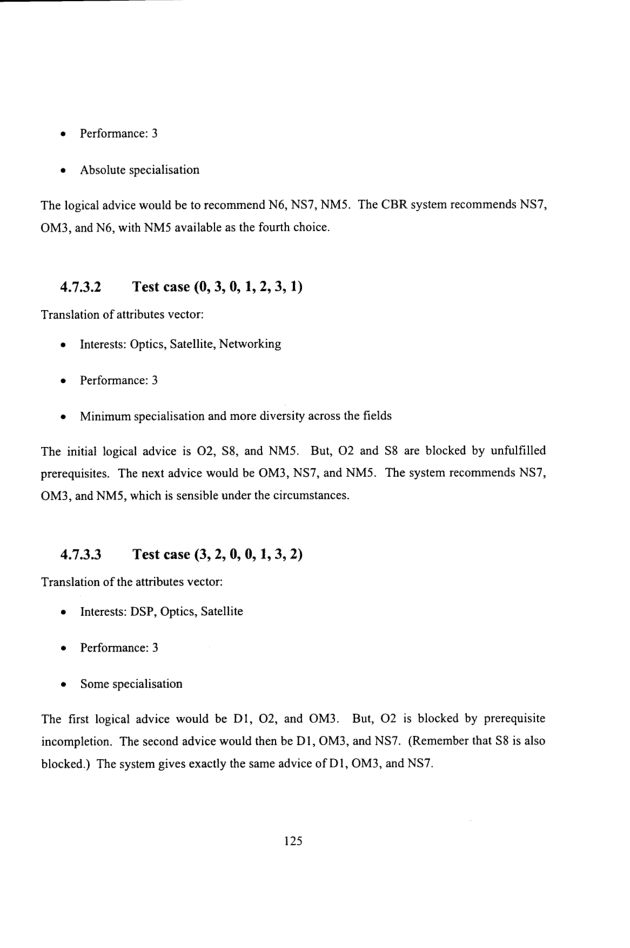
Source PDF · page 136 of 201Check original scan ↗
4.1.2) A Test case (0,3,1, 2, 0,3,3)
Translation of the attributes vector:
• Interests: Optics, Networking, Microwave
• Performance: 3
• Absolute specialisation
The logical advice begins with 02, OM3, and N6. But, the prerequisite of 02 has not been
fulfilled yet. The next and final advice would OM3, N6, and NM5. The system recommends
OM3, M4, and NS7, with D l, NM5 and N6 as subsequent choices. The discrepancy may be
result from the fact that the knowledge base makes up less than 10% of the overall possible
cases.
4.7.3.5 Test case (0,1, 0,3, 2,3,3)
Translation of the attributes vector:
• Interests: Networking, Satellite, Optics
• Performance: 3
• Absolute specialisation
The first human advice would be N6, NS7, and NM5. Because the prerequisites of NS7 and
NM5 have not been fulfilled, the second and final advice is then N6, S8, and 02. The system
gives exactly the same advice of N6, S8, and 02 as well.
4.7.3.6 Test case (0,1,3, 0, 2,3,3)
Translation of the attributes vector:
• Interests: Microwave, Satellite, Optics
• Performance: 3
126
View original scanned page
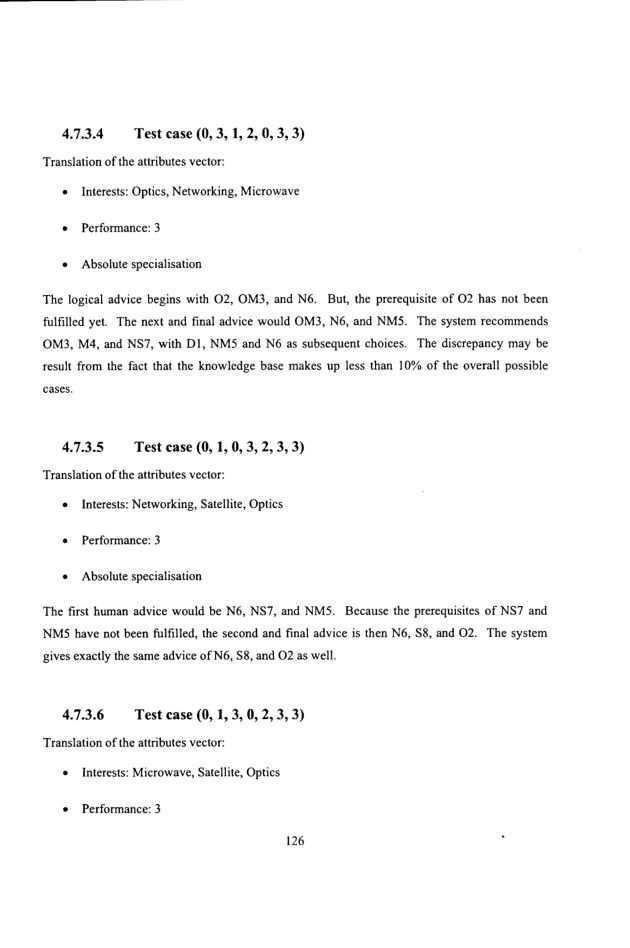
Source PDF · page 137 of 201Check original scan ↗
Absolute specialisation
Initially, the human advice would be M4, OM3, and NM5. But, OM3 and NM5 are blocked due
to incomplete prerequisites. The subsequent advice would be M4, S8, and NS7. Given that NS7
is also blocked, the final advice would be M4, S8, and 02. The prototype system recommends
M4, S8, and D1 (with M4 available as the next ranked choice). Diversity (or lack of it) within
the knowledge base may have caused this difference.
4.7.3.7 Test case (0, 0,1, 2,3, 3,1)
Translation of the attributes vector:
• Interests: Satellite, Networking, Microwave
• Performance: 3
• Minimal specialisation with more diversity across fields
The best logical advice would be NS7, NM5, and OM3. But, all of these courses are blocked
because none of the prerequisites have been fulfilled. The next and final advice would be S8,
N6, and M4. The CBR system recommends S8, N6, and D1 (with M4 available as the next
ranked choice). Diversity (or lack of it) within the knowledge base may have caused this
difference.
4.7.3.S Test case (1, 2, 0, 0,3,3,2)
Translation of the attributes vector:
• Interests: Satellite, Optics, DSP
• Performance: 3
• Some specialisation
127
View original scanned page
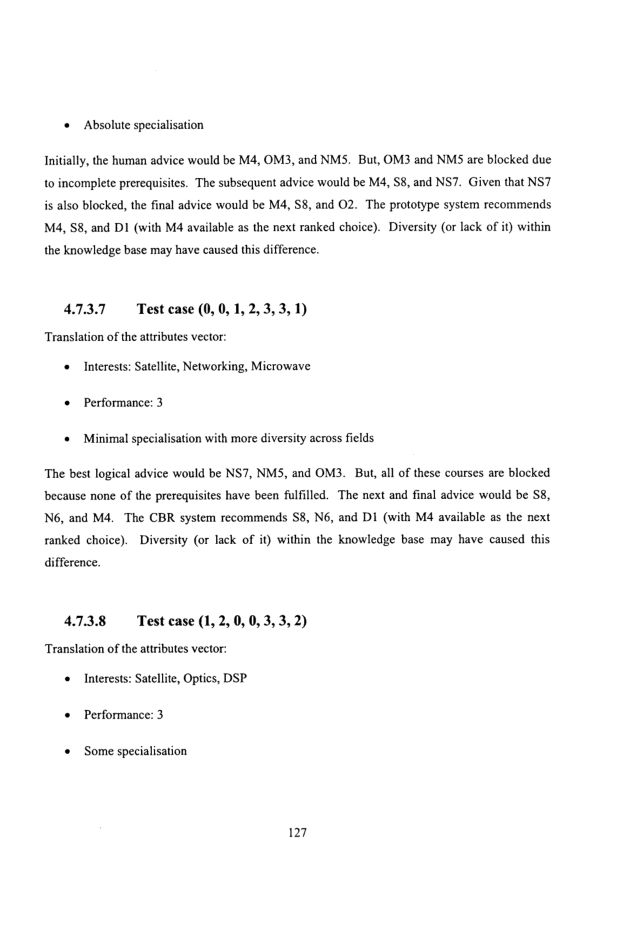
Source PDF · page 138 of 201Check original scan ↗
The first advice would be S8, 02, and 0M3. Because OM3 is blocked for not having the
prerequisite fulfilled, the next advice would be S8, 02, and D l. The system also recommends
S8, 02, and Dl in exactly the same order.
From the comparison table D-2 (Appendix D), the improvement version has clearly
outperformed the other two algorithms, in both overall matching percentage and the ranking as
seen in table 4-5.
Table D-3 uses the trivial Information Retrieval algorithm to calculate the similarity percentage
between the output of each algorithm and the expected recommendation. For each of the case,
each algorithm is given a discrete value between 1 and 3, where 3 denotes the best match for that
particular case. The matching percentage is then totalled to yield to overall matching percentage.
The individual case ranking is also summed up to show the final ranking among three
algorithms, where the higher the value is, the more efficient that algorithm can make
recommendation.
Correlation Ranking
Trivial Euclid Improve Trivial Euclid Improve
comparison between algorithm when performance is lower than difficulty
0.845 0.655 0.845 3 1 3
1.000 1.000 1.000 3 3 3
1.000 1.000 1.000 3 3 3
1.000 1.000 1.000 3 3 3
0.964 0.964 1.000 2 2 3
0.964 0.964 0.964 3 3 3
0.802 0.926 0.964 1 2 3
1.000 1.000 1.000 3 3 3
7.574 7.508 7.772 total 21.000 20.000 24.000
comparison between algorithm when prerequisites are not yet fulfilled
0.886 0.756 0.802 3 1 2
0.756 0.886 0.964 1 2 3
1.000 1.000 1.000 3 3 3
0.655 0.655 0.802 2 2 3
0.802 0.655 1.000 2 1 3
0.655 0.655 0.964 2 2 3
Figure 4-5: Correlation and Ranking table to show the efficiency of improvement algorithm over earlier
versions
128
View original scanned page
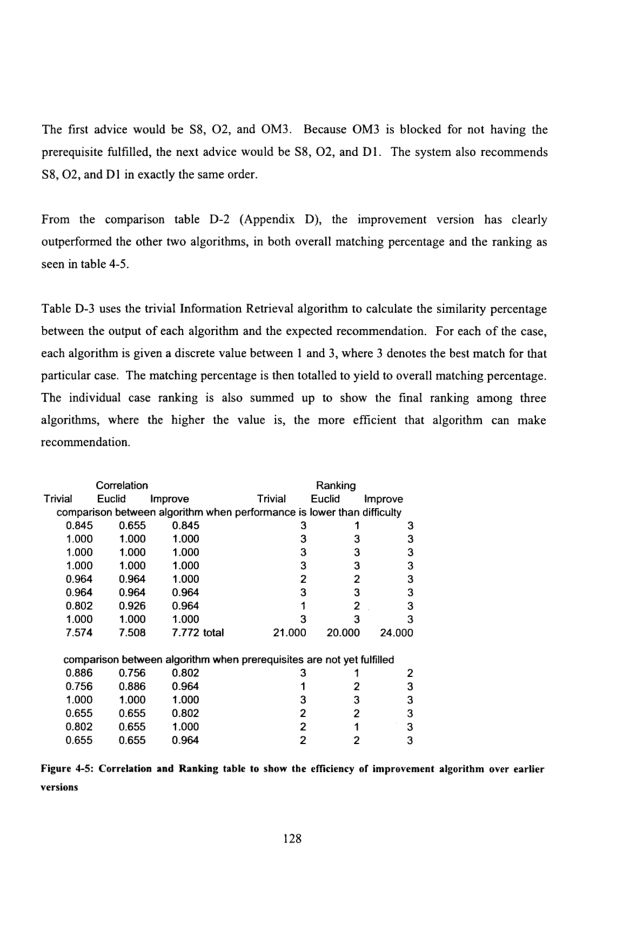
Source PDF · page 139 of 201Check original scan ↗
4.7.4 Plausibility when both the student’s performance is lower
than the course’s difficulty AND the prerequisites of the
recommended courses have not been fulfilled
Both tests above are combined here to see the effect on the overall plausibility and sensibility of
the given academic advices.
4.7.4.1 Test case (3, 0,1, 2, 0,2,3)
The first test case is when the problem profile (DSP, OPTIC, MWAVE, NTWRK, SATEL,
PRFM, CHRT) of (3, 0,1,2 , 0, 2, 3).
The advisor will recommend D l, N6, and NM5. Now, N6 is deemed too difficult (difficulty
level 3) for this student (PRFM = 2). The next three courses NS7 (prerequisite not fulfilled), M4
(also deemed to be too difficult), are OM3 (prerequisite not fulfilled) are not recommended.
This leaves either 02 or S8 as the final choice. Using the improvement algorithm, the prototype
system recommended NM5, D l, and S8, which corresponds to the logic of an academic advisor.
4.7.4.2 Test case (0, 0,3, 2,1,2, 2)
Another test for stability under small change is to assign a prerequisite vector for the given
courses. For testing purposes, make the prerequisites for courses associated with multiple
disciplines (e.g., OM3 and NS7) not yet fulfilled. The prerequisite vector of (Dl, 02, OM3, M4,
NM5, N6, NS7, S8) will have the values (1, 1,0, 1, 1, 1,0, 1).
Here is a test problem.
(See
http://cbr.tanat.net/match.php?tabIe=3&DSP=0&QPTIC=0&MWAVE=3&NTWRK=2&SATEL
= 1&PRFM=2&CHRT=2)
129
View original scanned page
Source PDF · page 140 of 201Check original scan ↗
A student who is interested in Microwave, Networking, and Satellite (in order of preference), has
an average academic performance, and wants some specialisation in his fields will have a profile
(DSP, OPTIC, MWAVE, NTWRK, SATEL, PRFM, CHRT) as (0, 0 ,3 ,2 , 1,2,2).
Now, as an academic advisor, the instant advice given will be the courses M4, NM5, and N6.
Taking into account that the perceived difficulties (difficulty level 3) of M4 and N6 are probably
beyond the student’s academic performance (PRFM = 2), the advisor will skip these two courses
and recommend NM5, OM3, and NS7. Because the prerequisites of OM3 and NS7 have not yet
been fulfilled, the advisor will find another two courses to substitute these. Thus, the final
recommendation will be NM5, S8, and either D1 or 02.
The prototype system using the improvement matching algorithm actually recommends a very
similar set of courses, which contain NM5, 02 and D l, with a possibility of SB. Now, using
commonsense, SB should have a higher precedent over Dl and 02. However, keep in mind that
pure CBR depends entirely on the quality of cases in its knowledge base. Currently, the number
of cases is less than 10% of the overall number of every possible permutation. In addition, no
rules are in place to double check the final advice against the preference in the fields of interest.
We can use such rules to detect that SB is within the student’s field of interests and Dl and 02
are not, thus adjusting the ranking of SB. This last process can be integrated into the refine phase
in the CBR cycle.
4.8 Framework
4.8.1 Characteristics of Case-Based Academic Advisement
Recommender Systems
The increasing scarcity of human academic advisement resources makes it difficult for students
to readily access academic advisement services regardless of time and place. Academic advisors
use their own experiences to solve most of the student cases that are queried to them. However,
as student cases become more complex, the advising decision experiences that academic advisors
are experts in tend to diverge - academic advising experience is distributed among experts and
130
View original scanned page
Source PDF · page 141 of 201Check original scan ↗
the advising experiences do not necessarily overlap. Nevertheless, when a student has a
problem, he or she wants it solved as soon as possible. If that expert advisor is not available, the
student has to wait, which is annoying and creates a negative image for the school or department.
Advising experience must be available to every student at all times. Since academic advising
experience can be deemed an educational institution asset, it has to be collected, preserved, and
used as efficiently and effectively as possible. The best way to achieve this is to use CBR to
develop academic advisement systems.
The goal of developing a case-based academic advisement recommender system is to create a
knowledge repository that contains academic advising experiences for a complex advising
domain that changes over time. This knowledge repository will be used in an institution by a
group of people with varying levels of expertise. It is obvious that the development and use of
such a system does not only involve technical processes, but also raises managerial and
organisational issues as well. The tasks that should be performed to develop a case-based
academic advisement recommender system and the processes that have to be put into place to
make such a system operational are described.
Suppose that students are thought of as customers and academic advisors as salespeople.
Academic advice or “recommendations” by academic advisors are always at least based on
knowledge about the availability of courses, interest in the fields of study, the student’s academic
performance, and specialisation behaviour. A concept of “recommender agents” was developed
in an attempt to model the behaviour of salespeople. Such agents draw on previous results from
CBR (among machine learning and other advances in AI technology) to develop user models,
and anticipate and predict user preferences. Given its characteristics, this concept can likely be
applied to model the behaviour of academic advisors [30].
131
View original scanned page
Source PDF · page 142 of 201Check original scan ↗
4.8.2 Development and Use of Case-Based Academic
Advisement Recommender Systems
4.8.2.1 Process Types
The table 4-1 below outlines the different processes, namely managerial processes,
organisational processes, and technical processes, over the two phases, namely system
development and system use.
System Development System Use
Managerial Processes Goal Definition Progress
Awareness Creation Verification and
CBR-Tool Selection Controlling
Organisational Processes Project Team Selection End-User Training
Initial Domain Selection Continuous
Project Team Training Knowledge
Knowledge Acquisition Process Acquisition
Development Utilisation Process
Utilisation Process Development
Technical Processes General System Specification Continuous System
IT-System System Implementation Maintenance
Related System Integration
System Verification
Knowledge Initial Knowledge Acquisition Continuous
Repository Core Knowledge Acquisition Knowledge
Related Acquisition and
Maintenance
Table 4-1: Process Types
132
View original scanned page
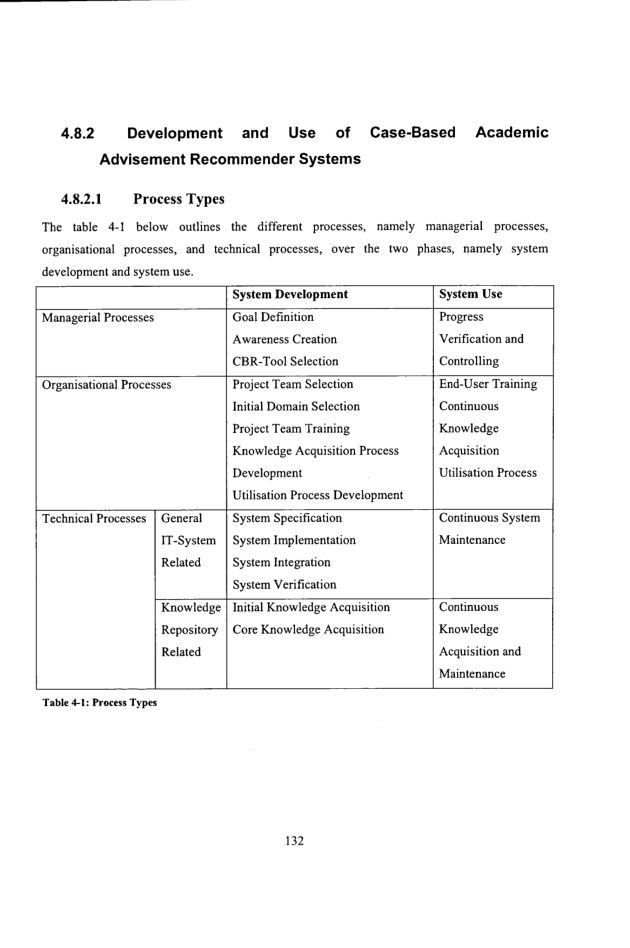
Source PDF · page 143 of 201Check original scan ↗
4.S.2.2 Managerial Processes during System Development
4.8.2.2.1 Goal Definition
For a case-based academic advisement recommender system project to be successful, precise
goals must be determined at the outset. This enables management to fix the direction in which
the project should develop and to measure the success of the project upon completion. Hard
(quantitative) and soft (qualitative) success criteria should be identified (Stolpmann & Wess,
1999).
Hard criteria are measurable quantities and cover aspects like:
• Problem solution quality (advice soundness, consistency)
• Process quality (average time needed to solve a student case)
• Organisational quality (speed up in new academic advisor training, flexibility of staffing,
cost per interaction)
In contrast, soft criteria measure the subjective quality of the academic advisement:
• Student satisfaction (availability of the academic advisors, perceived competence,
friendliness)
• Academic advisor satisfaction (workload, work atmosphere, repetitiveness of tasks,
intellectual stimulation)
• Institution aspects (preservation of knowledge, publicity)
The goal must be communicated to the project team, and the team has to be motivated to achieve
them. When project goals are selected, it is important that these goals are realistic in terms of
their time frame and whether they can be achieved with an acceptable amount of resources. The
case-based academic advisement recommender project must be seen as part of the long-term
knowledge management strategy for the institution. Since knowledge increases and evolves, the
experience in a CBR system must be maintained continuously. System development is only the
initial phase in any CBR project.
133
View original scanned page
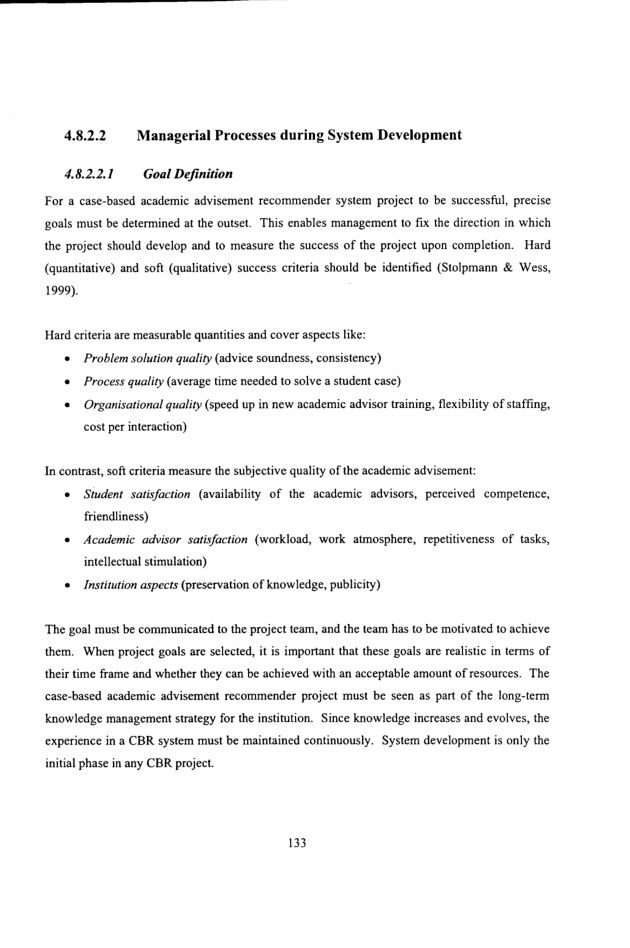
Source PDF · page 144 of 201Check original scan ↗
4.8.2.2.2 A wareness Creation and Motivation
The case-based academic advisement recommender system project targets the most precious
asset of human academic advisors: their experience. The project’s goal is to collect the academic
advising experience of each relevant academic advisor and make it available to whoever needs it
in the institution.
Obviously, the academic advisors will have a motivational barrier to giving away their
experience. Every academic advisor knows that “knowledge is power”. In academic advisement
environments or domains where experience is being used to solve problems, having experience
translates into being superior and indispensable, whereas giving away the knowledge can be
perceived as becoming obsolete.
However, as soon as academic advisors become part of a project team and understand that
sharing knowledge means that they will get back much more than they invest, most barriers
disappear. It has to be made clear that the user and beneficiary of the developed system will be
themselves and not an anonymous party. They will be able to access the experiences of their
colleagues and advise on cases they might not have been able to advise on before, as well as end
situations in which colleagues constantly pester them for advice. The resulting academic
advisement system will enable them to work with increased efficiency and effectiveness.
Apart from the academic advisors, management and administration has to be motivated as well.
CBR is perceived to be “academic” by most managers and administrators. While investing
resources into a database project seems to be no problem for them, investing into CBR is
investing into a venture with an uncertain outcome. It has to be clarified that CBR is an
established technology and by no means only an academic “playground”. It also has to be
clarified that the initial installation of the case-based academic advisement recommender system
is only the beginning of a process that will enable the institute to capture and reuse experience.
Management and administrators must be prepared to invest resources on a continuous basis
while the system is operational. A CBR system is useful only if it contains knowledge and it is
maintained on a continuous basis. Without continuous management support and advisors who
are willing to fill and use the system, any CBR project is bound to fail.
134
View original scanned page
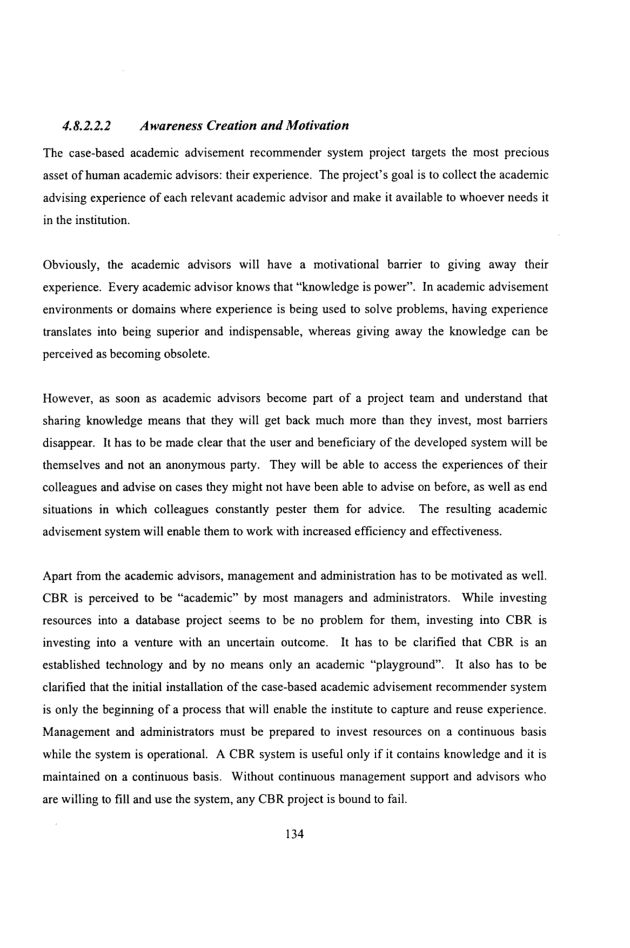
Source PDF · page 145 of 201Check original scan ↗
4.8.2.2.3 CBR Tool Selection
Earlier, the author described the prototyping of a proof of concept case-based academic advising
system. However, each institute has the choice of using the existing tools with the cost of
significant customisation. Based on the project, domain, and user-group specifications, a
suitable tool to develop the case-based academic advisement recommender system may be
chosen instead. Criteria to be taken into account include:
• The operating environment in which the system is going to be used (hardware and
software, network architecture, database type, etc.)
• The complexity of the technical domain (home appliances or networked workstations)
• The level of experience of the students and the academic advisors
• The organisation of the academic advisors (study programs under responsibility, physical
locations, etc.)
• The project goals that have been defined
Since the case-based academic advisement recommender system is going to serve as a long-term
knowledge repository for the institution, this selection should be based not only on technical
criteria, but also should take into account economic and institutional considerations, as well as
the strategic decisions of the institute.
4.8.3 Tweaking
There is a mode of operation, namely navigation by browsing or navigation by proposing,
whereby a student can be presented with a group of cases during each recommendation cycle and
the next cycle can be based on the feedback provided [29]. The student can also be asked to
express feedback in the form of a tweak or a set of tweaks. In short, the student can implicitly
select one of the presented cases and express directional preferences for certain features. For
instance, in the Academic Advisement system, the student can be presented with the single best
case during each recommendation cycle and introduce tweaks over features such as subject
136
View original scanned page
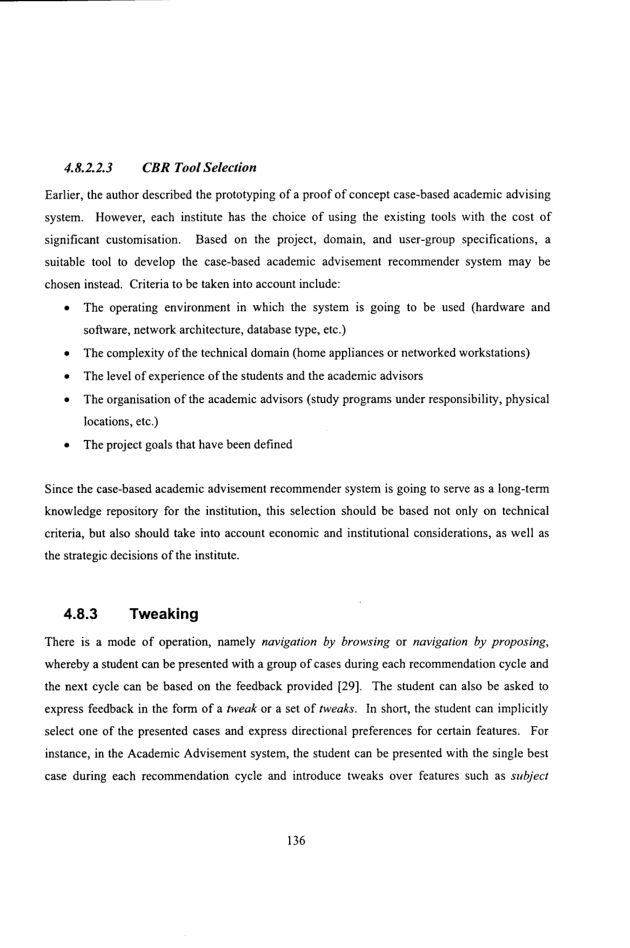
Source PDF · page 146 of 201Check original scan ↗
difficulty (find me easier or more difficult subjects) or teaching style (find me subjects with
lectures, workshops, or online delivery).
In a sense, tweaking is a combination of navigation by asking and navigation by proposing -
sequences of cases can be proposed and the student can be asked for specific information about
particular features. However, the cost to or involvement of the student should be lower than
value elicitation because the student is not expected to provide specific feature values of which
they may have little or no knowledge. This strategy can also combine elements of preference-
based feedback since the student must explicitly identify a preferred case over which the tweaks
should be applied.
4.8.4 Ratings-based
Recently, ratings-based feedback has become a popular form of feedback in recommender
systems. The basic idea is to ask the student to rate individual recommendation proposals - the
student provides case-level feedback. For example, we can design an Academic Advisement
recommender system to compile personalised subject lists for students based on their learned
fields of interest and, as such, it is involved in recommending subjects to students. We can
probably encourage students to rate the system’s subject recommendations (using a 5-point scale
from strong-negative to strong-positive) as a means of fine-tuning subsequent recommendation
cycles.
Generally, ratings-feedback is a relatively low-cost form of feedback since the student need only
express a qualitative (or perhaps quantitative) indication of interest at the level of an individual
case. The level of effort naturally increases if the student needs to rate many or all of the
recommended items, but we should allow students to choose to rate as few or as many of the
subjects as they desire.
137
View original scanned page
Source PDF · page 147 of 201Check original scan ↗
4.8.5 Preference-Based
Perhaps, the lowest cost form of feedback may be for the student to express a simple positive or
negative preference for one of the recommended cases. This form of feedback can be viewed as
a subset of tweaking in the sense that the student is just asked to express an individual positive or
negative preference without needing to indicate specific feature tweaks. Similarly, it has a lower
cost than ratings-based feedback because the student is not expected to distinguish between
different levels of preference.
138
View original scanned page

Conclusion and future works
Source PDF · page 148 of 201Check original scan ↗
Chapter 5
Conclusion and Future Works
5.1 Conclusion
Case-based reasoning (CBR) has been an active area of research for the past two decades. It was
proposed and implemented as a cognitive model by artificial intelligence researchers and then
applied as a model for building expert systems. Since the early 1990s, several popular
educational applications and innovations have been developed from the lessons learned from
CBR research, although none were directly related to academic advising.
This thesis designs, develops, and validates a prototype case-based academic advisement
recommender system that can be used to conduct online academic advising. A summary of the
features of the prototype academic advisement recommender system, including its features, is
presented in this chapter. It concludes with a list of future enhancements for the further
development of the case-based academic advisement recommender system.
Although the prototype system is small, it serves its purpose well as a proof of concept. The
prototype system was built for the normal case of students finishing one academic year and
advancing to the next. The cases only take into account “clear pass” students (i.e., students not
failing any courses). It also only considers a single stream of a program with multiple streams
(majors).
None of these are serious limitations. The test cases are quite general and valid for students
advancing from any year (n) of the program to the subsequent year (n+1). As the system can
also enforce prerequisites, it can handle students who have failed one or more courses in the
current year. The extension to multiple streams or majors is also quite straight forward when, as
for Electrical and Computer Engineering at RMIT, the program has a common structure and
majors are based simply on the selection of a subset of core courses for that major in each year
level.
139
View original scanned page
Source PDF · page 149 of 201Check original scan ↗
Expanding the system to cover all possible student situations in such a program primarily
involves adding sufficient cases to cover all of these student situations, to give an academic
advisement recommender system with only one universal case base.
To develop case-based academic advisement recommender systems that will be used in dynamic,
institution environments by a large group of users, one must take into account the managerial (or
administrative), organisational (or institutional), and technical processes. It has to be
remembered that once a CBR system is in place, continuous knowledge acquisition and
maintenance is necessary. Processes for knowledge acquisition and maintenance have to be
developed and executed, and personnel have to be dedicated to performing these tasks. A non
technical framework that defines these processes can be found in the appendix.
Some findings are briefly outlined below. Two distinct expert system techniques should be used.
Rule-based reasoning should be used for the selection of core (non-elective) courses and filtering
out the courses whose prerequisites have not yet been fulfilled. However, CBR should be used
for the advisory functions, in particular the selection of electives. Given the set of attributes of
the problem student case or profile, sound and reasonable academic advice will be given in the
form of recommended courses for that particular student to enrol in.
The standard CBR methodology should be used as follows:
• Retrieve similar cases to the current student profile in question
• Reuse a set of courses recommended by a similar case
• Revise or adapt that solution to better fit the new student profile in question by collating
the ranked results of similar cases
• Retain the new set of recommended courses
The most common set of attributes in each student case are the fields of interest, popularity of the
course, pass rate and high marks rate, suitability with the current industry trend, reputation of the
lecturer, type of assessment, and specialisation preference.
140
View original scanned page
Source PDF · page 150 of 201Check original scan ↗
For the purpose of prototyping, only the fields of interest, the student’s academic performance,
and the student’s specialisation preference are used to demonstrate the underlying ideas and
concepts.
Some exceptional cases that could happen to students:
• Student is in 3rd year and has already chosen a major. This student performed well in the
minor stream courses, but did not perform well in the core major courses. The student
would then like to change their major half way. This can be addressed by utilising the
minimum-time rule to determine what courses they must take to complete in the
minimum time under the new major.
• Student failed one of the core courses, which is a prerequisite to many subsequent
courses. The student also progresses normally in other series of courses. At one point,
the student may have to enrol in courses that span more than three different academic
years. If desired, a maximum-span rule could be added to limit the number of academic
years spanned in a single enrolment year.
To efficiently index a case and retrieve it in a timely manner, the prototype case-based academic
advisement recommender system has a small case base. At this point, as a proof of concept, a 1-
dimensional flat structure of case indexes is used.
Features in the prototype case-based academic advisement recommender system:
• Advise student which courses to take next semester
• Input and update information on course prerequisites by editing the backend scripts
• Input and update information on the academic year requirements, also by editing the
backend scripts
Advantages:
• Easy access to the system from anywhere using a Web browser
• Reduces advising traffic to academic advisors
• Saves time for both staff (academic advisors) and students (advisees)
141
View original scanned page
Source PDF · page 151 of 201Check original scan ↗
Disadvantages:
• Even when this system is eventually developed as a live, fully-fledged production
version, no system is a perfect system. Therefore, the results should not be taken as final.
They should be crosschecked with an academic advisor
• Minimises student-advisor interaction, which may in turn affect the opportunity of
advisors to keep themselves up-to-date with individual progress at a personal level
• Key decisions cannot be taken using the system
• System may not provide answers to all possible questions
• Systems may not provide support in special or exceptional cases like drop outs,
incomplete, and failures. Need to contact academic advisors for decision making in these
extraordinary cases
• System does not take into consideration students’ strengths and weaknesses while
advising courses
5.2 Future Work
A number of improvements necessary to take the system from a prototype to a working system
have been identified in the previous section. Further improvements to the system would require
more research into existing and emerging variations in CBR methodology, as well as exploring
variations in the content and structure of the cases for this system. Some of these are outlined
below.
5.2.1 Case Representation
There are many ways of representing a case, including predicate representations, frames, or even
entries resembling database records. The prototype system developed here uses a simple
representation, as only a small set of attributes are used for a case. As more attributes are added
to cases, an alternative representation may provide better performance.
Three general features need to be captured: the problem-situation description, the solution, and
the outcome. The problem-situation is essentially a description of the characteristics of the
142
View original scanned page
Source PDF · page 152 of 201Check original scan ↗
problem in the context in which it occurs. The representation must match the reasoning goals of
the system. However, it is not always obvious what a case should be. A problem description
may need to include features that are intermediary, or a solution-in-progress. A description, after
some reasoning, may need to be redescribed to reflect the situation more accurately (for example,
the condition of a patient as the disease progresses). Most of the difficulty comes when
information is time-based, or changes over time. Current methods of representing cases are
mostly static - how should the case representation be made dynamic in order to reflect changes?
Should a situation be represented as one large monolithic case, or distributed cases with portions
related to each other? How can such distributed cases be retrieved and judged similar?
An important problem to be addressed is the question of when to admit a case as a new case and
not as an adaptation of an existing case. In other words, what should be the extent of
dissimilarity between two cases before they are considered two separate cases? Is it when they
differ in a sufficient number of features, or is it when they differ only in significant features but
differ significantly, or is it some combination or the two? Should there be a “metric of
goodness” developed to decide whether a case is sufficiently different to be treated as a new
case?
Another issue worth addressing is to understand whether it is important to know that a case was
derived from another case. If such knowledge is important, should such derived cases be
handled as versions of the initial case? Furthermore, should comparisons be made with the
original cases only, or should similarities be tested against the derived ones as well? One can
argue that it may be sufficient to test similarities against the most recent cases, as is normal in the
fields of medicine and law. For such a position, one needs to address the potential pitfall of
reaching the old case by modifying the most recent ones. In other words, how much of past
cases need to be considered without worrying about reinventing some really old cases?
5.2.2 Case Indexing
Indexing allows the cases to be retrieved selectively, quickly, and accurately. Identifying the
relevant features to be indexed is not trivial, especially for indexes that are not just surface or
143
View original scanned page
Source PDF · page 153 of 201Check original scan ↗
shallow features. Retrieving the correct or relevant case is crucial to the success of CBR in
solving new problems. Once cases are represented and indexed, they need to be stored and
organised in an efficient structure for fast and accurate retrieval. Memory may be organised as a
simple list or a discrimination or dependency graph in order to reduce the search effort, and the
most efficient retrieval algorithm determined.
Another problem is the uncontrolled growth of the case base. For example in the main
undergraduate program for the School of Electrical and Computer Engineering at RMIT, about
300 new students are enrolled each year. If only 10% of them result in new cases, that is 30 new
cases each year. The total for all programs at RMIT would result in hundreds of new cases each
year. How do we determine which cases to store and which are to be weeded out? Essentially,
what makes a “good” case? Currently, maintaining the case library is carried out manually, with
a case base administrator browsing through each case and deciding whether to keep it or remove
it. While there are simple procedures (such as time stamping) to assist the administrator, it is
still a time consuming process, especially with thousands of cases in the library.
5.2.3 Improving Case-Based Recommendation
Treating student profiles as transactions and the rated courses therein as item sets, the Apriori
algorithm can be used to derive a set of course-course association rules and confidence levels.
The resulting confidence values are taken as probabilities and used to fill in a course-course
similarity matrix, which provides the additional similarity knowledge necessary to compare non
identical profile items [31].
Since the matter of additional similarity coverage rests in populating the matrix as densely as
possible, two natural extensions suggest themselves. First, the directly generated rules can be
changed together (A -> B and B -> C imply A -> C) to provide indirect course relationships
(absolutely useful for inter-disciplinary electives).
Building such course-course similarity knowledge to address the sparsity/maintenance problem
is similar in spirit to item-based collaborative techniques. The item-based collaborative
144
View original scanned page
Source PDF · page 154 of 201Check original scan ↗
approach uses rating overlaps to build course-course similarities, and suggested courses are then
retrieved in direct comparison to the elements/measures/attributes that comprise a student profile.
The direct nature of such item retrieval recalls direct content-based item recommendation, as
well as the potential cost in terms of diversity.
The availability of course similarity knowledge facilitates a new type of similarity-based
recommendation strategy that combines measures/attributes from case-based and collaborative
recommendation techniques. It facilitates the use of more sophisticated CBR-like similarity
metrics on ratings-based profile data, which in turn make it possible to leverage indirect
similarities between profile cases, and so generate improved recommendation lists. This new
recommendation strategy consists of two basic steps:
• The target profile, t, is compared to each profile case, s, is an element o f S, to select the k
most similar cases
• The courses contained within these selected cases (but absent in the target profile) are
ranked according to the relevance to the target, and the r most similar courses are
returned as recommendations
5.2.4 Case Adaptation and Learning
A CBR system learns through adaptation (i.e., modifying a retrieved case that partially matches
the current problem) to solve a new problem. This means that over time new cases are acquired
and the system’s problem solving performance should improve as it "learns". Learning may be
from positive examples given by the domain expert or from its own success (or even from its
failure) in achieving the problem-solving goal. However, adaptation formulas are not always
easy to define, even by a domain expert. How does the case-based reasoner know what to adapt
and when? Can adaptation rules that are sufficiently generic (for all situations) be built so that
the case-based reasoner is able to detect the differences between the new and retrieved case,
decide what needs to be adapted, determine which adaptation strategy to choose (from several
appropriate strategies), and project the likelihood of succeeding?
145
View original scanned page
Source PDF · page 155 of 201Check original scan ↗
In summary, some of the open issues and research challenges are in the areas of case
representation, similarity matching, selecting indices and generating new indices dynamically,
and case library organisation (as new cases are encountered and entered into the library), as well
as mixing CBR with other paradigms to build hybrid systems.
5.2.5 Emerging Hybrid Systems
CBR hybrid systems capitalise on the inherent strengths of the other reasoning paradigms to
counter the weaknesses in CBR and complement its strengths. The most common combination
attempted at this point is combining rule-based reasoning (RBR) with CBR and model-based
reasoning.
Academic Advice CBR systems solve new academic profiles/preferences by retrieving stored
prior cases and adapting their advices to fit new student circumstances [25]. Traditionally, CBR
systems draw their cases from a single local case base tailored to their task. However, when a
system’s own set of cases is limited, it may be beneficial to supplement the local case base with
cases drawn from external case bases for related tasks. The effective use of external case bases
requires strategies for multi-case base reasoning (MCBR):
• For deciding when to dispatch problems to an external case-base
• For performing cross-case base adaptation to compensate for differences in the tasks and
environments that each case base reflects
5.2.6 CBR and Rule-Based Reasoning (RBR)
Rules of the form IF-THEN-ELSE cover a single aspect of knowledge, whereas a case covers a
particular problem-solving situation. It is sometimes difficult for a domain expert to come up
with rules to problem solving, whereas cases are actually examples of a particular situation.
Hence, acquiring cases is generally easier than rules.
146
View original scanned page
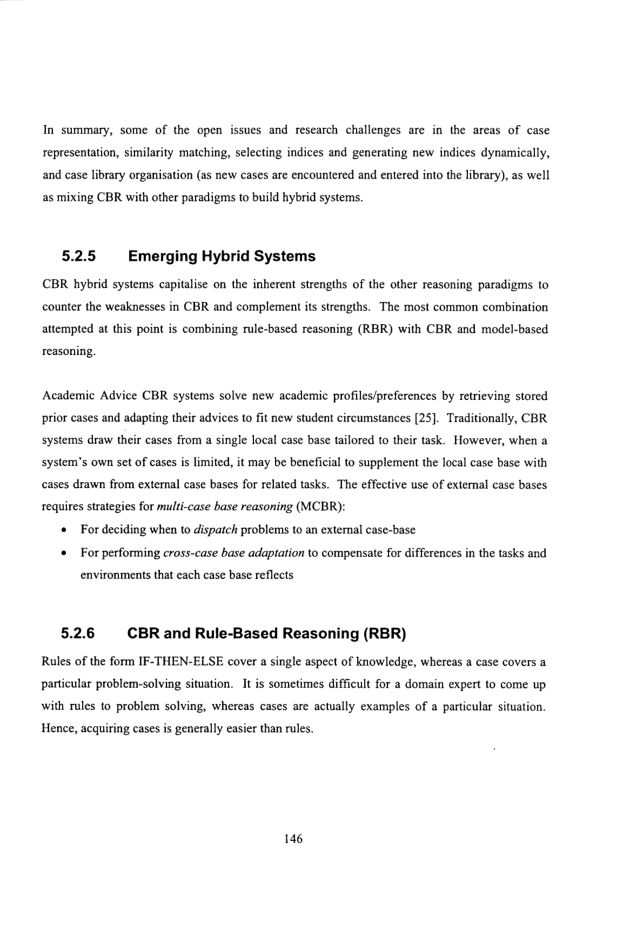
Source PDF · page 156 of 201Check original scan ↗
RBR has some inherent weaknesses:
• Past experiences are not “learned”
• New, novel problems that deviate from the norm cannot be solved (because no rules are
applicable)
• Maintaining a large rule base is difficult and time consuming
The wrong information in rules must be individually edited, and every time a new rule is added,
there is the risk of redundancy or contradiction. Deleting a rule may interrupt the reasoning
process, whereas removing an individual case does not have the same extensive consequences.
Hence, RBR systems are more difficult to maintain and update to keep up with the rapidly
changing domains.
Thus, most hybrid systems have a combination of rules and cases, and may be according to
whether rules and cases are independent of each other, or whether one was derived from the
other (i.e., derive cases from rules, or rules from a set of sample cases). Rules may be used to
capture broad trends in the domain, while cases are used to support exceptions to the rules or
violations of the rules. Cases may be kept as positive examples to support, explain, or justify
rules, as counter-examples to rules, or when rules fail because they are ill defined. However,
there are problems integrating cases and rules, and these have to do with control - which mode
of reasoning to use, and when. To date, there is still a lack of cognitive models of how human
experts integrate rules and cases.
The system proposed in this thesis assumes the use of RBR for the identification of core courses
and perquisites, as these are easily defined by rules. However, the thesis concentrates on the use
of CBR to help students select electives, which is not easily defined by rules. Essentially, RBR
and CBR are used to solve different parts of the advising problem.
147
View original scanned page
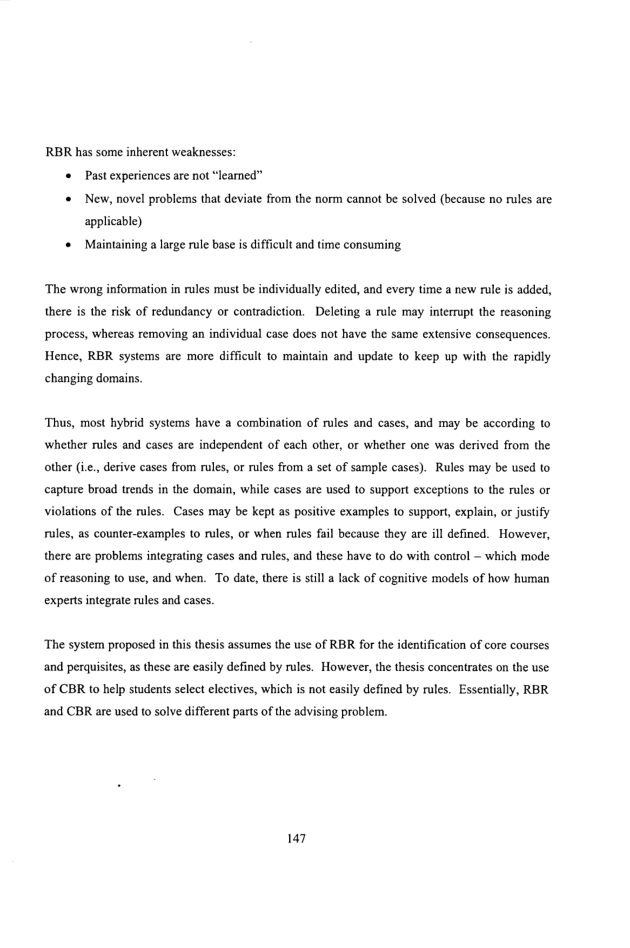
Source PDF · page 157 of 201Check original scan ↗
5.2.7 Machine Induction
The academic advisement can exploit the approach to machine learning known as induction.
Other case-based systems and data mining applications have made machine induction
commercially useful (and viable).
ID3 [32] is a non-incremental algorithm, meaning it derives its classes from a fixed set of
training instances. An incremental algorithm revises the current concept definition, if necessary,
with a new sample. The classes created by ID3 are inductive, that is, given a small set of training
instances, the specific classes created by ID3 are expected to work for all future instances. The
distribution of the unknowns must be the same as the test cases. Induction classes cannot be
proven to work in every case since they may classify an infinite number of instances. Note that
ID3 (or any inductive algorithm) may misclassify data.
5.2.7.1 Data Description
The sample data used by ID3 has certain requirements, which are:
• Attribute-value description - the same attributes must describe each example and have a
fixed number of values.
• Predefined classes - an example's attributes must already be defined, that is, they are not
learned by ID3.
• Discrete classes - classes must be sharply delineated. Continuous classes broken up into
vague categories such as a metal being "hard, quite hard, flexible, soft, quite soft" are
suspect.
• Sufficient examples - since inductive generalization is used (i.e. not provable) there must
be enough test cases to distinguish valid patterns from chance occurrences.
148
View original scanned page
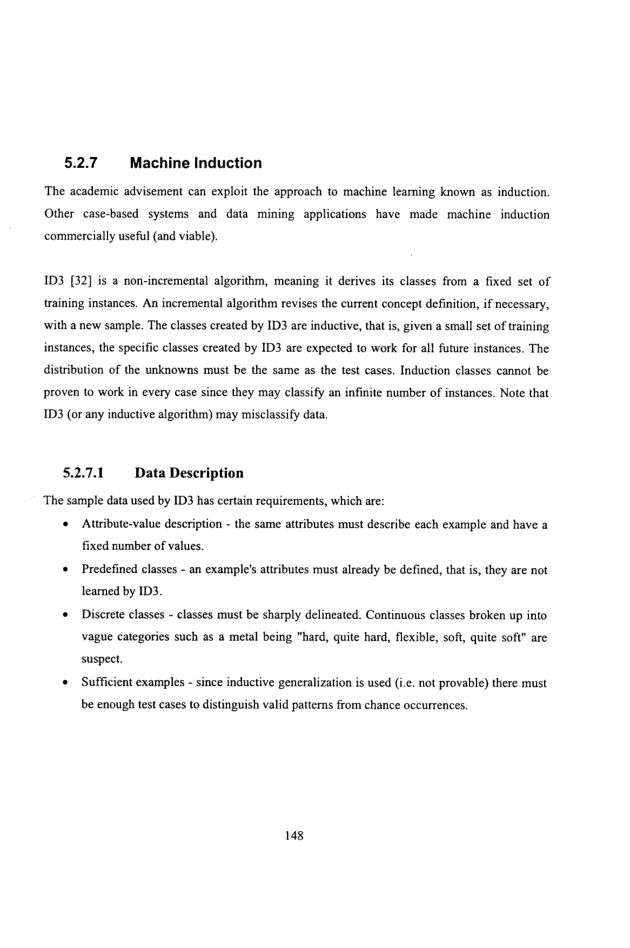
Source PDF · page 158 of 201Check original scan ↗
S.2.7.2 A ttribute Selection
How does ID3 decide which attribute is the best? A statistical property, called information gain,
is used. Gain measures how well a given attribute separates training examples into targeted
classes. The one with the highest information (information being the most useful for
classification) is selected. In order to define gain, we first borrow an idea from information
theory called entropy. Entropy measures the amount of information in an attribute.
Given a collection S of c outcomes
Entropy(S) = S -p(I) log? p(I)
where p(I) is the proportion of S belonging to class I. S is over c. Log? is log base ?.
Note that S is not an attribute but the entire sample set.
Machine learning can be applied to automate index assignment. Case attributes can be improved
to assume ordered symbol sets. This can then be used with a symbolic learning algorithm, one
that learns classification rules, which is more appropriate for comparatively small numbers of
training examples of the attributes. IDS algorithm can be implemented here, as it can leam
decision trees in which rules are implicit. The improvement of the prototype system can employ
IDS to induce decision trees for case indexing. IDS learns a decision tree by recursively
partitioning the training set according to the feature that best discriminates instances of each case
attribute. Each learned decision tree represents a number of rules for assigning an attribute in
knowledge cases.
149
View original scanned page
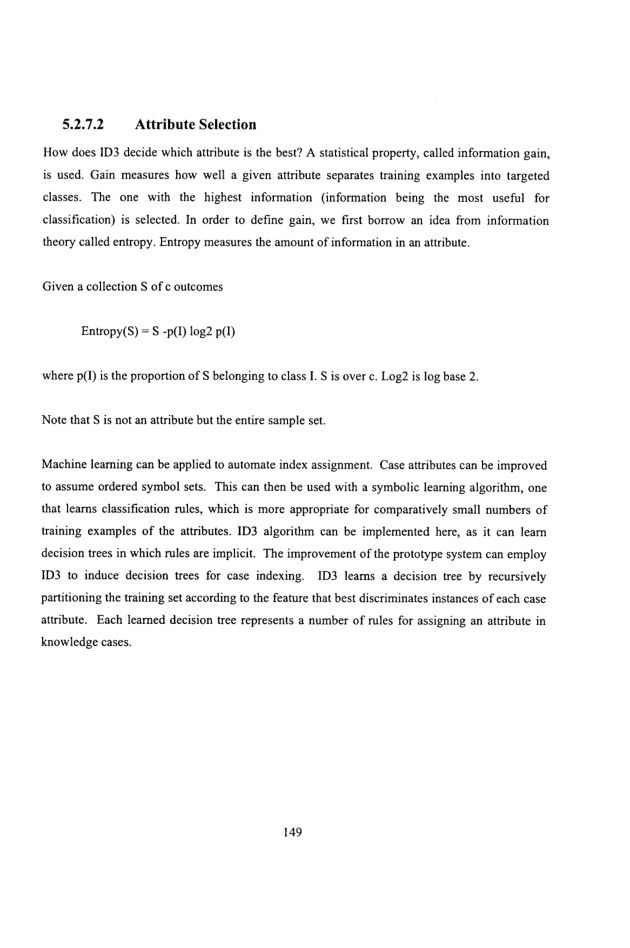
Source PDF · page 159 of 201Check original scan ↗
5.3 Implications
Finally, the work done in this research (i.e., the design of cases) and the development of the
prototype case-based academic advisement recommender system is no doubt an important
building block towards the design and implementation of a full production system. Ultimately, a
fully developed system could eliminate the need for human academic advisors. In turn, this
would enable ubiquitous academic advising for distance online students who define the changing
face of the higher education in the developed regions.
150
View original scanned page

Bibliography
Source PDF · page 160 of 201Check original scan ↗
Bibliography
[1] Aamodt A., and Plaza E. ‘Case-Based Reasoning: Foundational Issues, Methodological
Variations, and System Approaches’, AICOM, Vol. 7, Nr. 1, March 1994, pp. 39-59.
[2] Aleven V., and Ashley, K. D. 1996, ‘How different is different?: Arguing about the
Significance of Similarities and Differences’. Advances in Case-Based Reasoning: Third
European Workshop, EWCBR-96, Lausanne, Switzerland, November 1996, pp. 1-15.
[3] Armengol, E., and Plaza, E. 2001, ‘Similarity Assessment for Relational CBR’. Case-
Based Reasoning Research and Development: Fourth International Conference, ICCBR-
2001, Vancouver, BC, Canada, July/August 2001, pp. 44-58.
[4] Bergmann, R., Breen, S., Goker, M., Manago, M., and Wess S. 1998, Developing
Industrial Case-Based Reasoning Applications: The INRECA-Methodology, Springer-
Verlag, Berlin Heidelberg, Germany.
[5] Branting, L. K. 2001, ‘Acquiring Customer Preferences from Return-Set Selections’.
Case-Based Reasoning Research and Development: Fourth International Conference,
ICCBR-2001, Vancouver, BC, Canada, July/August 2001, pp. 59-73.
[6] Brinkman, P. T., and Morgan, A. W. 1994, “The Future of Higher Education Finance.” In
T. R. Sanford (ed.), Preparing for the Information Needs o f the Twenty-First Century.
San Francisco: Jossey-Bass.
[7] Burke, R. 2001, ‘Ranking Algorithms for Costly Similarity Measures’. Case-Based
Reasoning Research and Development: Fourth International Conference, ICCBR-2001,
Vancouver, BC, Canada, July/August 2001, pp. 105-117.
151
View original scanned page
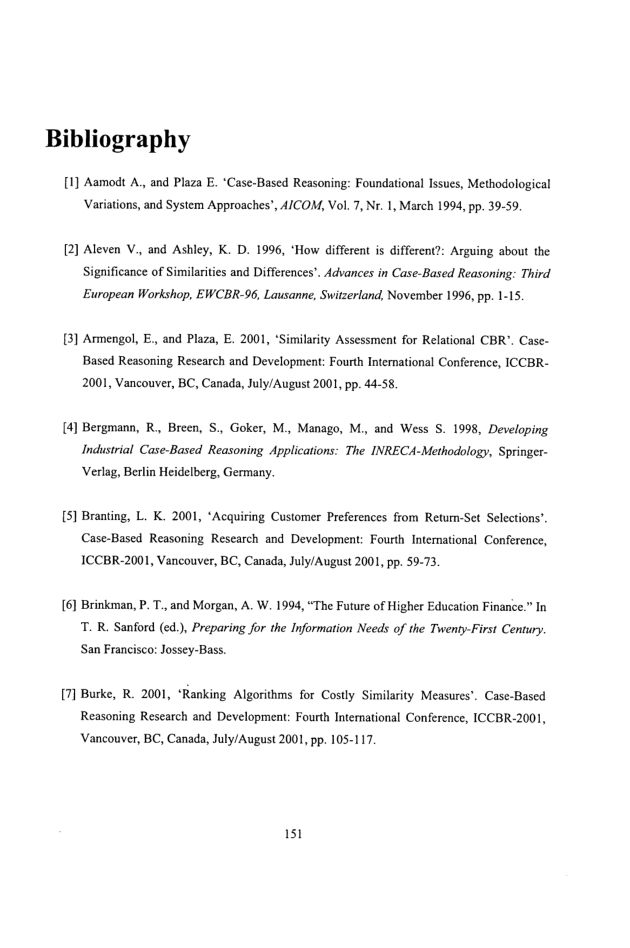
Source PDF · page 161 of 201Check original scan ↗
[8] Davis, R., and King, J. 1977, ‘An overview of production systems.’ In E. W. Elcock and
D. Michie (eds.), Machine Intelligence 8. New York: McGraw-Hill.
[9] Department of Education, Science, and Training. 6 April 2002, University
Undergraduate Final Applications and Final Offers Data for 2002 [online]
http://www.dest.gov.au/highered/statistics/unioffers02.htm [Accessed 20 May 2002]
[10] Dillon, W. R., and Dillon, G. M. 1996, Multivariate Analysis: Methods and
Analysis. John Wiley and Sons, New York.
[11] Edwards, J. S., and Bader, J. L. 1988, ‘Expert systems for university admissions’.
Journal o f Operational Research Society, 39(1), pp. 33-40.
[12] Ferguson, W., Bareiss, R., Bimbaum, L., and Osgood, R. 1992, “ASK systems:
An approach to the realization of story-based teachers.” Journal o f the Learning Sciences,
2, pp. 95-134
[13] Finley, P., and King, M. 1989, ‘Experiences in developing an expert system for
MBA admissions’. Journal o f the Operation Research Society, 40(7), pp. 625-635.
[14] Fleck, R. A., and Shirley, B. M. 1990, ‘Expert systems for transfer credit
evaluation: Problems and prospects’. College and University, 65(2), pp. 73-83.
[15] Goker, M. & Roth-Berghofer, T. 1999, ‘Development and Utilization of a Case-
Based Help-Desk Support System in a Corporate Environment’. Case-Based Reasoning
Research and Development: Proceedings o f the 3rd International Conference on Case-
Based Reasoning, ICCBR-99, Seeon Monastery, Germany, July 27-30, 1999, ed. K.
Althoff, R. Bergmann & L. K. Branting, Springer-Verlag, Germany, pp. 132-146.
152
View original scanned page
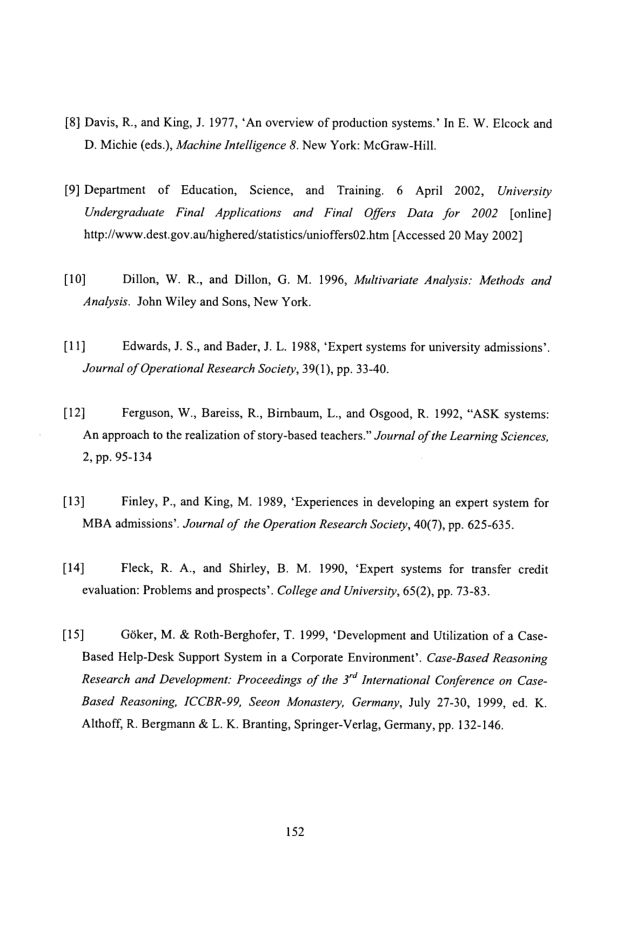
Source PDF · page 162 of 201Check original scan ↗
[16] Grupe, F. “An Internet-based expert system for selecting an academic major:
www.MyMajors.com” The Internet and Higher Education, Vol. 5, Issue 4 , 2002, pp.
333-344
[17] Hammonds, K. H., and others. “The New ‘U ’: A Tough Market Is Reshaping
Colleges.” Business Week, Dec. 22, 1997, pp. 96-102.
[18] Harmon, P., and King, D. 1985, Expert systems: Artificial intelligence in business.
John Wiley & Sons, Inc. New York, NY.
[19] Hines, E. R. 1981, ‘Policy making for more effective academic advisement in
two-year colleges. Research in Higher Education, 14(2), pp. 119-134.
[20] Hofmeister, A. M. 1986, ‘Formative evaluation in the development and validation
of expert systems in education’. Computational Intelligence, 2, pp. 65-67.
[21] Iglezakis, I. and Reinartz, T. 2002, ‘Relations between Customer Requirements,
Performance Measures, and General Case Properties for Case Base Maintenance’.
Advances in Case-Based Reasoning: Sixth European Conference, ECCBR-2002,
Aberdeen, Scotland, UK, September 2002, pp. 159-173.
[22] Khoshgoftaar, T. M., and Allen, E. B. ‘Classification of fault-prone software
modules: Prior probabilities, costs, and model evaluation.’ In Technical Report TR-CSE-
97-52. ’ Boca Raton, FL USA, June 1997. Florida Atlantic University.
[23] Kolodner, Jane 1993. ‘Matching and Ranking Cases’. Case-Based Reasoning,
Morgan Kaufmann Publishers, CA, USA, pp. 321-368.
[24] Kramer, H. C. 1982, “Evaluation of academic advisors: Administrators and
faculty perceptions”. NACADA Journal, 2, (3), pp. 30-36
153
View original scanned page
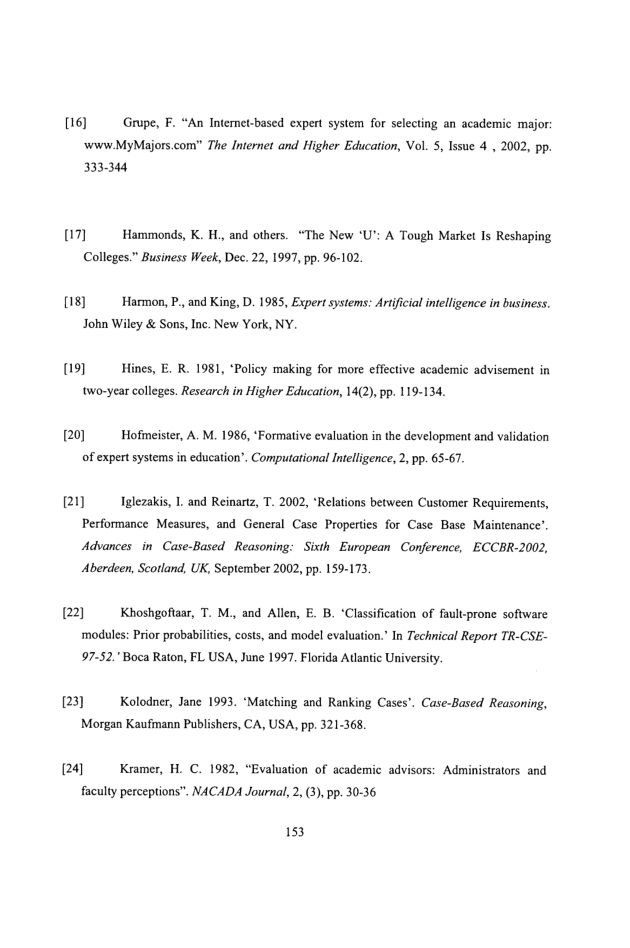
Source PDF · page 163 of 201Check original scan ↗
[25] Leake, D. B., and Sooriamurthi, R. 2002, ‘Automatically Selecting Strategies for
Multi-Case-Base Reasoning’. Advances in Case-Based Reasoning: Sixth European
Conference, ECCBR-2002, Aberdeen, Scotland, UK, September 2002, pp. 204-219.
[26] Lenz, M., Bartsch-Sporl, B., Burkhard, H., and Wess, S. 1991, Case-Based
Reasoning Technology: From Foundations to Applications, Spring-Verlag, Berlin
Heidelberg, Germany.
[27] Macunovich, D. J. “Will There Be a Boom in the Demand for U.S. Higher
Education Among Eighteen- to Twenty-Four-Year-Olds?” Change, 1997, 3, 34-44.
[28] Mahoney, J., Borgard, J. H., and Hombuckle, P. A. 1978, “The relationship of
faculty experience and advises load to perceptions of academic advising”. Journal o f
College Student Personnel, 10, pp. 28-32.
[29] Me Ginty, L. and Smyth, B. 2002, ‘Comparison-Based Recommendation.
Advances in Case-Based Reasoning: Sixth European Conference, ECCBR-2002,
Aberdeen, Scotland, UK, September 2002, pp. 575-589.
[30] Montaner, M., Lopez, B., and de la Rosa, J. L. 2002, ‘Improving Case
Representation and Case Base Maintenance in Recommender Agents’. Advances in Case-
Based Reasoning: Sixth European Conference, ECCBR-2002, Aberdeen, Scotland, UK,
September 2002, pp. 234.248.
[31] O’Sullivan, D., Wilson, D., and Smyth, B. 2002, ‘Improving Case-Based
Recommendation: A Collaborative Filtering Approach’. Advances in Case-Based
Reasoning: Sixth European Conference, ECCBR-2002, Aberdeen, Scotland, UK,
September 2002, pp. 278-291.
[32] Quinlan, J. R. “ID3 Algorithm” Machine Learning, Vol. 1, No. 1, 1975.
154
View original scanned page
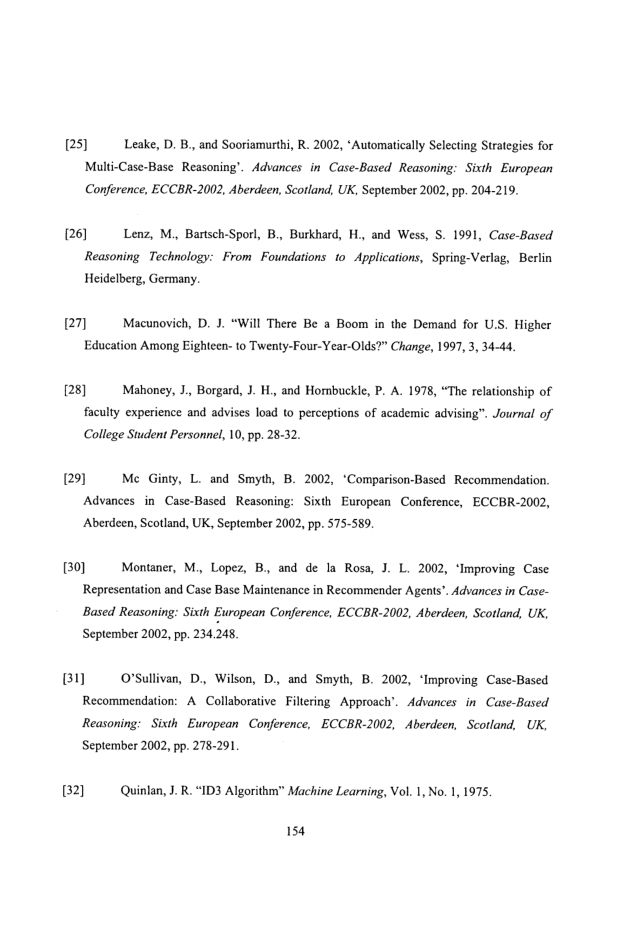
Source PDF · page 164 of 201Check original scan ↗
[33] Schank, R. 1982. Dynamic memory: A theory of learning in computers and
people. New York: Cambridge Univ. Press.
[34] Schank, R., and Abelson, R. 1977, Scripts, plans, goals and understanding.
Erlbaum, Northvale, NJ.
[35] Shortliffe, E. 1976, Computer-based medical consultation: MYCIN. New York,
NY: American Elsevier.
[36] Simon, H. A. 1981, The sciences o f the artificial. MIT Press, Cambridge, MA
[37] Smyth, B., and McClave, P. 2001, ‘Similarity vs. Diversity’. Case-Based
Reasoning Research and Development: Fourth International Conference, ICCBR-2001,
Vancouver, BC, Canada, July/August 2001, pp. 347-361.
[38] Stahl, A. 2002, ‘Defining Similarity Measures: Top-Down vs. Bottom-Up’.
Advances in Case-Based Reasoning: Sixth European Conference, ECCBR-2002,
Aberdeen, Scotland, UK, September 2002, pp. 406-420.
[39] “Standards and guidelines for academic advising”. 1986. NACADA Journal, 6(2),
pp. 63-66.
[40] Stickle, F. 1982, “Faculty and student perception of faculty advising
effectiveness”. Journal o f College Student Personnel, 23(3), pp. 262-265.
[41] Sullivan, J., Butzek, J., and Klein, G. 1989, ‘Development of an expert system for
student advisement’. In O. T. Hargrave (ed), Academic advising: Transition and
continuity (pp. 6-7). Dallas, TX.
155
View original scanned page
Source PDF · page 165 of 201Check original scan ↗
[42] Turing, A. 1950, ‘Computing machinery and intelligence’, Mind, 59, pp. 433 -
460.
[43] Watson, I. 1997. ‘Understanding CBR’. Applying Case-Based Reasoning:
Techniques for Enterprise Systems, Morgan Kaufmann Publishers, CA, USA, pp. 15-38.
[44] Cheetham, W., and Graf, J. 2002, ‘Developing Expertise: Color Matching at
General Electric Plastics’. Applying Knowledge Management: techniques for building
organisational memories. Ed. Watson, I. Morgan Kaufmann Publishers, CA, USA, pp.
87-120.
[45] Weber-Lee, R., Barcia, R. M., Martins, A., and Pacheco, R. C. 1996, ‘Using
Typicality Theory to Select the Best Match’. Advances in Case-Based Reasoning: Third
European Workshop, EWCBR-96, Lausanne, Switzerland, November 1996, pp. 445-459.
[46] Winston, G. C. “Why Can’t a College Be More Like a Firm?” Change, 1997, 5,
33-38.
[47] Wittgenstein, L. 1953, Philosophical Investigations. Basil Blackwell, Oxford.
[48] Zadeh, L. A. “Fuzzy sets” Information and Control, Vol. 8, 1965.
156
View original scanned page
Appendices
Source PDF · page 166 of 201Check original scan ↗
Appendices
Appendix A: Non-technical Framework
A.1 Organisational Processes during System Development
Project Team and Initial Domain Selection
The creation of a project team to serve as the “knowledge engineers”, and the selection of a
group to serve as the initial test users of the system, are the first organisational steps that must be
taken.
Apart from the person implementing the case-based academic advisement recommender system
(CBR consultant), the project team should contain academic advising personnel that are very
experienced in the relevant sub domain (e.g., different program of study) to be modelled and well
respected by the academic advisors outside the project group. Personnel that are interested in
“technology” rather than implementing useful systems are very common in academic
environments, but definitely not helpful in creating a case-based system and should be avoided.
Once selected, the members of the group should be kept constant (i.e., fluctuations should be
avoided).
The group of initial users should comprise two types of academic advising personnel and
students. The first type of academic personnel should be on a comparable level of expertise with
the project team with respect to the selected sub domain (i.e., expert users), and the other should
be academic advising personnel who are less familiar with the specific problem area (i.e.,
intermediate users). Finally, the students represent the users of the academic advice given (i.e.,
novice users). While the expert test users can communicate to the project group in their
language, the intermediate users and the novice users will represent the target group for which
the system is being implemented. Feedback from both types of users is required for a successful
project. After a first “rapid prototype” has been implemented, the expert users can provide
advice regarding problems with the knowledge modelled in the system. In contrast, the members
157
View original scanned page
Source PDF · page 167 of 201Check original scan ↗
of the intermediate user group will serve as models of the academic advisors that will use the
system, while the members of the novice user group will test the user-friendliness of the self-
service system. The vocabulary used to represent the cases and the knowledge contained within
them has to be adjusted to the intermediate and novice user groups.
The domain selected for the initial knowledge acquisition is of the utmost importance. The
domain should be representative of the student cases that are queried to the academic advisors in
terms of complexity and frequency. It should also be a problem area that accounts for a
considerable amount of the workload, as well as an area the academic advisors are interested in
sharing (obtaining) knowledge about.
Training the Project Team
Training the project team is an organisational process that has a major impact on the success of
the help desk project. At the beginning of the project, the project team is usually inexperienced
with respect to CBR and knowledge acquisition. Since the project group will be responsible for
system maintenance and continuous case acquisition after the development has finished, it is
very important that they are trained in CBR as well as in knowledge acquisition and modelling
during the initial knowledge acquisition.
While the project team should also get advanced training to be able to model, fill, and maintain
the knowledge in the system, the test users only need to be trained in using the resulting case-
based academic advisement recommender system.
Development of the Knowledge Acquisition and Utilisation Processes
The introduction and use of a case-based academic advisement recommender system usually
causes a re-evaluation and modification of the existing knowledge and information management
processes in an academic advising environment. When the system is used, it must be integrated
into the operating environment of the academic advisors and become part of the standard
business process. Existing processes must be altered to facilitate the flow of information to and
158
View original scanned page

Source PDF · page 168 of 201Check original scan ↗
from the CBR system. When the organisational processes are defined, the tasks to be performed,
the personnel or roles to perform these tasks, and the communication among the groups/roles
have to be fixed.
After the development of the case-based academic advisement recommender system is complete,
it will serve as the central source of information for the academic advisors. To ensure a smooth
flow of information, the knowledge sources and formats as well as the qualifications of the
personnel that require the knowledge have to be analysed, and processes that allow the efficient
and effective acquisition and use of knowledge have to be developed. One should keep in mind
that while the group enacting the initial knowledge acquisition process is the project team and
rather experienced, the users who use the system (both in terms of knowledge retrieval and
continuous acquisition) may be less qualified.
It may useful to define four roles for the organisational processes during the use of the academic
advisement system:
• The academic advisor
• The student
• The CBR author
• The CBR administrator
Academic advisors are the users from the target group. Their duty is to use the implemented
academic advisement system in their daily work. If they cannot find an appropriate solution with
the system, they will have to solve the student case on their own and generate a new case.
Depending on the domain and managerial decisions, this new case may or may not be made
immediately available as an “unconfirmed” case to the other academic advisors. For
maintenance purposes, the academic advisors are also encouraged to comment on the quality and
applicability of the cases in the case base.
The students are also the users from the target group. They should have access only to the self-
service system, which gives advice based on their individual circumstances and preferences.
159
View original scanned page
Source PDF · page 169 of 201Check original scan ↗
They may be asked to provide feedback and ratings of the given advice, which in turn can be
captured into the system as a “refined but unconfirmed” case.
The unconfirmed (new or refined) cases have to be verified in terms of their correctness and
suitability for the case base by the CBR author(s). The CBR author is a person with experience
both in the domain and in using the CBR system. While the CBR author can decide on the
quality and inclusion of a case in the case base, he or she is not allowed to perform modifications
on the vocabulary, similarity, or adaptation knowledge. These can only be performed by the
CBR administrator.
The personnel enacting the roles of the CBR author(s) and the CBR administrator should be
included in the project group from the start of the project. It should be noted that both these roles
require a considerable amount of resources and should be performed by dedicated personnel. If
the institution does not permit dedicating more than one person to these tasks, the duties of the
CBR author and CBR administrator should be performed by one person.
A.2 Technical Processes during System Development
General IT-System Development Related Processes
The development of a case-based academic advisement recommender system is similar to any
other IT project in most aspects. As usual, the system has to be specified, implemented,
integrated, and verified. The definition of the requirements, implementation, and the testing and
revision of the prototype and the actual case-based academic advisement recommender system
are steps that have to be performed in accordance with standard software engineering techniques.
However, the user interfaces and the connection to supporting programs (integration) are two
features that require additional attention.
The essential task in developing a user interface is to present the relevant data at the right
moment, in the right representation, and on a level of abstraction that is suitable for the current
users of the system. If the available data is presented to the users in a way that they do not
160
View original scanned page

Source PDF · page 170 of 201Check original scan ↗
understand, in a representation they are not familiar with, or at a moment when it is irrelevant, it
will only cause confusion and be of no use. The user interface of the case-based academic
advisement recommender system has to be developed in accordance with the user group (i.e.,
academic advisor and student), the specific domain (e.g., program of study), and the institution’s
academic policies (i.e., who is allowed to see what kind of data). It has to present the right data,
at the right moment, on the right level of abstraction, and in accordance with institution policies.
A case-based academic advisement recommender system cannot operate in isolation. While the
CBR system will store experience, it will not contain data regarding student academic records,
structures of programs of study, or other academic rules. The student information is stored in a
student records database. The program structures information is usually stored in separate
database. Since this information is needed during academic advising, the system must have
interfaces to these databases.
Initial Knowledge Acquisition for the Case-Based Academic Advisement
Recommender System
A CBR system is useless without cases. When the case-based academic advisement
recommender system is handed over to the academic advisors, it has to contain enough cases to
cover at least part of the relevant present student cases. Otherwise, the system will be considered
useless and the project will fail. Initial knowledge acquisition serves three major goals:
• Training the project team in knowledge acquisition
• Initialising the knowledge in the system
• Collecting enough help desk cases to bootstrap the system
During initial knowledge acquisition, the knowledge in the system can be distributed among the
domain model (vocabulary), similarity measure, adaptation knowledge, and the case base.
These knowledge containers (Richter, 1998) have to be created and filled. While the similarity
measures, adaptation knowledge, and vocabulary are compiled knowledge, the case is interpreted
at runtime. In principle, each container could be used to represent most of the knowledge.
However, this is obviously not very feasible, and the CBR consultant should carefully decide on
161
View original scanned page
Source PDF · page 171 of 201Check original scan ↗
the distribution of knowledge into the containers. After the initial knowledge acquisition is
completed, the distribution is more or less fixed and should only be changed with caution.
The processes for the acquisition of knowledge for each container is run in parallel and cannot be
easily separated during the initial knowledge acquisition. Since the vocabulary lays the ground
for entering the cases and describing the similarity measures and adaptation knowledge, it has to
be available first. However, to be able to create a domain model (i.e., the vocabulary) one has to
understand how the domain is structured, and this can only be done by looking at the cases,
similarities, and adaptation rules.
A good way to approach this problem is to create and use standardised forms to acquire an initial
amount of cases from the project team [HOMER system]. The form should be developed in
cooperation with the project team. The first thing that must be done is to ask the project team to
fill out as many case acquisition forms as they can. By looking at the elements of the forms, the
vocabulary (i.e., the phrases that have to be used and the domain structure) can be derived and a
vocabulary that is capable of describing the cases on the forms can be modelled.
By asking the project team to define the range of possible values for each attribute on the forms,
and inquiring what would have happened if one of the values on a form were different, a broad
range of cases can be created and the vocabulary expanded in a short time. Discussion among
the project team members raises the level of understanding of both the approach and the
problems, and it should be encouraged in this early phase. One should also keep in mind that the
goal is not to model the domain in every detail, but on a level that helps the system’s user solve a
problem (i.e., the system does not have to solve the problem autonomously). Especially during
initial knowledge acquisition, it is advisable to have more cases on an “everyday” level, rather
than having a few extremely specific ones.
1 6 2
View original scanned page
Source PDF · page 172 of 201Check original scan ↗
While the initial vocabulary is being created and value ranges fixed, questions regarding
adaptation rules and similarities should be posed and the results entered into the system.
One of the major challenges one must face when creating a system to capture and represent the
experience of domain experts is determining the level of abstraction with which the domain and
the knowledge will be modelled. If the model is too simplistic, it will cause problems while the
experience is being captured and miss important details. If, however, the domain model is too
specific, the user will get lost quickly in useless details and knowledge acquisition will be very
tedious and time consuming. Maintenance is very difficult for both a too simplistic and a too
complex model.
The decision to use a structured domain model approach as opposed to a textual query-answer-
based approach also depends on the system’s intended users. For inexperienced academic
advisors or students, a tool with which simple student cases can be given advice by answering a
limited number of questions is of great value (Thomas et al., 1997). However, for experienced
academic advisors who would not bother to use a system for (subjectively) trivial problems, a
structured domain model approach may be more appealing. The system will be able to present
the not-so-obvious similar solutions that the academic advisors could not find. Since knowledge
contained in the domain model is used in similarity calculation, the retrieved solutions will be
similar in a semantic and structural manner. The domain model allows the solutions in the case
base to be applicable to a broader range of problems.
163
View original scanned page
Source PDF · page 173 of 201Check original scan ↗
Appendix B: Knowledge Base Contents
DSP:OPTIC:MWAVE:NTWRK:SATEL:PRFM:CHRT:Dl:02:OM3:M4:NM5:N6:NS7:S8
0 0 0 1 2 3 1 3 0 0 0 0 0 1 1 1
0 0 0 1 2 3 2 2 0 0 0 0 1 0 1 1
0 0 0 2 1 3 1 1 0 0 0 0 1 0 1 1
0 0 0 3 1 2 2 1 0 0 1 0 1 0 1 0
0 0 0 3 1 2 2 3 0 0 1 1 1 0 0 0
0 0 0 3 1 2 3 2 0 0 0 1 1 0 1 0
0 0 1 0 2 3 1 3 0 0 0 0 0 1 1 1
0 0 1 0 3 2 2 1 0 0 1 0 1 0 1 0
0 0 1 2 0 3 3 2 0 0 1 0 0 0 1 1
0 0 1 2 3 0 1 2 0 0 1 0 1 1 0 0
0 0 1 3 2 0 2 1 0 0 1 0 1 0 1 0
0 0 2 0 1 3 3 3 0 1 0 0 0 0 1 1
0 0 2 0 3 1 1 3 0 1 0 0 0 1 1 0
0 0 2 0 3 1 22 0 0 1 0 0 1 1 0
0 0 2 1 0 3 3 1 0 0 1 0 1 0 1 0
0 0 2 1 3 0 3 1 0 0 1 0 1 0 1 0
0 0 2 3 1 0 2 3 0 1 1 1 0 0 0 0
0 0 3 0 2 1 1 2 0 1 1 0 0 0 1 0
0 0 3 2 0 1 3 3 0 1 1 1 0 0 0 0
0 0 3 2 1 0 2 3 0 1 1 1 0 0 0 0
0 1 0 0 3 23 1 1 0 0 0 1 0 1 0
0 1 0 2 0 3 1 3 0 0 0 1 0 0 1 1
0 1 0 2 3 0 2 2 0 0 1 0 1 1 0 0
0 1 0 3 0 2 3 1 1 0 0 0 1 0 1 0
0 1 2 0 0 3 23 0 1 0 0 0 0 1 1
0 1 2 0 3 0 1 3 0 0 0 0 1 1 1 0
0 1 3 0 0 2 2 2 0 1 1 0 0 0 1 0
164
View original scanned page

Source PDF · page 174 of 201Check original scan ↗
0 1 3 0 2 0 1 1 1 0 1 0 0 0 1 0
0 1 3 0 2 0 3 1 1 0 1 0 0 0 1 0
0 1 3 2 0 0 3 2 0 1 1 0 1 0 0 0
0 2 0 1 0 3 2 1 1 0 1 0 0 0 1 0
0 2 0 1 3 0 3 3 0 0 0 0 1 1 1 0
0 2 0 3 0 1 1 2 1 0 0 1 1 0 0 0
0 2 0 3 0 1 2 3 0 0 1 1 1 0 0 0
0 2 0 3 1 0 1 1 1 0 1 0 0 0 1 0
02 1 0 3 0 3 2 1 0 0 0 1 1 0 0
0 2 1 3 0 0 1 3 0 0 1 1 1 0 0 0
0 2 3 0 0 1 2 1 1 0 1 0 0 0 1 0
0 2 3 0 1 0 3 3 1 1 1 0 0 0 0 0
0 2 3 1 0 0 1 2 1 1 1 0 0 0 0 0
0 3 0 0 2 1 2 1 1 0 0 0 1 0 1 0
0 3 0 1 0 2 1 2 1 0 0 0 0 0 1 1
0 3 0 1 0 2 3 1 1 0 1 0 0 0 1 0
03 0 1 2 0 2 3 1 0 0 0 1 1 0 0
0 3 0 2 1 0 3 2 1 0 0 1 1 0 0 0
0 3 1 0 0 2 3 2 1 0 0 0 0 0 1 1
03 1 0 2 0 1 1 1 0 1 0 0 0 1 0
0 3 1 2 0 0 2 1 1 0 1 0 1 0 0 0
0 3 2 0 0 1 1 2 1 1 1 0 0 0 0 0
03 2 0 0 1 23 1 1 1 0 0 0 0 0
View original scanned page

Source PDF · page 175 of 201Check original scan ↗
Appendix C: PHP scripts
Functions.inc
<?
defme("RANK_NUM", 10); // number of cases to be ranked
define("ENROL_COURSE_NUM", 3); // number of courses to be enrolled in
Stables = array(T => 15, '2' => 20, '3' => 47);
// build case from given values
function build_case($dsp=0, $optic=0, $mwave=0, $ntwrk=0, $satel=0, $prfm=0, $chrt=0) {
return array(
'DSP' => Sdsp,
'OPTIC' => Soptic,
'MWAYE' => Smwave,
■NTWRK’ => Sntwrk,
'SATEL' => Ssatel,
'PRFM' => Sprfm,
'CHRT' => Schrt
);
}
// calculate the size of given case
function casesize(Scase) {
Ssum = 0;
foreach (Scase as Svalue) {
Ssum += pow($value, 2);
}
166
View original scanned page
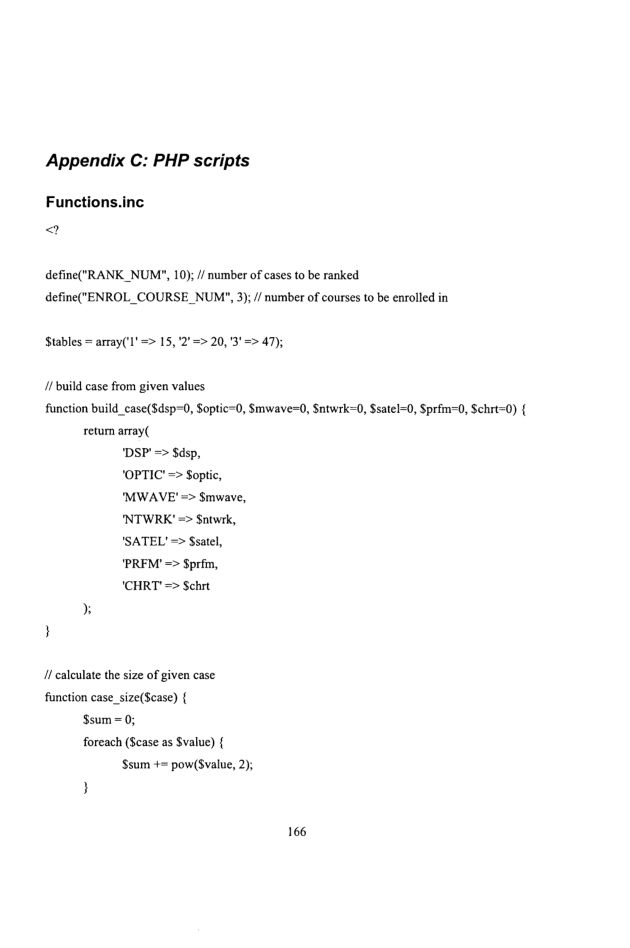
Source PDF · page 176 of 201Check original scan ↗
return sqrt(Ssum);
}
// multiply the corresponding pair and sum up the values
function sumproduct($vl, $v2) {
$sum = 0;
foreach ($vl as $key => $ value) {
$sum += $value * $v2[$key];
}
return $sum;
}
// exhaustive search through the case base
function found_new_solution(&$match,$pos,$id,$percent,
$DSP, $OPTIC, SMWAVE, SNTWRK, SSATEL, $PRFM, $CHRT,
$D1,$02,$0M3,$M4,$NM5,$N6,$NS7,$S8) {
for ($j=RANK_NUM; $j>$pos; $j—) {
$match[$j] = $match[$j-l];
}
$match[$pos] = array('id' => $id, 'percent' => $percent,
'DSP' => $DSP, 'OPTIC' => SOPTIC,
'MWAVE' => SMWAVE, "NTWRK" => SNTWRK,
'SATEL' => SSATEL, 'PRFM' => SPRFM,
'CHRT' => SCHRT, 'Dl' => $D1,
02' => $02, 'OM3' => SOM3, 'M4' => $M4,
•NM5' => SNM5, "N6' => $N6, 'NS7' => SNS7,
'S8' => SS8);
}
// display standard table header showing attributes
function attr_tab_header() {
167
View original scanned page
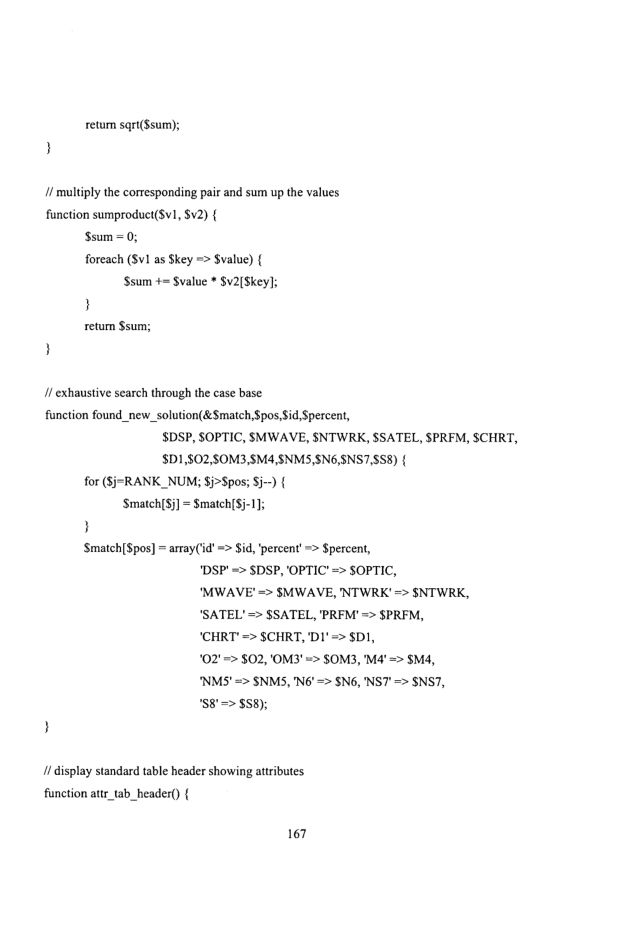
Source PDF · page 177 of 201Check original scan ↗
print "<th>DSP</th>";
print "<th>OPTIC</th>";
print "<th>MWAVE</th>";
print "<th>NTWRK</th>";
print "<th>SATEL</th>";
print "<th>PREM</th>";
print "<th>CHRT</th>";
}
// display standard table header showing solutions
function solu_tab_header() {
print "<th>Dl</th>";
print "<th>02</th>";
print "<th>OM3</th>";
print "<th>M4</th>";
print "<th>NM5</th>";
print "<th>N6</th>";
print "<th>NS7</th>";
print "<th>S8</th>";
}
// display INT vector
function show_interest($i) {
print "<td>" . $i[’DSP'] . "</td>";
print "<td>" . $i ['OPTIC'] . "</td>";
print "<td>" . $i['MWAVE] . "</td>";
print "<td>" . $i[rNTWRK'] . "</td>";
print "<td>" . $i['SATEL'] . "</td>";
print "<td>" . $i['PRFM'] . "</td>";
print "<td>" . $i['CHRT'] . "</td>";
168
View original scanned page
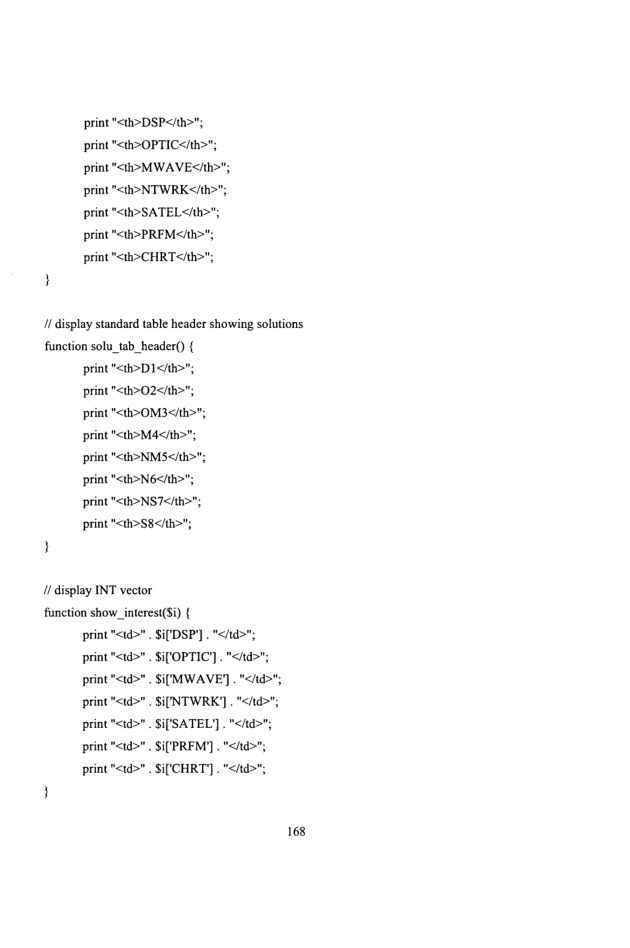
Source PDF · page 178 of 201Check original scan ↗
// display solutions in table
function show_solution($s, $mode = "") {
if (strlen($mode) > 0) {
printf("<td>%2.3f</td>", $s['Dl’]);
printf("<td>%2.3f</td>", $s['02']);
printf("<td>%2.3f</td>", $s['OM3']);
printf("<td>%2.3f</td>", $s['M4']);
printf("<td>%2.3f</td>", $s[rNM5’]);
printf("<td>%2.3f</td>", $s["N6']);
printf("<td>%2.3f</td>", $s[K!S7']);
printf("<td>%2.3f</td>", $s['S8']);
} else {
print "<td>" . $s['Dl'] . "</td>";
print "<td>" . $s['02']. "</td>";
print "<td>" . $s['OM3']. "</td>";
print "<td>" . $s['M4'] . "</td>";
print "<td>". $s[rNM5']. "</td>";
print "<td>" . $s['N6']. "</td>";
print "<td>". $s["NS7']. "</td>";
print "<td>" . $s['S8']. "</td>";
}
}
// initialize solution vectors
function init soluQ {
return array('Dl' => 0, '02' => 0, 'OM3' => 0, 'M4' => 0, KIMS' => 0, 'N6' => 0, 'NS7' =>
0, 'S8' => 0);
}
// initialize advice vector
169
View original scanned page
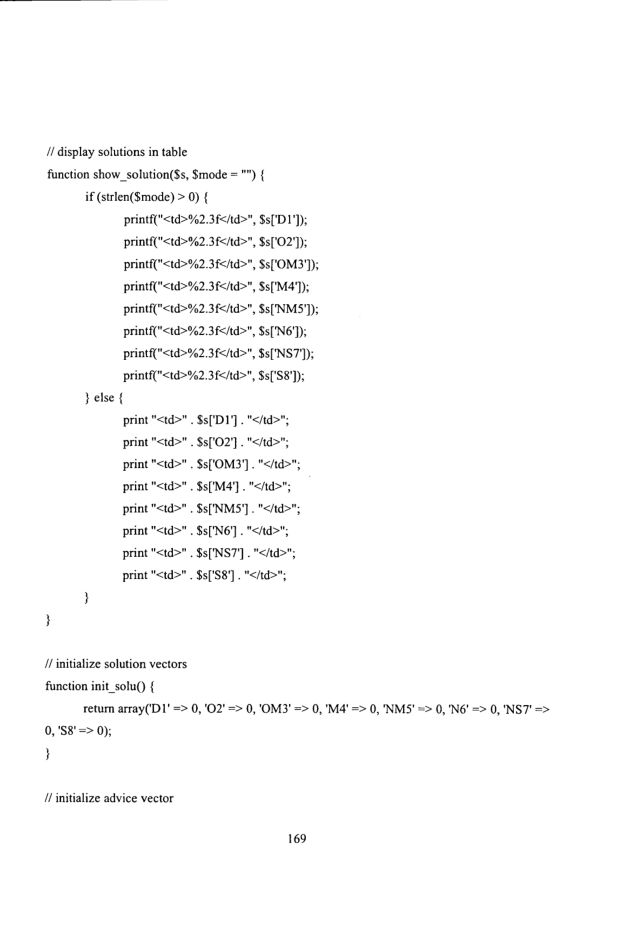
Source PDF · page 179 of 201Check original scan ↗
function init_advice() {
return array( 'COUNT' => init_solu(), 'RANKPCENT' => init_solu(), ’WEIGHT_SUM’
=> init_solu());
}
// show ranked cases in table
function process_ranked_cases($match) {
print "<table border=\"l\"><tr>";
attr_tab_header();
print "<td>case</td>";
print ”<td>percent</td>";
solu_tab_header();
print "</tr>";
Sadvice = init_advice();
for ($i=l; $i<=RANK_NUM; $i++) {
print "<tr>";
show_interest($match[$i]);
print "<td>".$match [$i] ['id']. "</td>";
printf ("<td>%2.3f</td>", $match[$i][’percent']*100);
show_solution($match[$i]);
print "</tr>";
foreach (Sadvice ['RANK PCENT'] as Scourse => $rank_percentage) {
// if this course is recommended, ie solution vector shows 1
if ($match[$i][$course] > 0) {
$advice['COUNT'][$course]-H-;
$advice['WEIGHT_SUM'] [Scourse] += (2/75 + (RANKNUM-
$i+l)/75) * 100;
if ($match[$i]['percent'] > $rank_percentage) {
170
View original scanned page
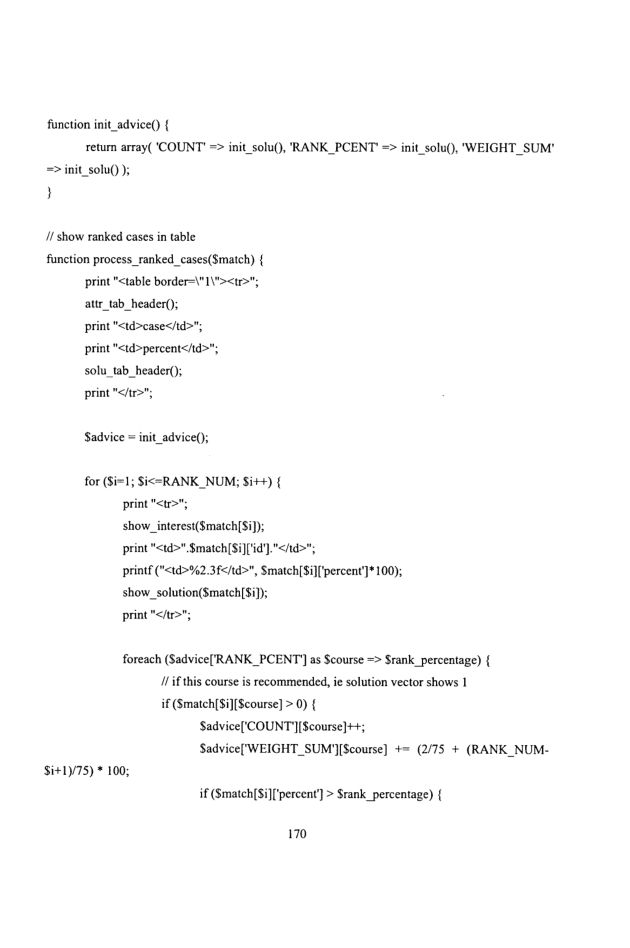
Source PDF · page 180 of 201Check original scan ↗
$advice['RANK_PCENT'][$course] = $match[$i]['percent']
100:
}
print "</table><p>";
return Sadvice;
}
// show advice in table format
function show_advice_table($advice, Sprerequisites, Sdifficulties) {
print '<table border=\"l\">";
print ’<tr>”;
print '<td>Description</td>";
solu_tab_header();
print </tr>";
print
print <td>Prequisite</td>";
show solution($prerequisites);
print </tr>";
print <tr>";
print <td>Difficulty</td>";
show_solution($di fficulties);
print </tr>";
print <tr>";
print <td>Count</td>";
show_solution($advice['COUNT']);
print
print
171
View original scanned page
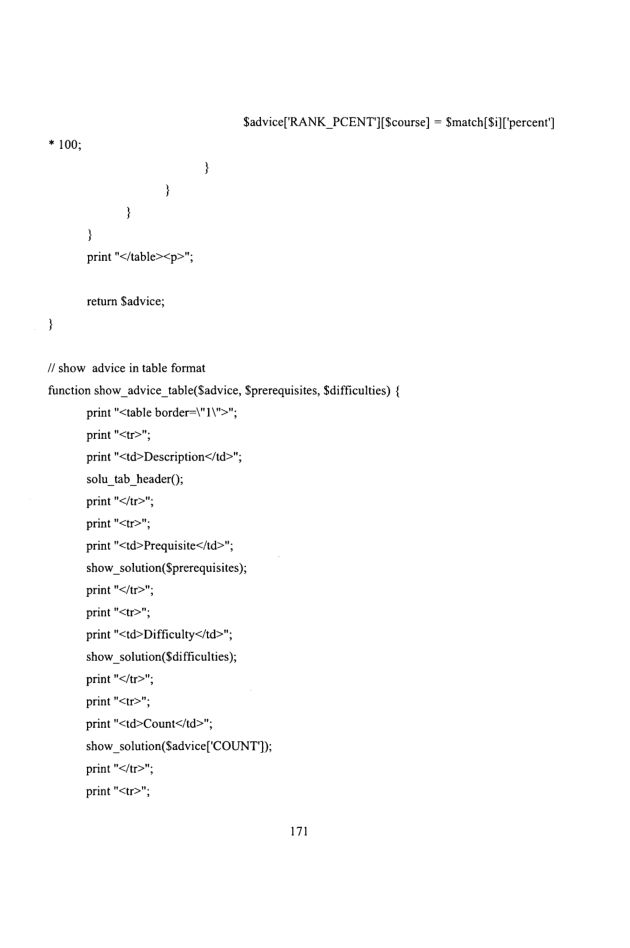
Source PDF · page 181 of 201Check original scan ↗
print "<td>Ranked Percentage</td>";
show_solution($advice['RANK_PCENT], "f’);
print "</tr>";
print "<tr>";
print "<td>Weighted Sum according to Counts</td>";
show_solution($advice['WEIGHT_SUM'], "f');
print "</tr>";
print "</table><p>";
}
// give out advice in plain English
function give_advice($advice, Sprerequisites, Sdifficulties, Sperformance) {
Sordinal = 0;
foreach ($advice['RANK_PCENT'] as Scourse => $rank_percentage) {
Srelevance = $advice['WEIGHT_SUM'][$course];
if ($prerequisites[$course] == 0) {
Scolour = "red";
treason = "<br>This course is not available because its pre-requisites have
not been fulfilled.";
} elseif ($difficulties[$course] > Sperformance) {
Scolour = "orange";
treason = "<br>This course is not recommended because its perceived
difficulty is greater than the student's demonstrated academic performance.";
} elseif (Sordinal < ENROL COURSE NUM) {
Scolour = "green";
$ordinal++;
Sreason = "<br>This is recommended as the choice # Sordinal.";
} else {
Scolour = "blue";
Sreason =
172
View original scanned page
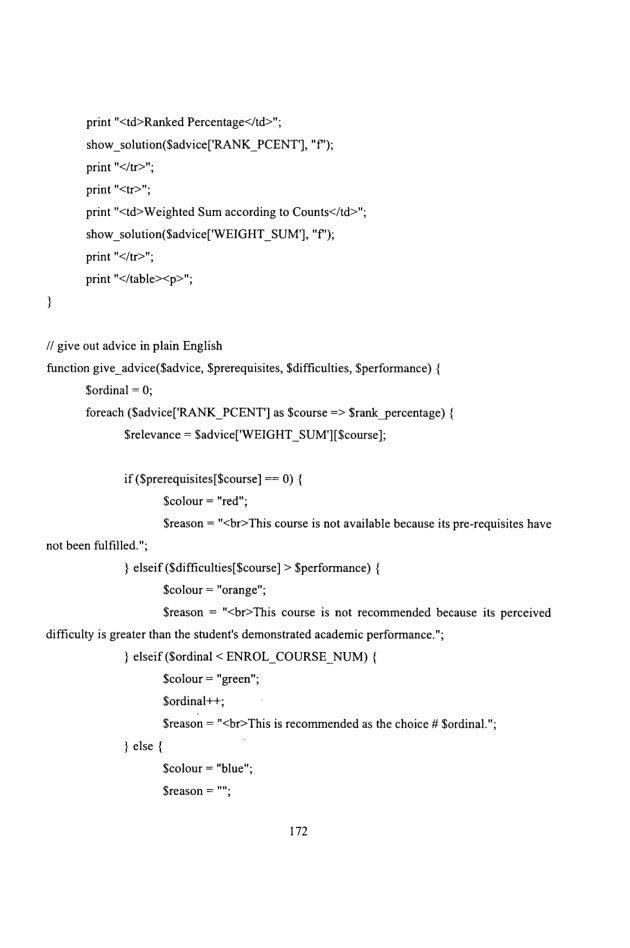
Source PDF · page 182 of 201Check original scan ↗
}
if ($rank_percentage > 0) {
printf("<p><font color=\"$colour\">The course Scourse has a rating of
%2.3f%% (matched with cases in the past) and a subrating of %2.3f%% (based on frequency of
occurrances in ranked cases). %s</font>",
$rank_percentage, Srelevance, Sreason);
}
}
}
?>
Index.php
<html>
<head><title>CBR</title></head>
<body>
<h3>Number of Different INT permutations out of 60 (5P3)
</h3>
<?
include("prepend.inc");
foreach (Stables as Skey => $ value) {
print "<a href=\"knowledge.php?table=$key\" target=\"_blank\">knowledge
$value</a><br>";
}
print "<h 1>Problem</h 1>\n";
print "<form method=\"GET\" action=\"match.php\">";
print "<table border=\"l\">\n";
print "<tr><td>id</td>\n";
attrtabheaderQ ;
173
View original scanned page
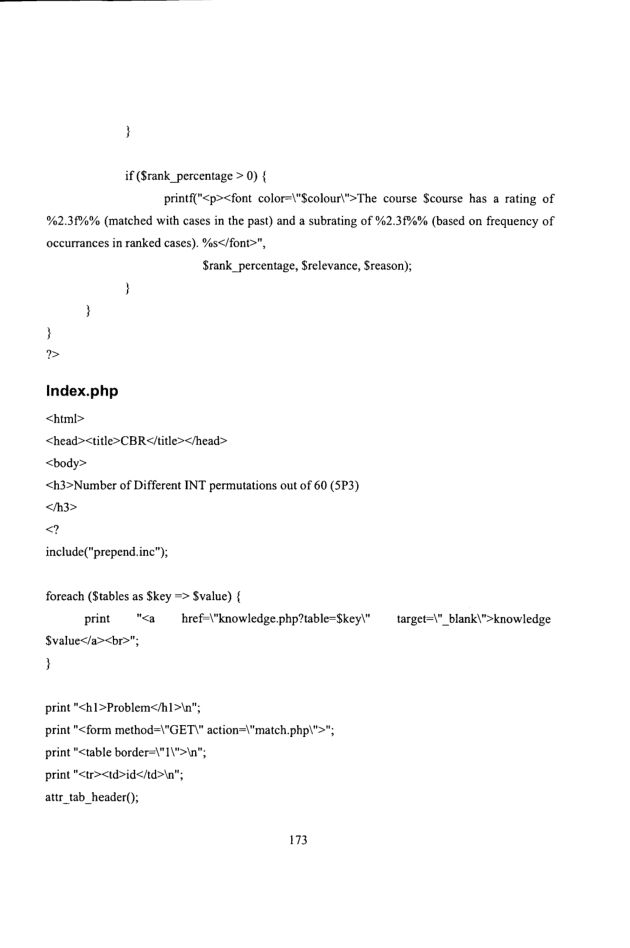
Source PDF · page 183 of 201Check original scan ↗
print "<td>knowledge 15</td><td>knowledge20</td><td>knowledge47</td>\n";
print "</tr>\n";
print "<tr><td><input type=\"Submit\" value=\"Submit\"></td>";
print "<td><input type=\"text\" name=\"DSP\" size=\"l\"></td>";
print "<td><input type=\"text\" name=\"OPTIC\" size=\"l\"x/td>";
print "<td><input type=\"text\" name=\"MWAVE\" size=\"l\"></td>";
print "<td><input type=\"text\" name=\"NTWRK\" size=\"l\"></td>";
print "<td><input type=\"text\" name=\"SATEL\" size=\"l\"></td>";
print "<td><input type=\"text\" name=\"PRFM\" size=\"l\"></td>";
print "<td><input type=\"text\" name=\"CHRT\" size=\"l\"></td>";
print "<td><input type=\"radio\" name=\"table\" value=\"l\"></td>";
print "<td><input type=\"radio\" name=\"table\" value=\"2\"x/td>";
print "<td><input type=\"radio\" name=\"table\" value=\"3\"></td>";
print "</tr>";
// display a list of predefined test cases in table
$ lines = file ('http://www.tanat.net/cbr/problems.txt');
foreach ($lines as $line_num => $line) {
Sproblem = build_case();
list($problem['DSP'],
$problem['OPTIC'],$problem['MWAVE'],$problem['NTWRK'],$problem['SATEL'],$problem['P
RFM'],$problem['CHRT'])=explode("\t",$line);
print "<tr>\n";
$query_str
"DSP=".$problem['DSP']."&OPTIC=".$problem['OPTIC']."&MWAVE=".$problem['MWAVE'].
"&NTWRK=".$problem['NTWRK']."&SATEL=".$problem['SATEL']."&PRFM=".$problem['P
RFM']."&CHRT=".$problem['CHRT'];
Sproblemid = strval($line_num+l);
174
View original scanned page
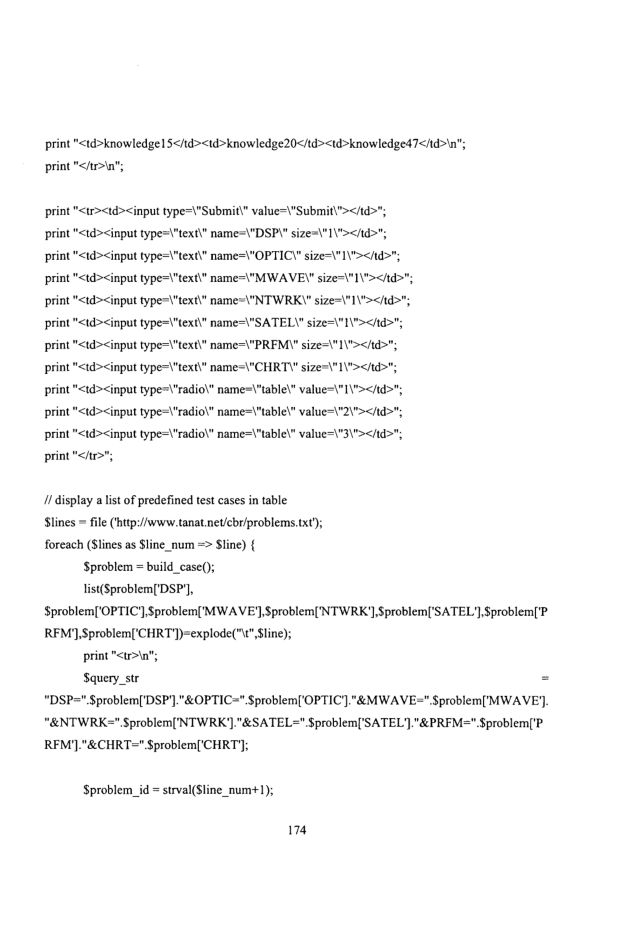
Source PDF · page 184 of 201Check original scan ↗
?>
<td><?=$problem_id?></td>
<?
show_interest($problem);
foreach (Stables as Skey => $ value) {
print "<td><a href=\"match.php?table=$key&$query_str\"
target=\"_blank\">$problem_id - $value</a></td>";
}
print "</tr>\n";
}
print "</table>\n";
print "</form>\n";
include("append.inc");
?>
</body>
</html>
175
View original scanned page
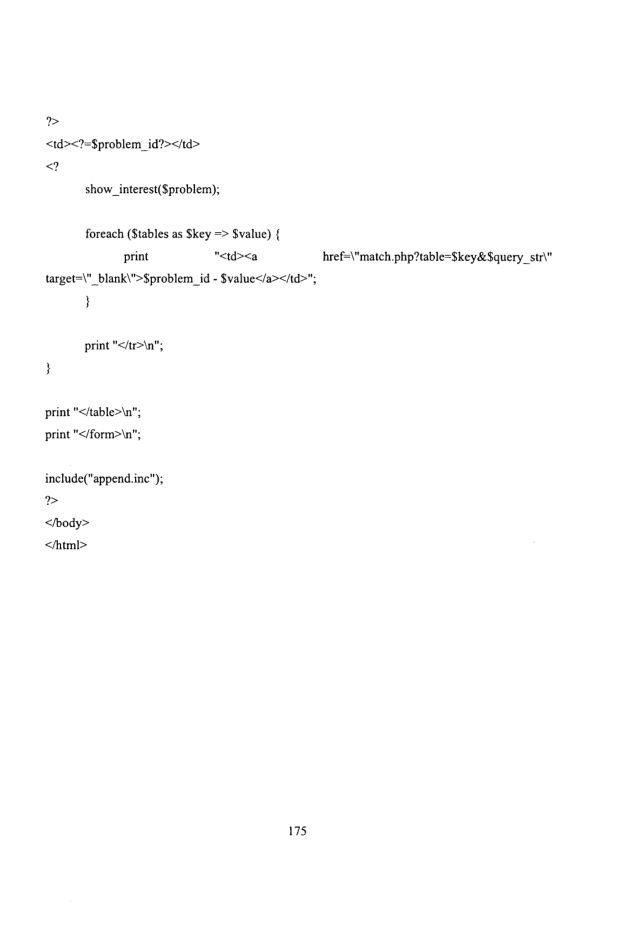
Source PDF · page 185 of 201Check original scan ↗
Knowledge.php
<?
include("prepend.inc");
$knowledge_size = $tables[$_GET['table']];
print "<h2>Knowledge $knowledge_size</h2>";
$query = "SELECT * FROM knowledge$knowledge_size";
$result = mysql_query($query) or die ("Query failed");
print "<table border=\"l\">\n";
print "<tr><td>id</td>\n";
attr_tab_header();
solu_tab_header();
print "<td>case size</td></tr>\n";
while ($row = mysql_fetch_array($result, MYSQL ASSOC)) {
print "<tr>\n";
print "<td>" . $row['id'] . "</td>\n";
show_interest($row);
show_solution($row);
Scase = build_case($row['DSP'], $row[’OPTIC'], $row['MWAVE'], $row["NTWRK'],
$row['SATEL'], $row['PRFM'], $row['CHRT']);
printf ("<td>%2.3f</td>\n",case_size($case));
print "</tr>\n";
}
print "</table><p>\n";
include("append.inc");
?>
176
View original scanned page
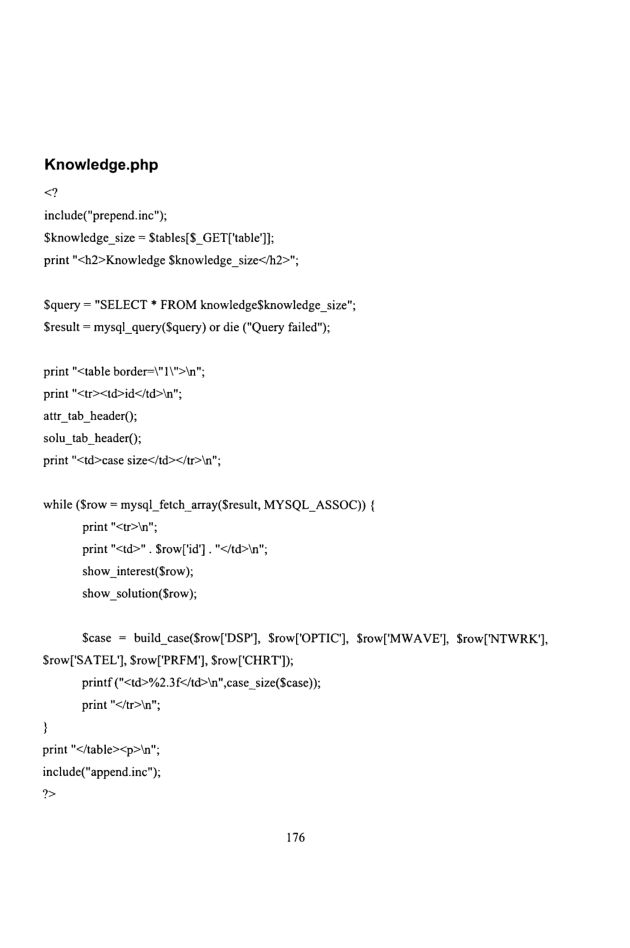
Source PDF · page 186 of 201Check original scan ↗
Match.php
<?
include("prepend.inc");
$knowledge_size = $tables[$_GET['table']];
print "<h2>Problem (using Knowledge $knowledge_size)";
print "</h2>";
print "<table border=\"l\">";
attr_tab_header();
print "<td>problem size</td>";
print "</tr>";
// create a problem vector
$problem =
build_case($_GET['DSP'],$_GET['OPTIC'],$_GET['MWAVE,],$_GET[rNTWRK'],$_GET['SA
TEL'],$_GET['PRFM'],$_GET[’CHRT']);
print "<tr>";
show_interest($problem);
printf ("<td>%2.3f</td>",case_size($problem));
print "</tr>";
print "</table><p>";
l^¥************************************ Diff of Mcsns
* * * * * * * * * * * * * * * * * * * * * * * * * * * * * * * * * * * * * * * * * /
for ($i=l; $i<=RANK_NUM; $i++) {
$match[$i] =
array('id,=>"0",,percent,=>0,'DSP’=>"0",'OPTIC'=>"0",,MWAVE'=>”0",,NTWRK'=>"0,',,SATE
L'=>"0",'PRFM->"0",'CHRT->"0",,D1'=>"0",'02'=>"0",'OM3'=>"0",,M 4->"0",,NM5'=>"0",'
N 6->"0”,'NS7'=>"0",'S8->"0");
177
View original scanned page
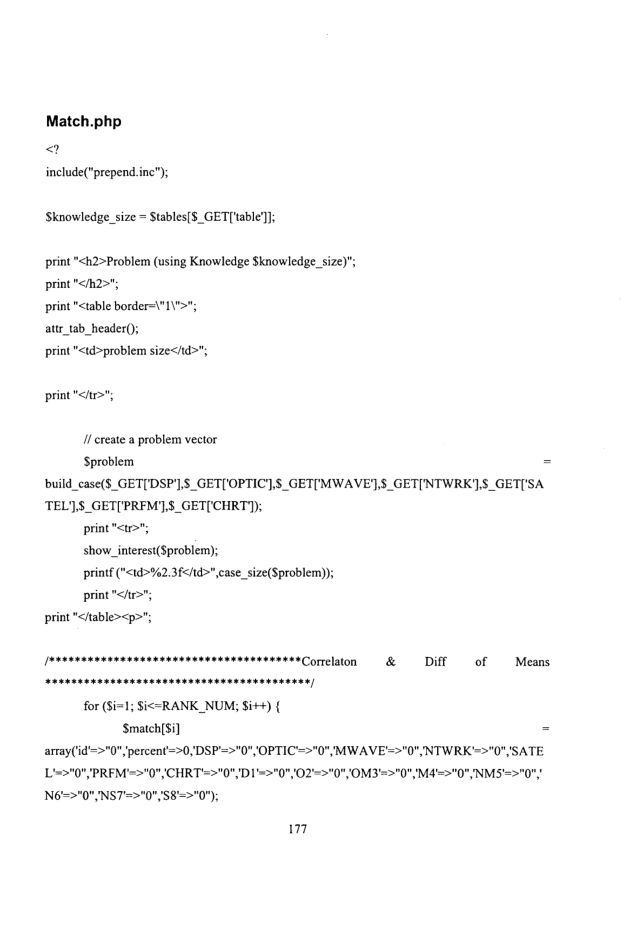
Source PDF · page 187 of 201Check original scan ↗
}
Squery = "SELECT * FROM knowledge$knowledge_size";
Sresult = mysql_query($query) or die ("Query failed");
while ($row = mysql_fetch_array($result, MYSQL ASSOC)) {
Scase = build_case($row['DSP'], $row['OPTIC'], $row['MWAVE'],
$row['NTWRK'], $row['SATEL'], $row['PRFM'], $row['CHRT’]);
Scaseint = array_slice($case, 0, 5);
Scasechar = array_slice($case, 5);
$problem_int = array_slice($problem, 0, 5);
Sproblemchar = array_slice($problem, 5);
$mean = Sproblemchar;
foreach (Scasechar as Skey => Svalue) {
$mean[$key] = (Svalue + $problem_char[$key]) / 2;
}
Sdiff = Sproblemchar;
foreach (Sproblem char as Skey => Svalue) {
SdifffSkey] = Svalue - $mean[$key];
}
// calculate matching percentage, using vector product divided by the product of
both case sizes. Assign a weight of 5 out of 7
$match_percent = sumproduct($problem_int, Scase int) /
case size(Sproblem int) / case size(Scase int) * 5/7;
$match_percent += (1- pow(case size(Sdiff) / case_size($problem_char), 2)) *
2/7;
for ($j=l; $j<=RANK_NUM; $j++) {
if ($match_percent > $match[$j]['percent']) {
178
View original scanned page
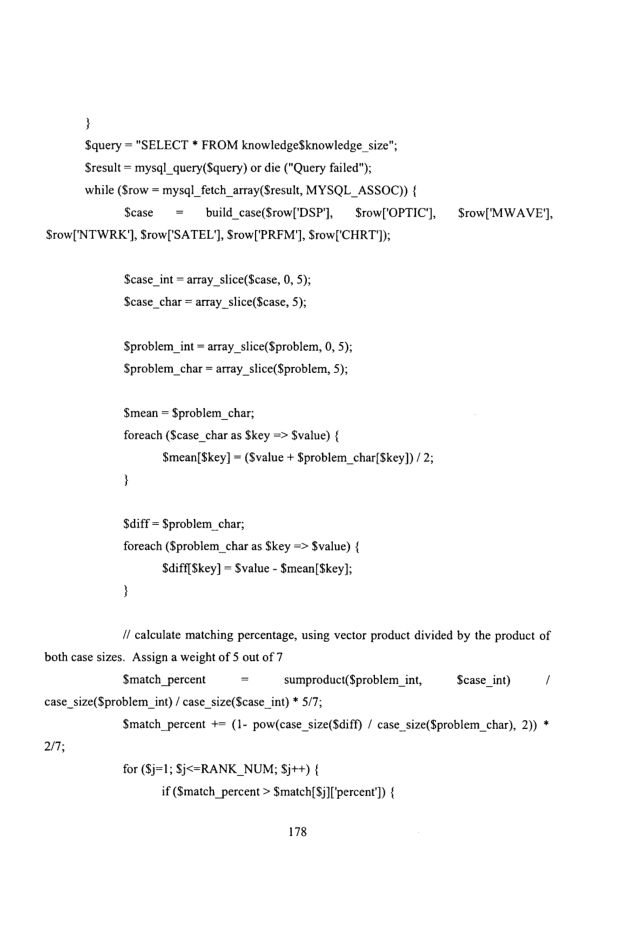
Source PDF · page 188 of 201Check original scan ↗
found_new_solution($match, $j, $row['id'], $match_percent,
$row['DSP'], $row['OPTIC], $row['MWAVE'],
$row['NTWRK'], $row['SATEL'],
$row['PRFM'], $row['CHRT'], $row['Dl'], $row['02'],
$row['OM3'], $row['M4'], $row["NM5'],
$row['N6'], $row['NS7'], $row['S8']);
break;
}
}
}
$difficulty = array('D 1' => 1, 02' => 2, '0M3' => 1, 'M4' => 3, 'NM5' => 2, "N6" => 3,
'NS7' => 1,'S8'=>2);
Sprereq = array('Dl' => 1, '02' => 1, '0M3' => 0, 'M4' => 1, 'NM5' => 0, 'N6' => 1, 'NS7'
= > 0 ,'S8'=> 1);
print "<h2>Correlation of Interests (INT) and Difference of Means</h2><br>";
$advicel = process_ranked_cases($match);
^* ************************************* *^2g^£m£g of 2 vectors
* * * * * * * * * * * * * * * * * * * * * * * * * * * * * * * * * * * * * * * * * /
for ($i=l; $i<=RANK_NUM; $i++) {
$match[$i] =
array('id'=>"0",'percent->0,'DSP'=>"0",'OPTIC'=>"0",'MW AVE'=>"0",'NTWRK'=>"0",'SATE
L'=>"0",'PRFM'=>"0",'CHRT'=>"0",'Dl'=>"0",'02'=>"0",'OM3’=>"0",'M4'=>"0",rNM5->"0",'
N6’=>"0",’NS7'=>"0",'S8'=>"0");
}
Squery = "SELECT * FROM knowledge$knowledge_size";
Sresult = mysql_query($query) or die ("Query failed");
while ($row = mysql_fetch_array($result, MYSQL ASSOC)) {
179
View original scanned page
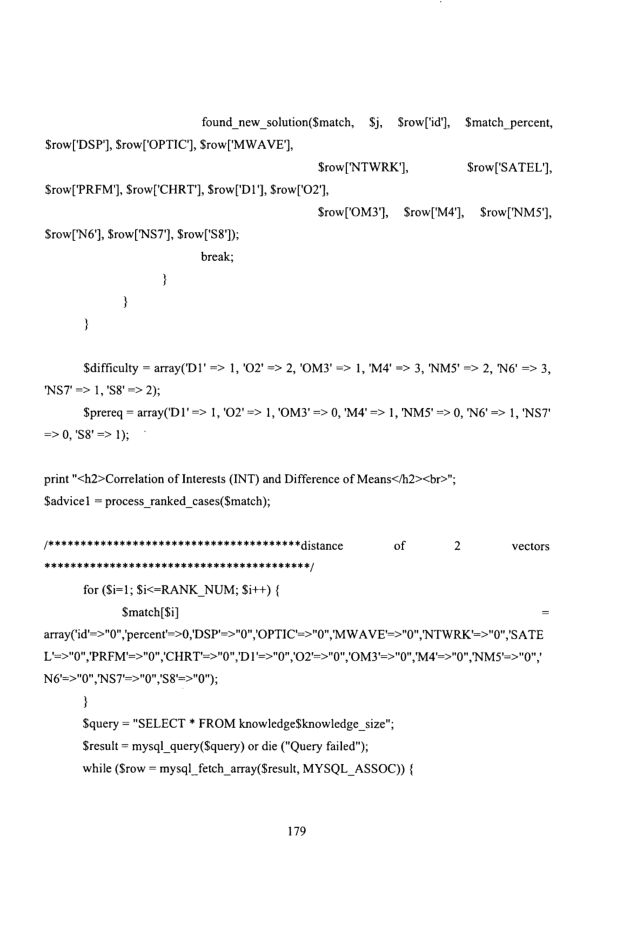
Source PDF · page 189 of 201Check original scan ↗
Scase = build_case($row['DSP'], $row['OPTIC'], $row['MWAVE'],
$row['NTWRK'], $row['SATEL'], $row['PRFM’], $row[’CHRT']);
Sdiff = build_case();
foreach ($case as $key => Svalue) {
$diff[$key] = Svalue - $problem[$key];
}
// calculate matching percentage, the further the distance from the knowledge
vector, the lower the matching percentage would be.
$match_percent = 1- pow(case_size($diff) / casesize(Sproblem), 2);
for ($j=l; $j<=RANK_NUM; $j++) {
if ($match_percent > $match[$j]['percent']) {
found_new_solution($matcli, $j, $row['id'], $match_percent,
$row['DSP'], $row['OPTIC'], $row['MWAVE'],
Srowf’NTWRK'], $row[’SATEL’],
$row['PRFM'], $row['CHRT'], $row['Dl'], $row['02’],
$row['OM3'], $row['M4'], $row["NM5'],
$row["N6'], Srow^NSV], $row['S8']);
break;
}
}
}
print "<h2>Distance of 2 vectors</h2xbr>";
$advice2 = process_ranked_cases($match);
trivial IR.
* * * * * * * * * * * * * * * * * * * * * * * * * * * * * * * * * * * * * * * * * /
for ($i=l; $i<=RANK_NUM; $i++) {
180
View original scanned page
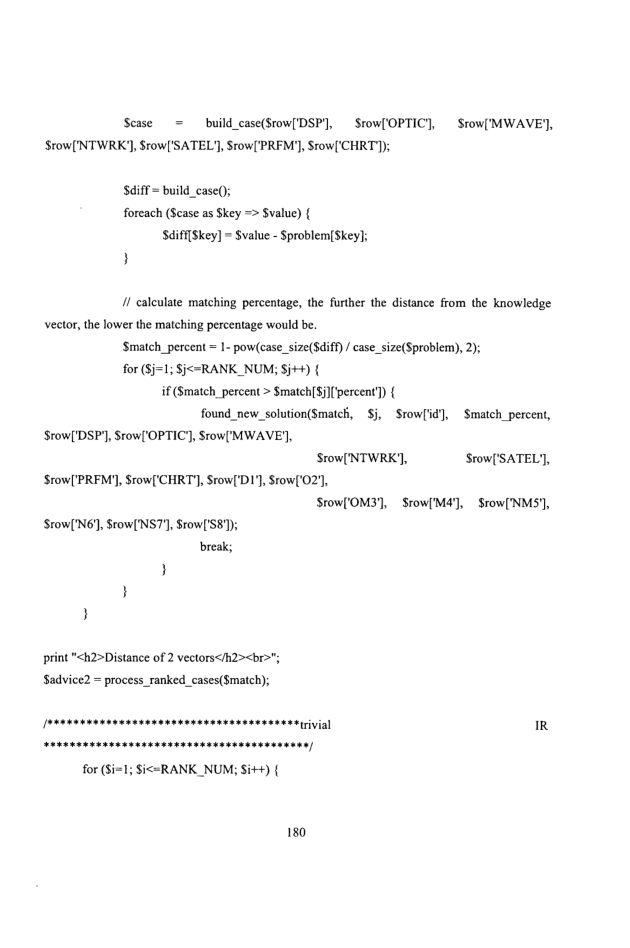
Source PDF · page 190 of 201Check original scan ↗
$match[$i] =
array('id'=>"0",'percent->0,'DSP'=>"0",'OPTIC->"0",'MWAVE'=>"0",'NTWRK->"0",'SATE
L'=>"0",'PRFM'=>"0",'CHRT'=>"0",’DT=>"0",'02->"0",'OM3'=>"0",'M4'=>"0",rNM5'=>"0",'
N6'=>"0",'NS7'=>"0",'S8'=>"0");
}
Squery = "SELECT * FROM knowledge$knowledge_size";
Sresult = mysqlquery(Squery) or die ("Query failed");
while ($row = mysql_fetch_array($result, MYSQL ASSOC)) {
Scase = build_case($row['DSP'], $row[’OPTIC'], $row['MWAVE'],
$row['NTWRK'], $row['SATEL'], $row['PRFM'], $row['CHRT']);
// matching percentage is calculated purely using trivial IR algorithm
$match_percent = sumproduct($problem,Scase) / case size(Sproblem) /
casesize(Scase);
for ($j=l; $j<=RANK_NUM; $j++) {
if ($match_percent > $match[$j]['percent']) {
found_new_solution($match, $j, $row['id’], $match_percent,
$row[’DSP'], $row['OPTIC’], $row['MWAVE'],
Srow [*NTWRK'], $row['SATEL'],
$row['PRFM’], $row[’CHRT'], $row['Dl'], $row['02'],
$row['OM3'], $row['M4'], $row['NM5'],
$row['N6'], $row[rNS7’], $row['S8']);
break;
}
}
}
print "<h2>Trivial IR algorithm</h2><br>";
Sadvice3 = process ranked cases(Smatch);
^* ******************************************************/
print "<h 1>Problem</h 1>";
181
View original scanned page
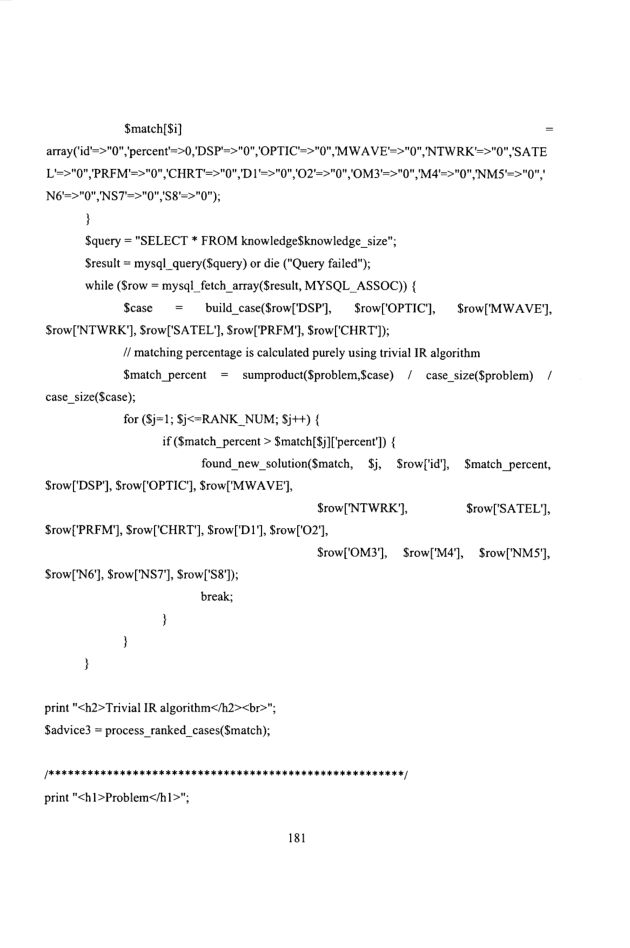
Source PDF · page 191 of 201Check original scan ↗
print "<table border=\"l\">";
attr_tab_header();
print "</tr>";
print "<tr>";
show_interest($problem);
print "</tr>";
print "</table><p>";
print "<hl>Advice Table</hl>";
print "<h3>Correlation of Interests (INT) and Difference of Means</h3><br>";
show_advice_table($advicel, Sprereq, Sdifficulty);
print "<h3>Distance of 2 vectors</h3><br>";
show_advice_table($advice2, Sprereq, Sdifficulty);
print "<h3>Trivial IR algorithm</h3><br>";
show_advice_table($advice3, Sprereq, Sdifficulty);
array_multisort( Sadvicel ['RANKPCENT'], SORTNUMERIC,
SORT_DESC,$advice3['WEIGHT_SUM'],SORT_NUMERIC, SORT_DESC);
array_multisort( $advice2['RANK_PCENT'], SORTNUMERIC,
SORT_DESC,$advice3['WEIGHT_SUM'],SORT_NUMERIC, SORTDESC);
array multisort( Sadvice3 ['RANK PCENT'], SORT NUMERIC,
SORT_DESC,$advice3['WEIGHT_SUM'],SORT_NUMERIC, SORT_DESC);
/ * * * * * * * * * * * * * * * * * * * * * * * * * * * * * * * * * * * * * * * * * * * * * * * * * * * * * * * /
print "<h 1>Problem</h 1>";
print "ctable border=\" l\"><tr>";
attr_tab_header();
print "</tr>";
print "<tr>";
showinterest(Sproblem);
182
View original scanned page
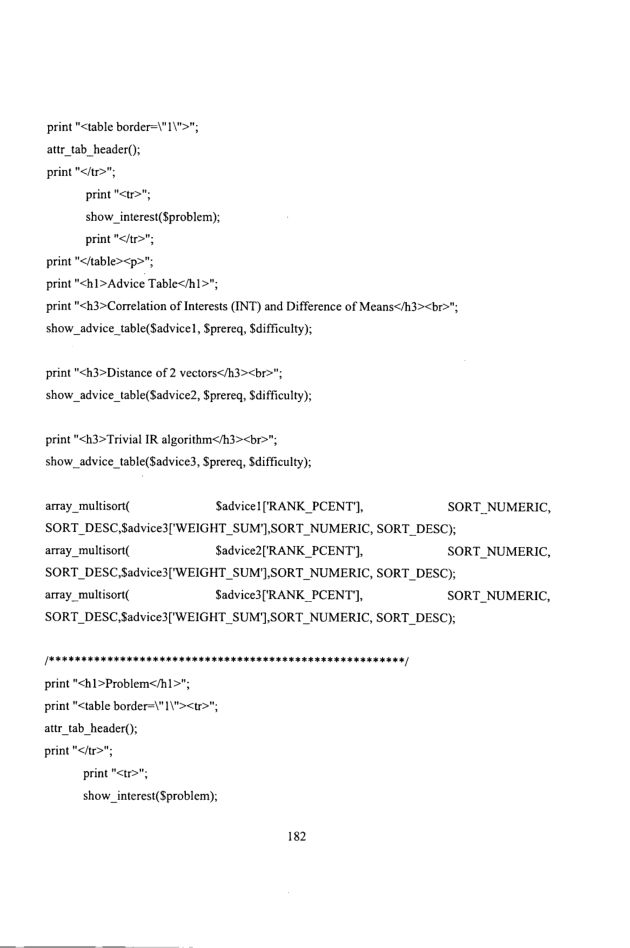
Source PDF · page 192 of 201Check original scan ↗
print "</tr>";
print "</table><p>";
print "<hl>Advice with Reasons</hl>";
print "<p><font color=\"red\">RED</font> denotes courses that are blocked due to its
unfulfilled pre-requisites<br>";
print "<font color=\"orange\">ORANGE</font> denotes courses that are not recommended due
to its perceived difficulty being greater than the student's demonstrated academic
performance<br>";
print "<font color=\"green\">GREEN</font> denotes the recommended course with a ranked
order<br>";
print "<font color=\"blue\">BLUE</font> denotes other possible courses student may consider
taking</p>";
print "<h3>Correlation of Interests (INT) and Difference of Means</h3><br>";
give_advice($advice 1, Sprereq, Sdifficulty, $problem['PRFM']);
print "<h3>Distance of 2 vectors</h3><br>";
give_advice($advice2, Sprereq, Sdifficulty, $problem['PRFM']);
print "<h3>Trivial IR algorithm</h3><br>";
give_advice($advice3, Sprereq, Sdifficulty, $problem['PRFM']);
include("append.inc ");
?>
183
View original scanned page
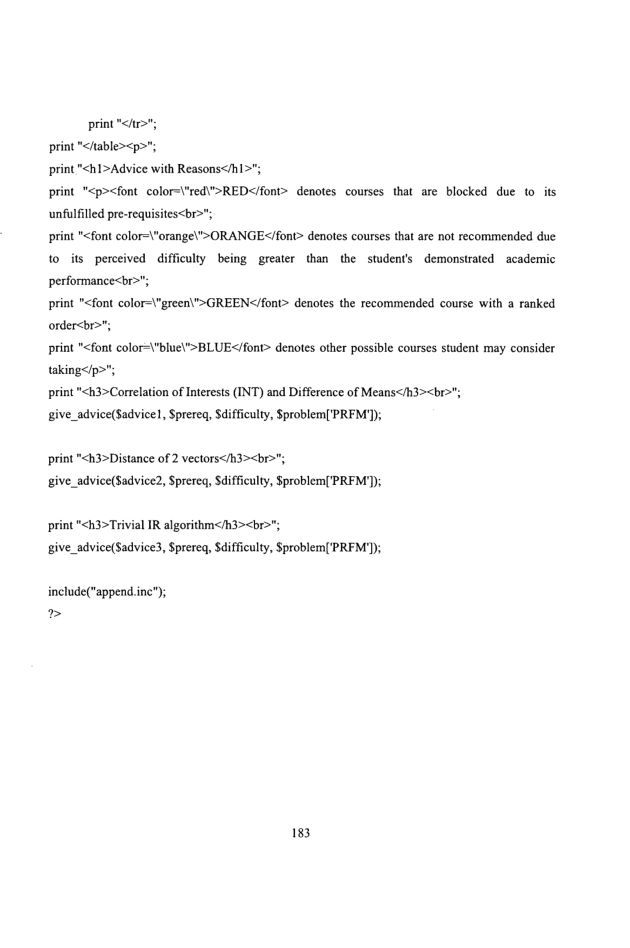
Source PDF · page 193 of 201Check original scan ↗
Appendix D: Algorithm Comparison and Validation
Test case Expected Result Trivial IR Euclidean Improvement
Distance
0,2, 0,3, 1,2,3 NS7, NM5, 02 NS7, 0M3, 02 02, 0M3, NS7 NS7, 0M3, 02
0,3,0, 1,2, 1, 1 0M3, NS7, D1 0M3, NS7, Dl OM3, NS7, Dl 0M 3, NS7, Dl
3, 2, 0,0, 1,2,2 D l, 02, 0M3 D l, 02, 0M3 D l, 02, OM3 D l, 02, 0M3
0, 3, 1,2, 0,1, 3 0M 3,NS7,D1 0M 3, NS7, Dl OM3, NS7, Dl 0M 3, NS7, Dl
0,1, 0,3, 2, 1,3 NS7, 0M3, Dl NS7, 0M3 (2) NS7, OM3 (2) NS7, 0M3, Dl
0,1, 3, 0,2, 2, 3 0M3, NM5, S8 OM3, NM5, NS7 0M 3, NM5, NS7 0M 3, NM5, NS7
0,0, 1,2, 3,2,1 NS7, NM5, 0M3 NM5, S8, NS7 NM5, NS7, S8 NS7, NM5, S8
1,2, 0, 0,3, 1,2 NS7, 0M3, Dl NS7, 0M3, Dl NS7, OM3, Dl NS7, 0M3, Dl
Table D -l: comparison between algorithms when performance is lower than difficulty
Test case Expected Result Trivial IR Euclidean Improvement
0, 2 ,0 ,3 , 1,3,3 N6, NS7, NM5 N6, OM3, NS7 OM3, N6, NS7 NS7, 0M3, N6
0, 3, 0, 1,2,3, 1 OM3, NS7, NM5 N6, OM3, NS7 OM3, N6, NS7 NS7, 0M3, NM5
3, 2, 0,0, 1,3,2 D l, OM3, NS7 D l, OM3, NS7 D l, OM3, NS7 D l, 0M3, NS7
0,3, 1,2, 0,3, 3 OM3, N6, NM5 M4, OM3, Dl M4, OM3, Dl 0M 3, M4, NS7
0,1, 0,3, 2, 3, 3 N6, S8, 02 N6, OM3, NS7 OM3, N6, NS7 N6, S8,02
0,1, 3, 0,2, 3, 3 M4, S8, 02 OM3, M4, NS7 OM3, M4, NM5 M4, S8, Dl
0, 0, 1,2, 3, 3, 1 S8, N6, M4 NM5, NS7, Dl NM5, NS7, Dl S8, N6, Dl
1,2, 0, 0,3, 3, 2 S8, 02, Dl NS7, OM3, NM5 NS7, OM3, NM5 S8, 02, Dl
Table D-2: comparison between algorithms when prerequisites are not yet fulfilled
184
View original scanned page
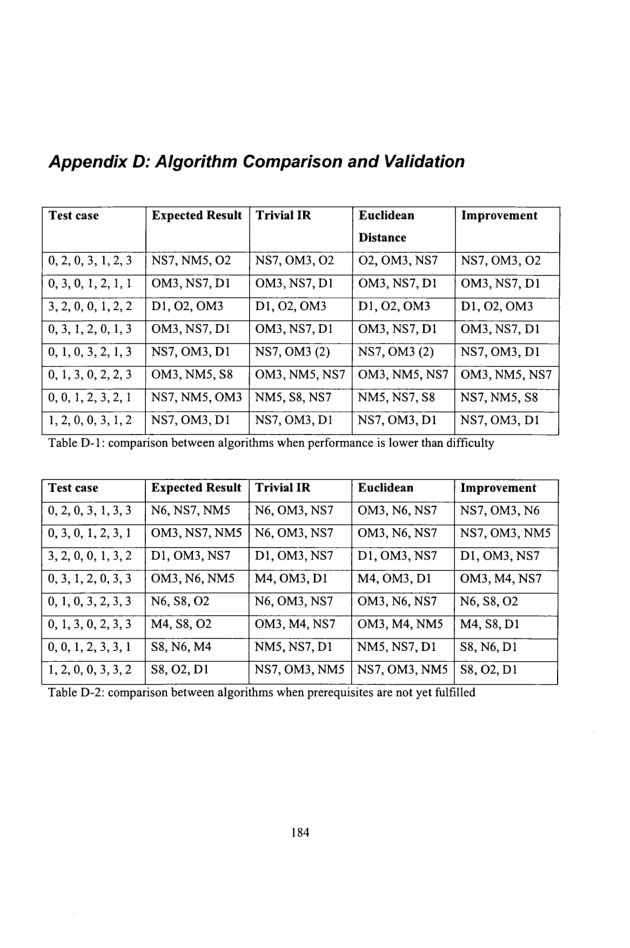
Source PDF · page 194 of 201Check original scan ↗
Appendix E: Example Screen Output
Problem (using Knowledge 47)
DSP OPTIC MWAVE NTWRK SATEL PRFM CHRT problem size
0 2 0 3 1 3 3 5.657
Correlation of Interests (INT) and Difference of Means
DSP OPTIC MWAVE NTWRK SATEL PRFM CURT case percent D1 0 2 OM3 M4 NM5 N6 NS7 !
0 2 0 3 1 2 2 14 99.206 0 0 1....... 0 0 1 1 I
0 2 0 3 1 1 3 13 98.413 0 1 0 0 0 1 1 (
0 2 1..... .......3...... ...........0...... 3 1 16 93.311 0 0 1... 0 1 0 1 (
1 2 0 3 0 1 3 26 93.311 0 0 0 0 1 1 1 (
0 1 0 3 ...........2....... .....2..... 1 8 92.914 0 0 1 0 1 ......... 0 1 (
0 3 0 2 1 1 2 18 92.914 0 1 1 0 0 0 1 (
1 ” 3... 0 " 2....... .............0....... ... 3...... 1 29 88.209 1 0 1 0 0 0 1 (
1 3.. 0 .....2 0 .... 1....... 1 i f 86.621 1 0 1 0 0 0 1 c
. . . . . . .
2... 1 " " " " 0....... 0 .... 3..... .... 2... 36 84.297 1 0 0 0 1......... 1 0 c
0 1.. 0 ..... 2....... ......3 ....1........ 3 7 83.107 0 0 0 0 0 1 1 1
Distance of 2 vectors
DSP OPTIC MWAVE NTWRK SATEL PRFM CIIRT case percent D1 0 2 OM3 M4 NM5 N6 NS7 S
0 2 0 3 1 2 2 14 93.750 0 0 I 0 0 1 1 0
0 2 0 3 1 1 3 13 87.500 0 1 0 0 0 1 1 0
0 2 1 3 0 3 1 16 81.250 0 0 1 0 1 0 1 0
1 2 0 3 0 1 3 26 81.250 0 0 0 0 1 1 1 0
185
View original scanned page
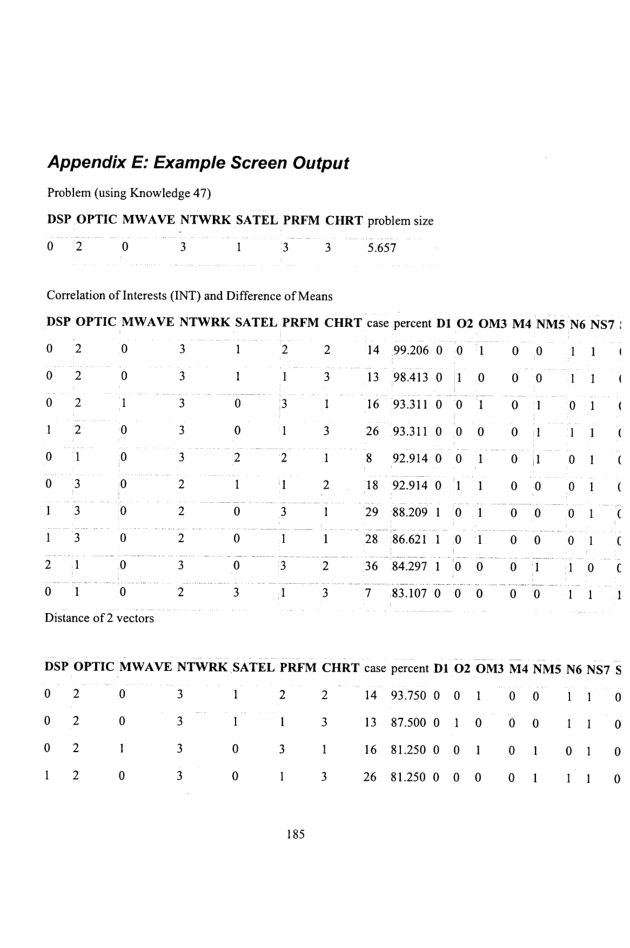
Source PDF · page 195 of 201Check original scan ↗
0 1 0 3 2 2 1 8 78.125 0 0 1 0 1 0 1
0 3 0 2 1 1 2 18 78.125 0 1 1 0 0 0 1
2 1 0 3 0 3 2 36 78.125 1 0 0 0 1 1 0
0 2 0 1 3 3 3 12 75.000 0 1 0 0 0 0 1
1 3..... 0 2 0 3 1 29 75.000 1 0 1 0 0 0 1
0 1 0 2 3 1 3 :7 68.750 0 0 0 0 0 1 1
Trivial IR algorithm
DSP OPTIC MNVAVE NTWRK SATEL PRFM CIIRT case percent D1 0 2 OM3 M4 NM5 N6 NS7
0 2 0 3 1 2 2 14 97.991 0 ;o 1 0 0 1 1
0 2 0 3 1 ... 1.... ....3..... 13 93.819 0 l 0 0 0 1 1
0 2 1 3 0 3 1 16 90.211 0 0 1 0 1 0 1
1 2 0 3 0 1 3... 26 90.211 0 0 0 0 1 1 1
0 1 0 3 2 2 1 8 89 222 0 0 1 0 1 0 1
0 3 0 2 1 1 2 18 89222 0 1 1 0 0 0 1
2 1.... 0 3 0 3 2 36 88.454 1 0 0 0 1 1 0
0 ' 2... 0 1 3 3 3 12 87.500 0 1 0 0 0 0 1
1 3 0 2 0 3 1 29 86.603 I o 1 0 0 0 1
2 0 :1 ..... 3.... 0 3 3 32 84.375 0 0 0 0 1 1 1
Problem
DSP OPTIC MWAVE NTWRK SATEL PRFM CHRT
0 2 0 3 1 3 3
Advice Table
Correlation of Interests (INT) and Difference of Means
Description D1 02 OM3 M4 NM5 N6 NS7 S8
186
View original scanned page
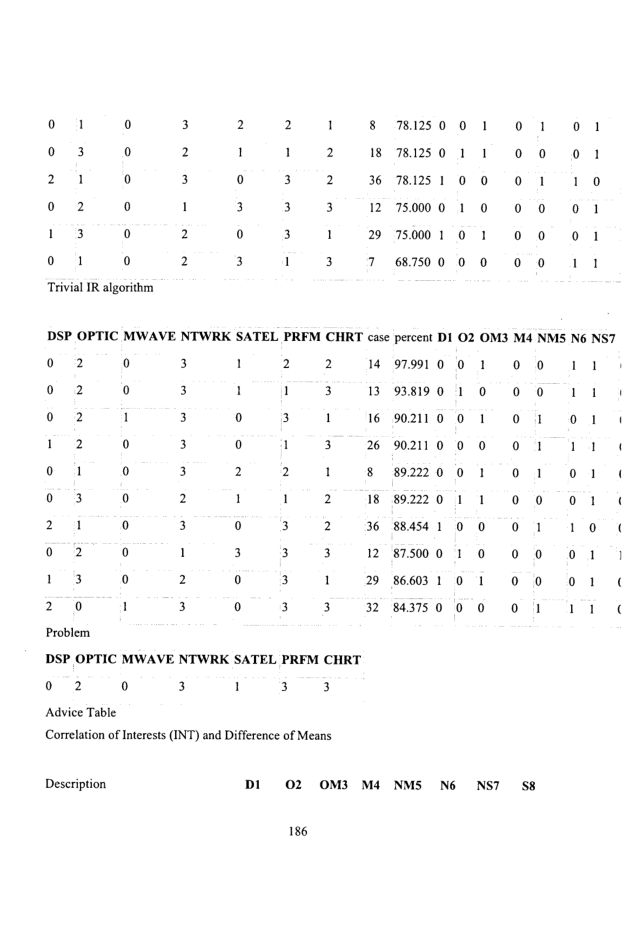
Source PDF · page 196 of 201Check original scan ↗
Prequisite 1 1 0 1 0 1 0 1
Difficulty 1 2 1 3 2 3 1 2
Count 3 2 6 0 4 5 9 1
Ranked Percentage 88.209 98.413 99.206 0.000 93.311 99.206 99.206 83.107
Weighted Sum according to Counts 20.000 24.000 64.000 0.000 41.333 52.000 94.667 4.000
Distance of 2 vectors
Description D1 02 OM3 M4 : NM5 N6 : NS7
Prequisite 1 1 0 1 0 1 0 1
Difficulty 1 2 1 3 2 3 1 2
2Count ...................2......... 3 5 0 4 5 9
Ranked Percentage 78.125 87.500 93.750 0.000 81.250 93.750 93.750 75.000
Weighted Sum according to Counts 13.333 30.667 54.667 0.000 44.000 54.667 92.000 10.667
Trivial IR algorithm
Description D1 02 OM3 M4 : NM5 N6 i NS7
Prequisite 1 1 0 1 0 1 0 1
Difficulty 1 2 1 3 2 3 1 2
Count ...................2......... 3 5 0 5 5 9 1
Ranked Percentage 88.454 93.819 97.991 0.000 90.211 97.991 97.991 87.500
Weighted Sum according to Counts 13.333 30.667 54.667 0.000 48.000 54.667 92.000 6.667
Problem
DSP OPTIC MWAVE NTWRK SATEL PRFM CHRT
0 2 0 3 1 3 3
Advice with Reasons
187
View original scanned page
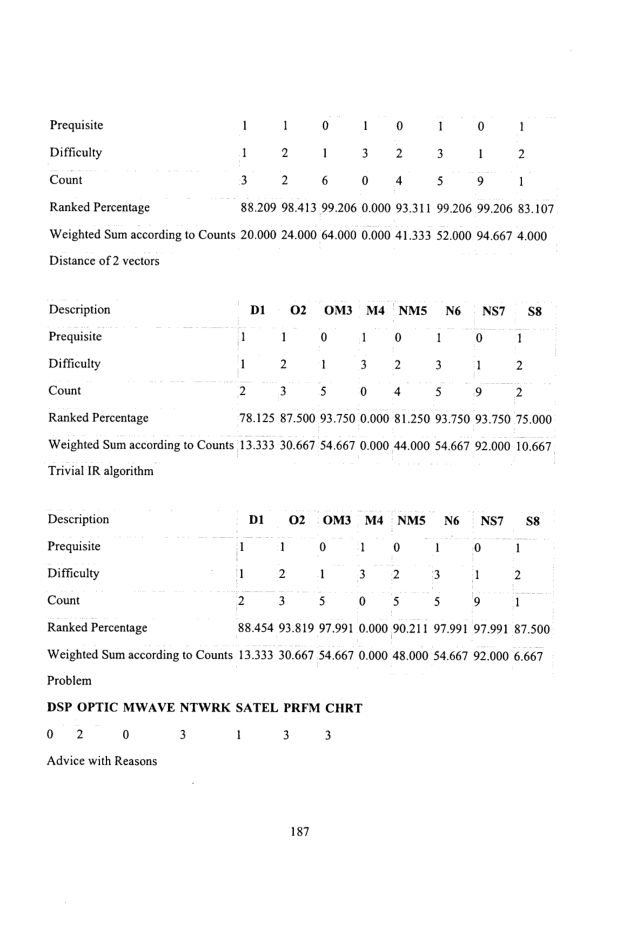
Source PDF · page 197 of 201Check original scan ↗
RED denotes courses that are blocked due to its unfulfilled pre-requisites
denotes courses that are not recommended due to its perceived difficulty being greater
than the student's demonstrated academic performance
GREEN denotes the recommended course with a ranked order
BLUE denotes other possible courses student may consider taking
Correlation of Interests (INT) and Difference of Means
The course NS7 has a rating of 99.206% (matched with cases in the past) and a subrating of
94.667% (based on frequency of occurrances in ranked cases).
This course is not available because its pre-requisites have not been fulfilled.
The course OM3 has a rating of 99.206% (matched with cases in the past) and a subrating of
64.000% (based on frequency of occurrances in ranked cases).
This course is not available because its pre-requisites have not been fulfilled.
The course N6 has a rating of 99.206% (matched with cases in the past) and a subrating of
52.000% (based on frequency of occurrances in ranked cases).
This is recommended as the choice # 1.
The course 02 has a rating of 98.413% (matched with cases in the past) and a subrating of
24.000% (based on frequency of occurrances in ranked cases ).
This is recommended as the choice # 2.
The course NM5 has a rating of 93.311% (matched with cases in the past) and a subrating of
41.333% (based on frequency of occurrances in ranked cases).
This course is not available because its pre-requisites have not been fulfilled.
The course Dl has a rating of 88.209% (matched with cases in the past) and a subrating of
20.000% (based on frequency of occurrances in ranked cases).
This is recommended as the choice # 3.
The course S8 has a rating of 83.107% (matched with cases in the past) and a subrating of
4.000% (based on frequency of occurrances in ranked cases).
Distance of 2 vectors
The course OM3 has a rating of 93.750% (matched with cases in the past) and a subrating of
54.667% (based on frequency of occurrances in ranked cases).
This course is not available because its pre-requisites have not been fulfilled.
188
View original scanned page
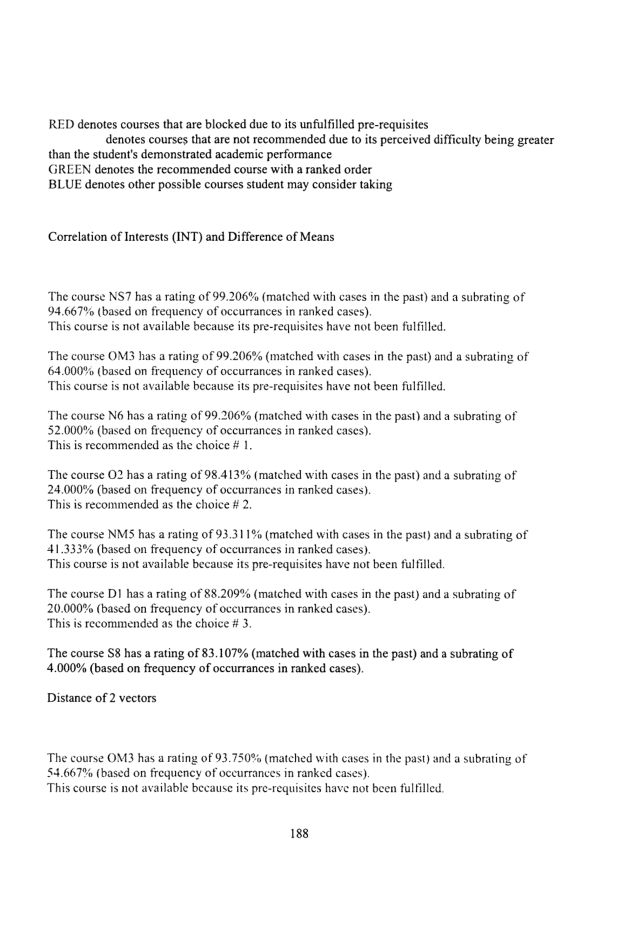
Source PDF · page 198 of 201Check original scan ↗
The course N6 has a rating of 93.750% (matched with cases in the past) and a subrating of
54.667% (based on frequency of occummces in ranked cases).
This is recommended as the choice # 1.
The course NS7 has a rating of 93.750% (matched with cases in the past) and a subrating of
92.000% (based on frequency of occurrances in ranked cases).
This course is not available because its pre-requisites have not been fulfilled.
The course 0 2 has a rating of 87.500% (matched with cases in the past) and a subrating o f
30.667% (based on frequency of occurrances in ranked cases).
This is recommended as the choice # 2.
The course NM5 has a rating of 81.250% (matched with cases in the past) and a subrating of
44.000% (based on frequency of occurrances in ranked cases).
This course is not available because its pre-requisites have not been fulfilled.
The course D1 has a rating of 78.125% (matched with cases in the past) and a subrating of
13.333% (based on frequency of occurrances in ranked cases).
This is recommended as the choice # 3.
The course S8 has a rating of 75.000% (matched with cases in the past) and a subrating of
10.667% (based on frequency of occurrances in ranked cases).
Trivial IR algorithm
The course N6 has a rating of 97.991% (matched with cases in the past) and a subrating of
54.667% (based on frequency of occurrances in ranked cases).
This is recommended as the choice # 1.
The course OM3 has a rating of 97.991% (matched with cases in the past) and a subrating of
54.667% (based on frequency of occurrances in ranked cases).
This course is not available because its pre-requisites have not been fulfilled.
The course NS7 has a rating of 97.991% (matched with cases in the past) and a subrating o f
92.000% (based on frequency of occurrances in ranked cases).
This course is not available because its pre-requisites have not been fulfilled.
The course 02 has a rating of 93.819% (matched with cases in the past) and a subrating of
30.667% (based on frequency of occurrances in ranked cases).
This is recommended as the choice # 2.
189
View original scanned page
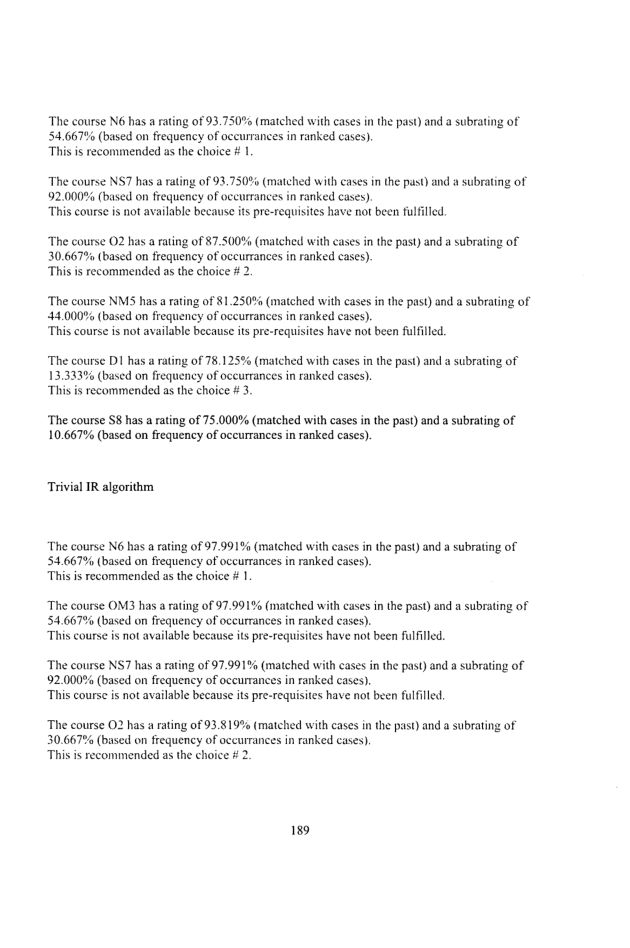
Source PDF · page 199 of 201Check original scan ↗
The course NM5 has a rating of 90.211% (matched with cases in the past) and a subrating of
48.000% (based on frequency of occurrences in ranked cases).
This course is not available because its pre-requisites have not been fulfilled.
The course D! has a rating of 88.454% (matched with cases in the past) and a subrating of
13.333% (based on frequency of occurrances in ranked cases).
This is recommended as the choice # 3.
The course S8 has a rating of 87.500% (matched with cases in the past) and a subrating of
6.667% (based on frequency of occurrances in ranked cases).
190
View original scanned page

Source PDF · page 200 of 201Check original scan ↗
3 1259 00782 2161
View original scanned page

Source PDF · page 201 of 201Check original scan ↗
RMIT UNIVERSITY LIBRARY
3 1259 00782 2161
View original scanned page