Find a relevant precedent
Represent a student’s situation as a case. Retrieve cases with similar interests, academic performance and specialisation preferences to guide elective selection.
Conclusion · printed pp. 140–141 ↗Can experience from past student cases help an advisor make the next course recommendation?
Original research, preserved. Interactive explanations, added in 2026.
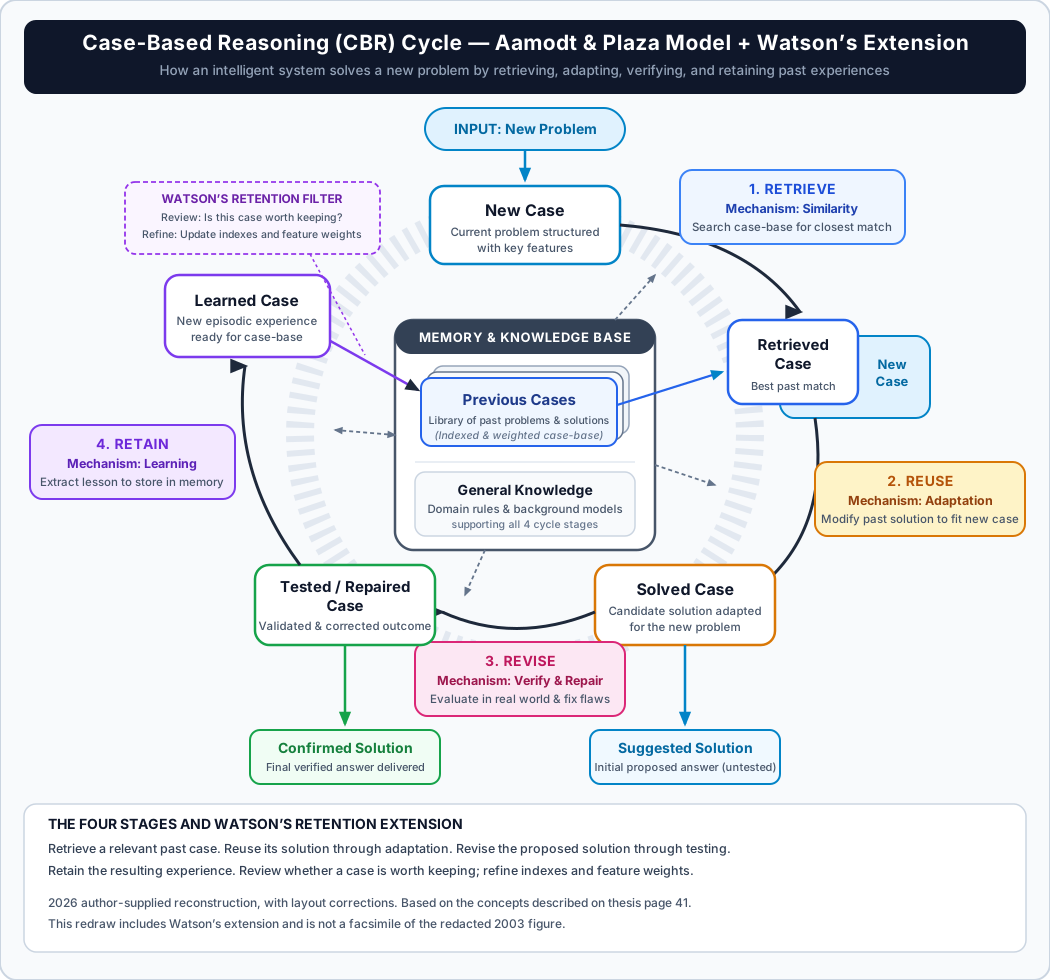
RetrieveFind prior cases whose circumstances resemble the new problem.
Select a stage. Learning guide based on the thesis, pp. 40–43.
This research involved the study of an application of Case-Based Reasoning (CBR) in the field of academic advising. Academic advisement has been recognised as an important function of higher education. However, there is a widespread desire to improve the advisement services provided by many educational institutions (e.g., colleges and universities) around the world. In the last ten years, CBR expert systems have made important contributions in many domains by applying CBR methodology to a variety of areas of human problem solving. However, to date, expert advisement systems have not been successfully applied to academic advisement, which seems to be a very appropriate domain for this technology.
Academic advising is an important and time consuming task, and different tools and techniques must be used to make it an effective and efficient process. This thesis describes the design, development, and validation of a prototype case-based academic advisement recommender system that supplements the conventional advising process, and could eventually evolve to replace human academic advisors when its full potential is realised.
The thesis separates two jobs: choosing a useful elective and deciding whether a student meets a course’s requirements. Its prototype brings these approaches together.
Represent a student’s situation as a case. Retrieve cases with similar interests, academic performance and specialisation preferences to guide elective selection.
Conclusion · printed pp. 140–141 ↗Use rule-based reasoning for core courses and prerequisite checks. A close match does not make an unavailable course an appropriate recommendation.
Conclusion · printed p. 140 ↗The thesis describes a prototype and calls for advisor cross-checking. Exceptional situations and key decisions still need human judgement.
Limitations · printed p. 142 ↗Change a fictional student profile. See how a similarity ranking changes, then how a prerequisite rule changes what can be recommended.
Six invented cases. One transparent similarity formula. No student data is collected.
Demo similarity = interest weight × exact interest match + remaining weight × performance proximity. Percentages are similarity scores, not probabilities or reported thesis results.
Read the source in sequence, jump to a chapter, or search across the proofread text. Every page links back to the original scan.
Read the 2026 reading and discovery guide ↗ · Explore the image QA lab ↗
The advising problem and research goals.
Cases, similarity, retrieval and knowledge.
Advising practice and expert systems.
Design, implementation and prototype validation.
Findings, limitations and open research questions.
References preserved from the source.
Framework, case base, PHP scripts and examples.
Source note: the scan’s printed numbering jumps from 134 to 136. The archive preserves all 201 supplied PDF pages; the reason for the missing printed number is unresolved.
Cite the 2003 thesis with its RMIT repository DOI. Use the original scan to check exact quotations, equations, tables and code.
Tonguthaisri, T. (2003). Enhancing Academic Advisement with Case-Based Reasoning [Master of Engineering thesis, RMIT University]. https://doi.org/10.25439/rmt.34846194
Thesis year: 2003. Repository deposit: 30 October 2026. The DOI identifies the RMIT record, not a new thesis or a claim that RMIT endorses this companion.
Version 2 was checked against all 201 supplied PDF pages. Transcription corrections are recorded separately from errors and unreadable regions in the original source. The original PDF and raw OCR remain available for comparison.
The diagram supplied by the author in 2026 reconstructs the redacted CBR cycle and includes a Watson extension. It is labelled as an editorial reconstruction, not as a recovered facsimile of the original illustration.
The explanations and sandbox on this page are new teaching material. They do not change the thesis’s text, date, authorship or findings. Read the edition and source notes ↗